


A grilled cervelat on August 1, Swiss National Day; it doesn’t get much more Swiss than that.
Keystone / Peter Klaunzer
What is the Swiss national dish? It’s a tricky question, as culinary specialities are usually linked to a specific canton or region. But the cervelat is a serious contender. This small, plump, pink sausage – unpretentious yet steeped in history – has been a fixture on plates, in rucksacks, on barbecues and in surprisingly passionate discussions among the Swiss for over a century.

Along with fondue, raclette, chocolate and rösti, cervelat (cervelas in French) is often cited as one of Switzerland’s most emblematic culinary products.
But fondue and raclette are very local products that have only become nationally popular since the middle of the 20th century, under the combined effect of marketing by the cheese industry and the propagation of a national identity built around the myth of an “Alpine nation”.
More
More
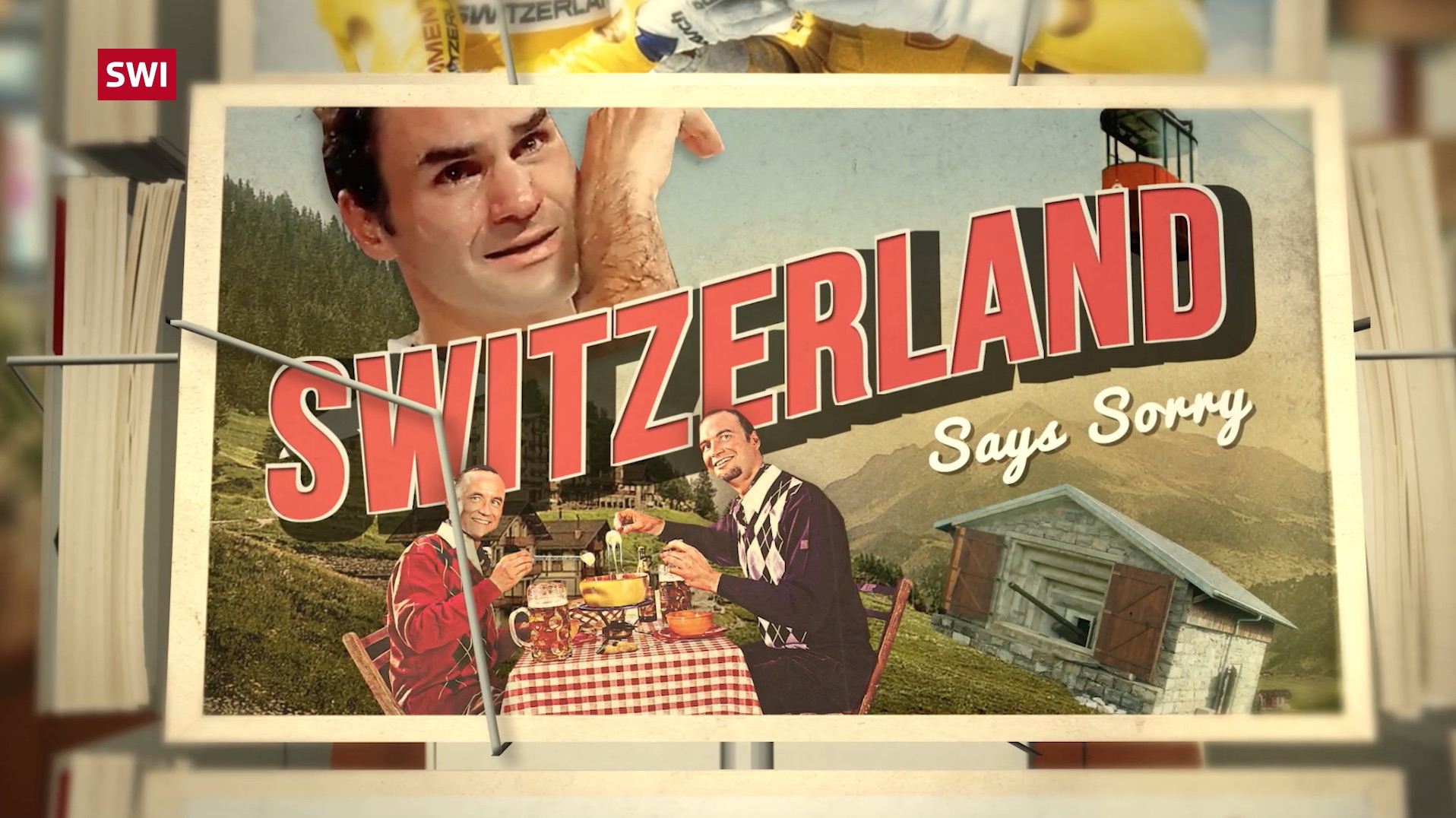
Switzerland says sorry! The fondue invasion
As for chocolate, it is only a processed product whose main ingredient, cocoa, doesn’t grow in Switzerland.
So, along with rösti, cervelat remains one of the strongest contenders for the title of “national dish”. There are several arguments in its favour. First, it has a very long tradition.
Cervelat-type sausages have been mentioned in culinary literature since the 16th century. As for the modern cervelat, it appeared in Swiss butcher’s as early as the 19th century.
One of the special features of cervelat is that “no canton or region can claim authorship”, notes Swiss Culinary Heritage. A good reason to make it a star of Swiss gastronomy.
But the most convincing argument is that it is eaten throughout the country. This mass distribution has its roots in the early 20th century, thanks to the widespread use of the mechanical mincer, which made it possible to sell this sausage in large quantities at a modest price.
Since then, cervelat has become a household word. “If I had to pick just one product that is quintessentially Swiss, it would be the cervelat,” Olivier Girardin, president of the Swiss Culinary Heritage Association, told Swissinfo. “Everyone eats it, in every region.”
More

More
‘Cervelat is the ultimate Swiss food’
Josef Zisyadis, director of the Semaine du goût (taste week), agrees. “The cervelat is what binds the Confederation together. It’s the sausage we eat from an early age, at picnics and holiday camps. It’s a bit of an all-purpose sausage,” he told a consumer programme devoted to cervelat on Swiss public broadcaster RTS.
Controversial subject
This success is borne out by the consumption figures. According to a recent estimate (2026) widely reported by the media, some 160 million cervelats are produced annually in Switzerland, which corresponds to an average consumption of around 20 per person per year.
Cervelat has become an essential part of summer barbecues, particularly on Swiss National Day, August 1. It can even be used to stir up controversy. For example, on national Day lasdt year, president of the right-wing Swiss People’s Party Marcel Dettling grilled a cervelat External linktied to the end of a halberd – a symbolic weapon of the Swiss resistance – on a fire fuelled by the pages of the agreement between Switzerland and the European Union.
But when it comes to cervelats, there’s no need to venture into the slippery slope of politics to stir up controversy. The Swiss love their national sausage so much that they can debate endlessly on issues that may at first seem quite trivial. The most frequently debated question: should you grill your sausage with or without the skin?

How do you split a cervelat sausage to grill it? For many Swiss people, the answer is obvious.
Keystone
And the debate doesn’t stop there. Should you slit a cervelat for better grilling? And if you do, should you split it all the way down or just at the ends? Is the cervelat better raw or grilled? Should it be served with mustard or mayonnaise? The list goes on and on…
As many recipes as there are butchers
There is no official recipe for cervelat. However, the sausage is based on the same recipe everywhere. It’s a mixture made essentially from pork (around 50%), topped up with a little beef, bacon and pork rind, which give it its characteristic texture. However, contrary to what the etymology of its name suggests, there is no trace of brains (cervelle in French) – this ingredient has been banned since the mad cow crisis.
Between 2006 and 2008, the mad cow crisis left cervelat lovers in a cold sweat. The problem stemmed from the skins, which are essential for giving cervelat its texture and texture. At the time, the skin came almost exclusively from Brazil, but the Swiss authorities banned imports for health reasons.
This lack of skin, which threatened the very existence of cervelat, was seen as a national tragedy. Widely reported in the media at the time, the shortage even prompted parliamentary interventions calling on the government to take action.
In the end, imports were allowed to resume under very strict conditions, and the famous sausage was saved. Today, most cervelat skins still come from Brazil, but producers are now also sourcing from Uruguay, Argentina and Paraguay.
Cervelat requires a precise segment of the beef small intestine, and Switzerland simply doesn’t produce enough to guarantee a stable supply. The cattle population is too small, the abattoirs too scattered, and the recoverable volumes too low to supply a dedicated industry.
Water or ice is added to this meat mixture to keep the temperature low during chopping and ensure a good bond, as well as a mixture of spices that often includes pepper, cloves, coriander, nutmeg and garlic. All cervelats also use nitrited salt (sodium nitrite mixed with common salt), which is essential for pink colouring and preservation.
But while the basic recipe is the same, butchers can add their own personal touch. The variation mainly comes down to the proportions of the mixtures and the choice of spices.
Differentiation also comes into play during the rubefaction (reddening) and smoking stages, which give the cervelat its pinkish colour and flavour, as well as preserving it. Smoking is done with spruce shavings and a mixture of beech and larch. Here too, a variation in the mixture or the use of other shavings changes the flavour.
Depending on the choices made during the production process, cervelats can taste very different.
More

More
From Aromat to absinthe: this is the taste of Switzerland
Not yet ready to shine internationally
These differences give rise to comparisons and rankings. A national competition, the Swiss Cervelat SummitExternal link, was even introduced in 2024. The competition, the third of which was held at the beginning of March, determines the “best cervelat in Switzerland”.
This kind of event might raise a smile, but the matter is more serious than it seems at first glance. Even though it’s relatively new, this competition is getting a lot of media coverage. And further proof of the importance of cervelats to the Swiss is the fact that members of the government don’t hesitate to make the trip. Economics Minister Guy Parmelin attended the first two editions, and the prizes this year were presented by Albert Rösti, who heads the energy/environment/transport/communications ministry.
But while the cervelat may be a superstar in Switzerland, it has a harder time convincing people abroad. The latest world rankings of the best sausages published by gastronomic portal TasteAtlas cruelly confirms this: Switzerland appears only three times, and its cervelat comes a modest 56th.
Even the St Gallen sausage, the best Swiss representative, comes only 23th, while the schüblig is down in 95th place. Meanwhile, the Portuguese, Polish and Basque traditions dominate the podium, and neighbouring Germany boasts no fewer than 18 specialities in the top 100.
Giant salad
Whether it’s fondue, raclette, chocolate or rösti, all the flagship products of Swiss gastronomy regularly set new records. The latest example came in March in Fribourg, where 977 people ate 48 kilos of chocolate. This world record is awaiting certification.
In this race for records, the cervelat is much more discreet. But Switzerland’s favourite sausage can still be credited with a feat: the world’s largest cervelat cheese saladExternal link was created last September by retailer Lidl. Weighing in at 264.5kg, it contained 96kg of cervelat, 80kg of cheese and 32kg of onions.
After validation by the Guinness World Records, this giant salad was divided into 2,000 portions and handed out to the public for free at the big autumn fair in Weinfelden, in canton Thurgau.
Edited by Samuel Jaberg. Adapted from French by AI/ts
How we translate with AI
We use automatic translation tools, such as DeepL and Google Translate, for some content.
Each translated article is carefully reviewed by a journalist for accuracy. Using translation tools gives us the time for more in-depth articles.
Learn more here about how we work with AI.


