


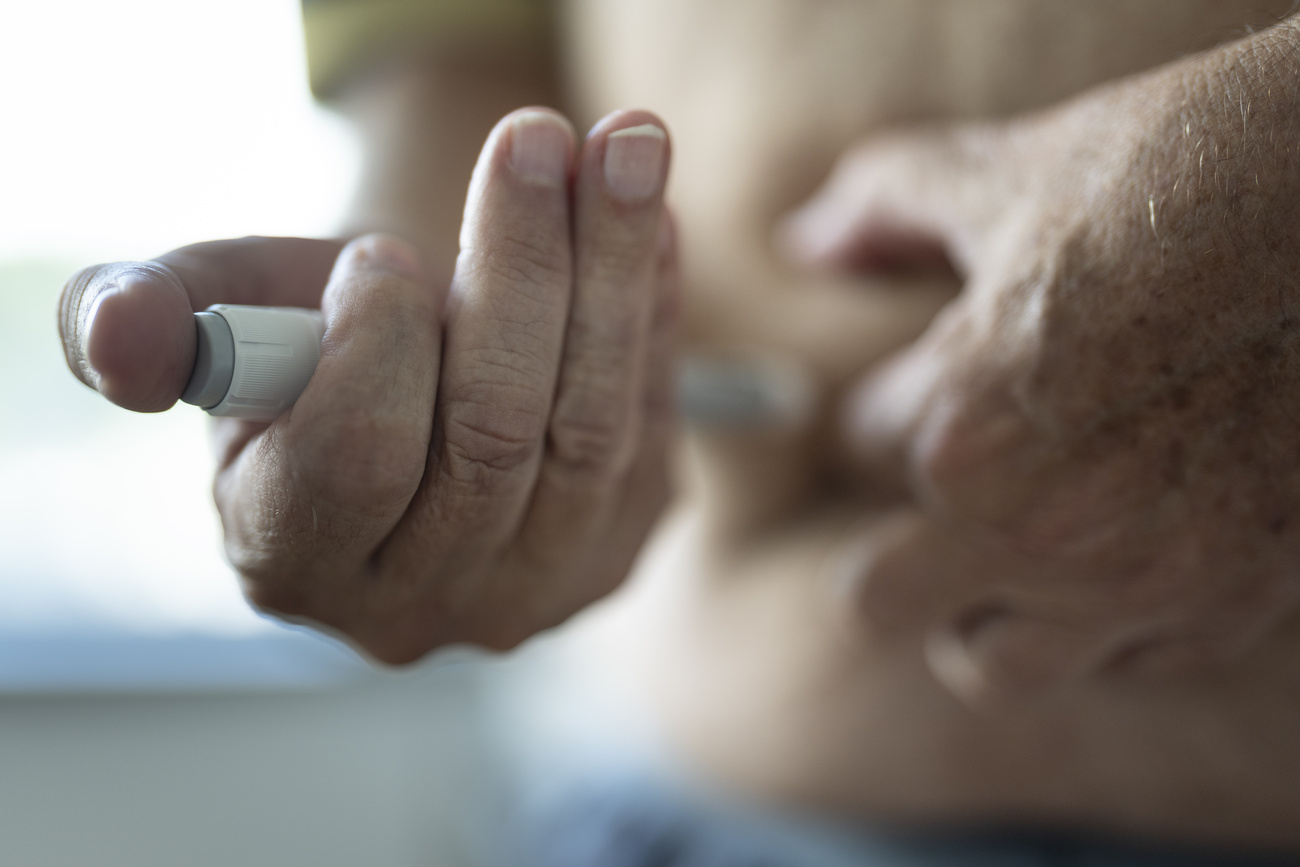
GLP-1 drugs have dramatically changed the outlook for people with obesity.
Gaetan Bally / Keystone
After missing the first wave of GLP-1 blockbusters, Roche is investing billions in a new generation of obesity treatments. With Novo Nordisk and Eli Lilly dominating the market, can the Swiss pharma giant still find a foothold?
In early March, Swiss pharma giant Roche put out some good news about the obesity drug candidate Petrelintide it’s developing with Danish biotech Zealand Pharma. In a phase II trialExternal link, the medication, injected once a week, met its primary endpoint of statistically significant weight loss. Participants shed on average 10.7% of their body weight and sustained the loss to 42 weeks with only mild side-effects.
But investors weren’t impressed. Shares of Zealand Pharma dropped by a record 35% the day after the announcement, while Roche fell around 3%.
In today’s world of obesity drugs, 10.7% weight loss is hardly remarkable. Users of Eli Lilly’s Zepbound (tirzepatide) and Novo Nordisk’s Wegovy (semaglutide) have reported losing 15-20%. In clinical trials of Zepbound, some participants shed upwards of 25% of their body weight.
But the future isn’t only about maximising weight loss, says Manu Chakravarthy, Roche’s global head of cardiovascular, renal, and metabolism product development and one of the executives leading its push into the obesity market.
“We’re not just looking at the number on the scale. We’re really looking at the overall health of the individual,” Chakravarthy told Swissinfo. “Not everybody will require the same thing at the same time over their journey with obesity and related comorbidities that can be 20, 40 even 60 years long.”
+ How Roche passed on a potential $14 billion-a-year weight-loss pill
Roche was among the first pharmaceutical companies to research drugs in the glucagon-like peptide-1 (GLP-1) class but abandoned the field after late-stage flops just before the latest GLP-1 boom began.
Having missed the first wave, it’s now battling to catch the second wave. The Basel-based company is spending billions on research and deals with smaller biotechs to develop a broad portfolio of obesity drugs that it hopes will differentiate itself in an increasingly competitive field.
The World Health Organization definesExternal link obesity as a chronic disease characterised by abnormal or excessive fat accumulation that poses a significant risk to health. It is measured by calculating a person’s body mass index (BMI) – body weight divided by height in metres squared. A BMI over 25 is considered overweight, and a reading of 30 or higher is classified as obese. The threshold varies for different ethnic groups. There is currently debateExternal link about including criteria beyond BMI to diagnose obesity.
The latest GLP-1 weight loss drugs are generally approved for chronic weight management in adults with a BMI of 30 or higher and people with a BMI of 27 or higher who also have weight-related conditions like high blood pressure, type 2 diabetes, or high cholesterol.
Scientists are still trying to understand obesity
Based on simple mathematics, there should be plenty of room for Roche in a rapidly growing market. By 2050, almost 60% of adults over 25 are expected to be overweight or obese, up from 29% in 1990, with the biggest growth in sub-Saharan Africa, according to a study in The LancetExternal link.
The rising number of obesity-related deaths and the costs of treating people with obesity has made it a top public health concern in many countries. The global costs of overweight and obesity are predicted to reach $3 trillion (CHF2.38 trillion) per year by 2030 and more than $18 trillion by 2060, accordingExternal link to the World Obesity Federation.

Kai Reusser, Swissinfo
This translates into a huge market opportunity for drugmakers. SalesExternal link of Eli Lilly’s tirzepatide, sold as Mounjaro and Zepbound, more than doubled in 2025 to $36.5 billion, making it the world’s best-selling medicine.
IQVIA, a global healthcare analytics and research group, estimates the global marketExternal link for anti-obesity drugs could grow from $66 billion in 2025 to $100-$200 billion a year by 2030. The huge range is due to significant uncertainty about how the market will evolve, said Sarah Rickwood, who heads thought leadership and the obesity initiative at IQVIA. Policies, prices, innovations, and patient preferences could dramatically change the market outlook, she said.
“It’s only been five years since modern obesity medicine came on the market,” Rickwood said. “We’re only just starting to address this very large global health challenge.”
+ Swiss regulator and media clash over weight-loss drugs
The latest GLP-1 medicines have been gamechangers by suppressing appetite and slowing gastric emptying, leading to dramatic weight loss. But it’s estimated that the penetration rate of GLP-1s so far is less than 10%External link of the global eligible obese population, most of whom are in the United States.
GLP-1 drugs simply don’t work for some patients, and women are more likely to see success than men. Some users suffer side-effects, ranging from vomiting and severe bloating to kidney damage, mental health issues, and vision problems. None of the offerings so far has been able to prevent muscle loss that frequently accompanies dramatic weight loss.
There are also growing questions about the long-term effects of GLP-1s. Some patients say weight loss plateaus over time, yet they fear regaining it if they come off the drugs. The latest drugs also appear to reduce the risk or severity of some of the roughly 200 comorbidities linked to obesity – including type 2 diabetes, hypertension and certain cancers – but not all.
+ Can weight-loss drugs help curb rising obesity levels in Switzerland?
Scientists and pharma companies including Roche are searching for answers that might lead to new, more targeted drugs that give them an advantage in a highly competitive market.
As many people are likely to self-pay for these drugs, price and patient preference also influence uptake. The first GLP-1 drugs in pill form are being launched, which is expected to lead to a surge in use among patients who favour oral treatments over injections. Generics, launched this year in some countries, are also expected to improve access to weight-loss drugs, especially in low-income countries.
Novo Nordisk’s Wegovy (semaglutide) was approved by Swissmedic in 2022 for weight management. Swissmedic approved Eli Lilly’s Mounjaro (tirzepatide) for type 2 diabetes in 2022 and for weight management in 2024.
Since March 2024, GLP-1 drugs for weight loss have been reimbursed by the country’s basic health insurance provided strict criteria are met. Swissmedic is currently evaluating Eli Lilly’s pill orfoglipron.
“We shouldn’t see the obesity market or the people who live with obesity as a sort of monolith,” said Rickwood. “It’s going to be extremely complex, highly segmented by body mass index, comorbidities, overlap of comorbidities and other profile dimensions such as ethnicity and gender.”
How Roche plans to get ahead
Companies are now clamouring to win the next wave. Last year Pfizer won a bidding war with Novo Nordisk for a small obesity drug developer, Metsera, in a deal valued at $10 billion. Several Chinese pharmaceutical companies are developing novel obesity drugs, with some in late-stage trials.
“We’re just at the beginning of the obesity and weight loss era and so the key differentiators are amount of weight loss, improved cardiovascular health and liver and kidney function as well as price per dose,” said Jens Neumann, a partner at PwC consulting firm in Switzerland and co-author of a recent reportExternal link on how to win the next GLP-1 era. “Currently, any product that has two-digit percentage weight loss has a chance.”

Kai Reusser, Swissinfo
But Roche’s strategy hinges on a bet that the market will shift from an obsession with maximum weight loss to a focus on precision metabolic health, an approach where medicines are tailored to an individual’s biology. Chakravarthy is convinced it has a leg up on competitors because of its legacy in obesity research, its “patient-centric approach”, and its diagnostics expertise, which can help identify risk factors for obesity.
To increase the chances of success, it has boosted its drug pipeline through a CHF11 billion ($13.8 billion) spending spree targeting what Chakravarthy said are “unique assets that can address individual patient needs”.
Central to this is Petrelintide. Unlike GLP-1s that target appetite and gastric slowing, Petrelintide is an amylin analogue that mimics a natural pancreatic hormone to increase satiety with potentially milder side effects. Roche is positioning it as a gentler alternative for those who cannot tolerate the nausea often associated with some GLP-1 drugs.
More

More
Roche’s big bet on big diseases
The rest of the development pipeline aims to fill other gaps. For those seeking more dramatic results, Roche is developing CT388, a GLP-1/GIP receptor that saw around half of participants lose at least 20% of their body weight in early trials.
It is also developing drugs to address obesity-associated conditions including Pegozafermin to treat severe fatty liver disease, Zilebesiran for uncontrolled hypertension and Emugrobart to combat the muscle loss that often accompanies rapid weight loss. A once-daily oral version is also in the works for those who dislike injections. The company sees the greatest potential in a combo cocktail of some of these drugs. None of them are expected to be launched before 2027.
Roche is hardly alone though. As of October 2025, there were 193 innovative drug candidates in development for obesity, up from 107 in August 2024External link, according to IQVIA. To maintain their lead, Novo and Eli Lilly are also working on next-generation treatments, targeting some of the same gaps in the marketplace.
With a suite of new medicines, Roche believes it can still catch up and become a top three player in the obesity market.
“We aren’t too late in the game because we’re not trying to fight for a slice of the current pie,” said Chakravarthy. “We’re actually trying to expand the whole pie. There are so many unmet needs.”
Edited by Nerys Avery/vm//ts


