


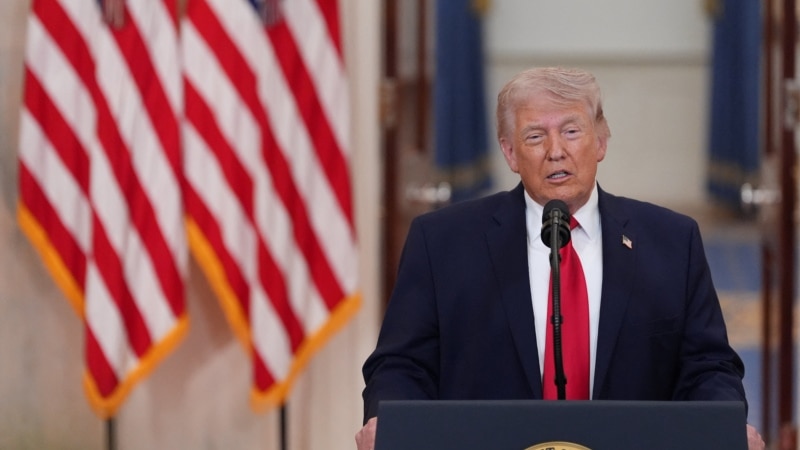
WASHINGTON — US President Donald Trump on April 1 said the United States is close to “finishing the job” in Iran, while warning that US forces will continue to strike the country “extremely hard” for another “two to three weeks.”
In his first address to the nation since the start of the conflict, Trump said US objectives were “nearing completion” after weeks of what he described as “swift, decisive, overwhelming victories on the battlefield — victories like few people have ever seen before.”
“As we speak this evening, it has been just one month since the United States military began Operation Epic Fury,” he said.
Trump outlined what he said were major battlefield gains, claiming Iran’s military capabilities had been severely degraded.
“Tonight, Iran’s navy is gone. Their air force is in ruins,” he said, adding that Iranian leadership figures “are now dead” and that command structures were being “decimated as we speak.”
He said Iran’s missile and drone capabilities had been “dramatically curtailed” and that weapons infrastructure was being destroyed. “Never in the history of warfare has an enemy suffered such clear and devastating large-scale losses in a matter of weeks,” Trump claimed.
The Threat
Trump defended the war as necessary to prevent Iran from acquiring nuclear weapons.
“This murderous regime also recently killed 45,000 of their own people,” he said, referring to the crackdown on protests inside Iran.
“For these terrorists to have nuclear weapons would be an intolerable threat,” he added.
He repeated his claim that Iran was “right at the doorstep” of acquiring a nuclear weapon and said its missile program could eventually threaten the United States, Europe, and other regions.
“This situation has been going on for 47 years and should have been handled long before I arrived in office,” he said, again criticizing previous administrations, including the nuclear deal negotiated under President Barack Obama.
Trump also said that while “my first preference was always the path of diplomacy,” Iran had rejected efforts to reach an agreement.
‘We Have All the Cards’
Trump said regime change “was not our goal,” but suggested it had effectively occurred. “Their leaders… are now dead,” he said.
He said he hoped to secure an agreement but warned of further escalation: “If there is no deal, we are going to hit each and every one of their electric generating plants very hard.”
“We have all the cards,” Trump added. “They have none.”
Trump acknowledged rising gasoline prices, saying the increase was “entirely the result” of Iranian attacks on commercial shipping and neighboring countries, and described it as temporary.
He also said the United States is “totally independent of the Middle East” for energy but remains involved to support allies.
At the same time, he criticized partners for not contributing more and said they should take responsibility for reopening the Strait of Hormuz.
Ahead of the speech, senior Democrats including Gregory Meeks of New York, Adam Smith of Washington, and Jim Himes of Connecticut issued a statement claiming Trump was “no closer to achieving his ill-defined goals.”
They cited the deaths of 13 US service members, hundreds injured, and wider regional and economic impacts. “We urge the president to immediately negotiate a cease-fire with Iran and work toward finding a diplomatic solution,” they said, warning of a “catastrophic war.”
Analysts See Messaging — And Risks
Analysts told RFE/RL the speech was aimed at shaping public perception while leaving uncertainty about next steps.
Jason Brodsky, policy director at United Against Nuclear Iran, said the address was meant to “rally public support around Operation Epic Fury.”
“It will be cast as not the US starting another endless war but ending one that the Iranian regime started in 1979,” he said.
But he warned that even if the US declares a cease-fire in “two to three weeks,” “there is a risk the Iranians will continue attacks as their imperative is rebuilding deterrence.”
“To change that calculus, the US may have to escalate,” he added.
Matthew Bartlett, a Republican strategist and former State Department appointee in the first Trump administration, said the speech was directed at multiple audiences.
“Communication is critical in a war with audiences here on the home front, as well as with the regime in Iran, with the great people of Iran and our allies in the region, in Europe, and beyond,” Bartlett told RFE/RL.
He added that while the address was necessary, “there are still many more unanswered questions about tomorrow and days and months in the future,” and that “while this could wind down, the chance for escalation stands.”
Bartlett said Trump appears to be trying to highlight military achievements while also setting conditions for a potential diplomatic phase, including addressing economic disruptions such as the Strait of Hormuz.
Gregory Brew, a senior analyst at Eurasia Group, told RFE/RL ahead of the speech that Trump was likely to emphasize both success and the need for continued operations.
Trump earlier said he was not concerned about Iran’s stockpile of highly enriched uranium, arguing it is buried underground and can be monitored.
However, experts say that if Iran retains control of its estimated 440 kilograms of highly enriched uranium, it could be closer to producing nuclear weapons than under a previously discussed negotiated settlement.
Trump said the US is “getting very close” to ending the conflict and pledged to “finish the job — and…finish it very fast.”
The coming weeks will be critical in determining whether the conflict de-escalates or intensifies, as diplomatic efforts and military actions continue to shape the future of US-Iran relations.


