

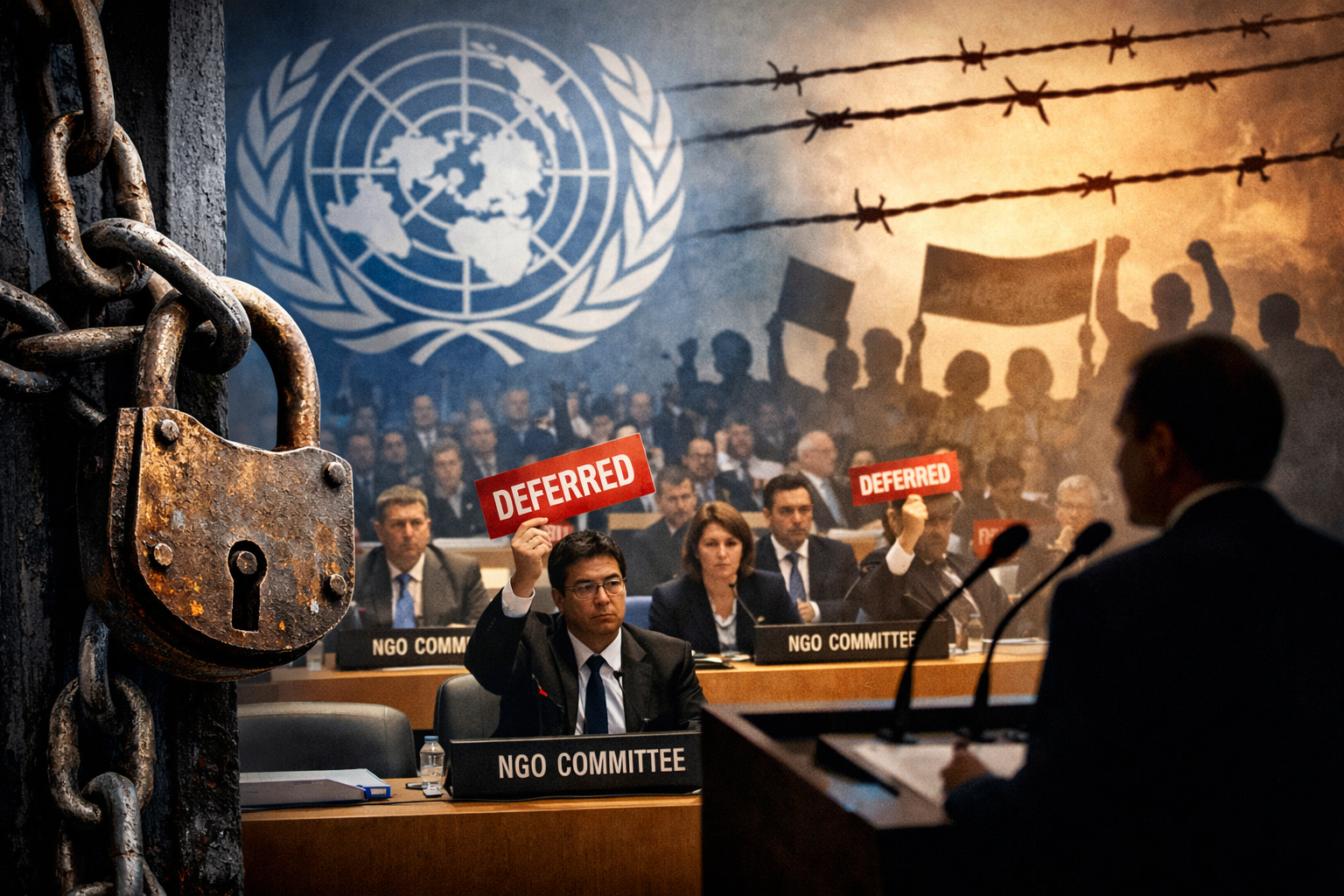
GENEVA, 1 April 2026 — Independent United Nations human rights experts have issued a stark warning over the growing marginalisation of civil society within UN mechanisms, calling on Member States committed to protecting human rights defenders to actively contest the upcoming elections to the Committee on Non-Governmental Organisations (NGO Committee), a key subsidiary body of the UN Economic and Social Council (ECOSOC).
In a strongly worded statement released ahead of the April elections, the experts expressed deep concern over what they describe as a systematic erosion of civil society access to the United Nations.
“We are witnessing increasingly coordinated efforts by certain States to exclude civil society from UN spaces,” the experts stated. “The NGO Committee’s accreditation process is being misused through repeated procedural deferrals, delaying applications for ECOSOC consultative status for years. This disproportionately affects organisations working on human rights.”
The experts further criticised the growing practice of promoting government-organised non-governmental organisations (GONGOs), warning that such entities dilute independent voices and undermine the integrity of UN deliberative processes.
A Critical Institutional Bottleneck
The NGO Committee, composed of 19 Member States elected for four-year terms, plays a decisive role in determining whether non-governmental organisations can obtain ECOSOC consultative status—effectively the gateway for civil society participation in the UN system. This status enables NGOs to access UN premises, participate in meetings, organise side events, and contribute to policy discussions.
However, according to the experts, the Committee has increasingly functioned as a barrier rather than a facilitator.
“In recent years, we have observed a clear pattern of delay and obstruction targeting organisations seeking to engage with the United Nations,” the statement noted.
The warning is particularly sharp given that many States currently seeking election to the Committee have been criticised for restricting civic space domestically. The candidates for the April 2026 elections include:
- Asia-Pacific: China, India, Saudi Arabia, United Arab Emirates
- Eastern Europe: Belarus, Estonia, Ukraine
- Latin America and Caribbean: Cuba, Nicaragua, Peru
- Africa: Cameroon, Côte d’Ivoire, South Africa, Sudan, Tunisia
- Western Europe and Others: Israel, Türkiye, United Kingdom, United States
Structural Abuse of Procedure
At the core of the concern lies the Committee’s use of procedural deferrals. When Member States pose questions—often repetitive or strategically framed—applications are automatically postponed to the next session, typically six months later. In practice, this creates indefinite delays.
The UN Secretary-General has previously warned that such prolonged deferrals can amount to de facto rejection, particularly for organisations working on politically sensitive human rights issues.
A recent analysis reinforces this concern: during the NGO Committee’s first regular session in 2026, nearly 50 per cent of the 647 questions posed to NGO applicants originated from just three States—raising serious questions about coordinated obstruction.
Call for Accountability and Reform
The experts did not limit their critique to diagnosis—they issued clear recommendations.
They urged States genuinely committed to protecting civil society to step forward and contest the elections, warning that the absence of such actors risks further institutional capture.
“Civil society is already struggling to maintain access and influence within the UN. The NGO Committee sits at the centre of this struggle,” the experts stressed.
They also called for procedural reforms to restore credibility and efficiency, including:
- Introducing public comment periods for NGO applications
- Allowing intersessional responses to State queries
- Ensuring timely decision-making within each session
Looking ahead, the experts proposed a more structural shift: periodic review of Committee membership based on objective benchmarks such as ratification of human rights treaties, performance under the Universal Periodic Review (UPR), and broader cooperation with UN human rights mechanisms.
A Test of Credibility
The statement ultimately frames the April 2026 elections as more than routine institutional turnover—it is a test of whether the UN system will uphold or undermine its own commitment to civil society participation.
“It is deeply concerning that so few States with a genuine commitment to human rights defenders have put themselves forward,” the experts concluded.
If left unchallenged, they warn, current trends risk transforming the NGO Committee from a gateway of inclusion into an instrument of exclusion—silencing precisely those voices the United Nations was designed to protect.


