


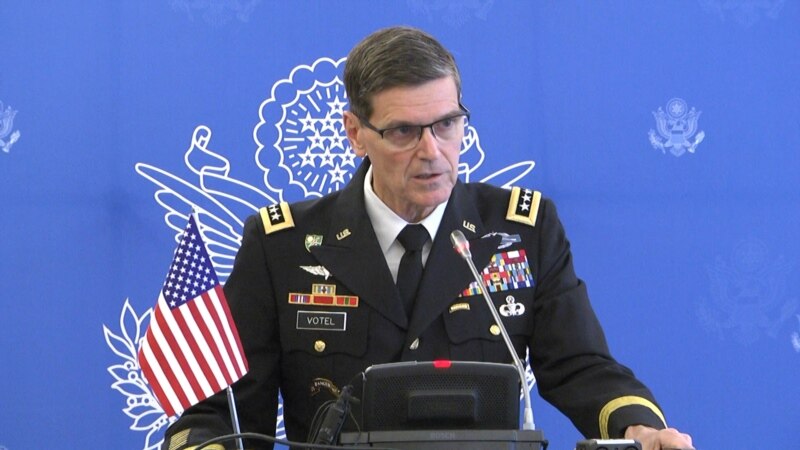
WASHINGTON — Iran is using tactical delay as a strategy in talks to end US and Israeli strikes that have decimated Tehran’s military capabilities amid a continued buildup of US forces in the Middle East, retired US Army General Joseph L. Votel — who led US Central Command from 2016 to 2019 — told RFE/RL in an interview on March 30.
Votel outlined the risks of escalation in the conflict and warned that without a political settlement to keep Iran from blocking the Strait of Hormuz, a prolonged international military presence might be required to keep the the key oil and gas transit route open.
RFE/RL: The United States is in a 10-day pause ordered by US President Donald Trump after threatening strikes on Iran’s energy infrastructure, allowing more time for talks. At the same time, Iran has allowed ships through the Strait of Hormuz. Do you see that as a sign Tehran wants a deal, or is it acting in its own interest?
Joseph Votel: We know Iran has a history of trying to prolong, prolong, prolong negotiations, and try to drag things along. So certainly, I think that’s a tactic they have tried, so on one hand we have to take that into consideration.
Secondly, in terms of the negotiations themselves, I don’t know how far along we actually are in this. I do think we are probably using third parties right now to help us with our negotiations. I know the Pakistanis had stepped up and were trying to assist with this. So it takes a little bit of time to get to some kind of meaningful discussion.
It may be a combination of both: the Iranians are trying to string us along, but also a recognition on the part of the administration that it does take a little bit of time to get these talks set up — meaningful talks set up — so that we can move toward some type of end state for the conflict.
RFE/RL: At the same time, the United States is increasing its military presence in the region. Does this buildup suggest something beyond negotiation tactics?
Votel: You have to recognize, first and foremost, that part of the purpose of those deployments is a messaging to the Iranians.
This is also about making sure we can provide the maximum amount of options for our military leaders and our civilian leaders, so that, if the president decides something, he has an array of forces from which his military commanders can devise courses of action and approaches that he might approve.
Those two things — the messaging aspect and providing flexibility — are very, very important. And I think that is probably the most important thing these forces are doing right now. Certainly they can do other things, like going to Kharg Island or other actions, for example. But this messaging and being able to provide a lot of options for our leaders are two of the primary things we’re doing right now.
RFE/RL: The administration has said it wants to ensure the Strait of Hormuz remains open. From a military standpoint, what would that actually involve? Would it necessarily fall to US forces, or will Israel play a direct role in such an operation? What could these ground operations look like?
Votel: I don’t know if the Israelis have forces postured for this. Certainly the United States is trying to do this.
One of the things that’s been talked about is going in and securing Kharg Island. And I think the purpose of that would be to secure the oil infrastructure and make sure it is in US hands. That could be a bargaining chip with the Iranian regime.
What that would look like is taking one of these elements that’s been deployed — whether Marines or Army forces — and deploying them onto the island, sustaining them and protecting them, and making sure they could stay there while we continued to pursue operations.
What that would do is give us control of the primary oil export location that the Iranians rely on. That may force them to act. Of course, that might generate a response from the Iranians — who probably would respond — so we would have to be prepared for that. But that’s what I think some of this might look like.
RFE/RL: Secretary of State Marco Rubio suggested this could be achieved without ground troops. Do you agree?
Votel: Ground troops play an important role in this, whatever we decide to do. They are going to be critical, if not for seizing this island then as a quick reaction force and being ready to respond to developments as they take place.
We have done escorts through the Strait of Hormuz without troops before, back in the 1980s. But we didn’t have the same threats then. Iran didn’t have the same capabilities.
So the nature of the threats Iran possesses today makes it more likely that some troops would be required.
In terms of what it looks like and how this ends, I think there are three broad objectives. First, a regime that is effectively “defanged,” that does not have the capabilities it had in the past and cannot threaten its neighbors.
Second, its military capabilities have to be diminished to the point where they cannot be effectively employed beyond its borders; that includes missiles, drones, the Iranian Navy, the IRGC Navy, and the ability to close the Strait of Hormuz or rely on proxies.
And third, we have to make sure they have no way to pursue a nuclear weapon. That includes not only destruction of infrastructure, but also bringing the highly enriched uranium they have produced under responsible control.
RFE/RL: During his recent trip to Europe, Rubio discussed with Group of Seven (G7) allies the need for potential long-term international patrols in the Strait of Hormuz. Even if active fighting stops, does this signal the US and its partners should expect a prolonged military presence in the region?
Votel: I definitely think that’s right. If we open up the Strait of Hormuz and we don’t have some kind of political settlement to the war then we will be doing this for a long period of time, and we need to be prepared for that.
That’s why coalition partners and international partners will be critical: to sustain it long term. Without a political settlement, we are going to have to hold this for as long as we can.
RFE/RL: What about Iran’s leadership? We’re hearing increasing discussion in Washington about potential interlocutors within Iran’s current leadership, including parliamentary speaker Mohammad Baqer Qalibaf. Does this suggest the United States is preparing to engage with elements of the existing regime rather than seeking its replacement?
Votel: What is likely, and what the United States government is beginning to appreciate, is that there will be some form of the regime that remains in place.
Our hope is there will be a leader who exhibits a level of pragmatism that we can work with to move this situation in a more positive direction and stop the fighting.
My concern is that the Islamic Revolutionary Guards Corps (IRGC) leadership appears to have very heavy influence, which means there are significant hard-liners still associated with the government. That may make it more difficult.
It’s also important to recognize there is no apparent opposition force ready to take over. The regime is the regime, and we are going to have to deal with it as we move forward.
RFE/RL: How do Iranian-backed groups like the Houthis affect the situation?
Votel: The Houthis could be a problem. They have a lot of capabilities, and while there was a cease-fire in place, they appear to have been taking measures that could allow them to cause real problems.
They are a significant concern. Shi’a militia groups in places like Iraq could also be a problem, but they can be dealt with by host nation forces with some US assistance.
The Houthis are more concerning because they have a much greater capability than many of the other Shi’a militia groups.
RFE/RL: There are increasing reports that Moscow is not only providing intelligence to Iran — including potentially targeting information — but also sharing drone technology and battlefield tactics refined during the war in Ukraine. How significant is this kind of support, and how is it shaping both the trajectory and the complexity of the conflict?
Votel: It’s a big problem, and it is definitely something the United States should be addressing with the Russians. If they are providing target information or capabilities that are prolonging this conflict, that needs to stop.
That is not necessarily going to be done militarily; it will have to be done diplomatically. We have to put pressure on the Russians to stop because this could prolong the conflict and make it even more difficult for us to achieve what we have already initiated.


