


Welcome to Wider Europe, RFE/RL’s newsletter focusing on the key issues concerning the European Union, NATO, and other institutions and their relationships with the Western Balkans and Europe’s Eastern neighborhoods.
I’m RFE/RL Europe Editor Rikard Jozwiak, and this week I am drilling down on two issues: A look at Hungarian vetoes and how they can change after the elections, and why Brussels is known as the Leaky City.
Briefing #1: The Fate Of Hungary’s Vetoes
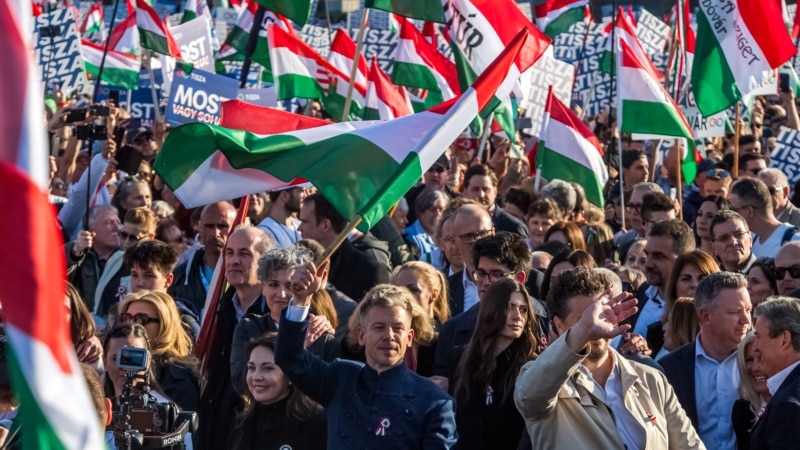
What You Need To Know: This week, the EU has entered something of a lull as the impending Easter holidays means there are few meetings of import being held in Brussels. But this lull isn’t just about the holidays; most are waiting for possibly the most consequential elections in Europe this year as Hungary goes to the polls on April 12.
With so much EU policy — notably related to support for Ukraine — becoming part of the Hungarian election campaign, there is a sense in the EU capital that things will only start to move once the elections are over, no matter if Fidesz’ Viktor Orban manages to prolong his 16-years-reign or if his rival, Peter Magyar, and his Tisza party wins.
This optimism stems from the fact that while Orban has made many harsh statements about Ukraine and President Volodymyr Zelenskyy, especially in recent months, he is expected to “mellow somewhat,” as one RFE/RL source put it, if he wins and allow some of his vetoes to be lifted.
Nearly all officials RFE/RL has talked to both from EU institutions and EU member states openly admit they would prefer a Tisza victory. But they caution that while EU-Ukrainian relations will likely improve with Magyar in power, they still expect him to be tough on Kyiv and not necessarily reverse everything blocked all at once.
Deep Background: So what things paused by Budapest are contenders for unblocking following the vote, regardless of who assumes the premiership?
For starters, there is an expectation in Brussels that the 90-billion-euro loan to Ukraine, initially green lit by Orban in December though later blocked due to the lack of Russian oil supplies via the Druzhba pipeline, will be approved in April.
A European Commission team of experts is currently in Ukraine, and even though they haven’t yet gained access to the damaged pipeline, there is hope in the EU that the infrastructure will soon be fixed, the oil will start flowing to Central Europe, and the loan will subsequently be waved through — even though politicking both in Budapest and Kyiv prevents any moves before April 12.
The EU’s 20th sanctions package on Russia, first meant to be approved around the fourth anniversary of the full-scale invasion of Ukraine on February 22, is also expected to be approved after the election. The initial proposal, which included a maritime services ban related to Russian petroleum products that would prohibit EU-based companies from providing services to any vessel transporting these products from Russian ports, is likely to be watered down or removed altogether due to spiraling energy costs in the wake of the Iran conflict.
Drilling Down:
- If Tisza wins, however, there will be an urge in Brussels to test some of the previous sanctions proposals that Hungarian up till now has rejected. These include sanctions on Russian nuclear energy, which other EU countries that still cooperate with Russia’s Rosatom are likely to veto.
- A potential Magyar government might be more inclined to approve individual sanctions on Russian Patriarch Kirill or people heading various Russian sports organizations and federations as the current Orban government has maintained a policy to veto any potential blacklistings of religious and sports-related individuals.
- New attempts to sanction violent Israeli settlers on the West Bank, vetoed by Budapest since 2024, and an attempt from 2025 to blacklist leading figures in the ruling Georgian dream party, also shot down by the Hungarians, might be resuscitated with a Tisza government even though other EU member states such as the Czech Republic and Slovakia might take over the veto button at least when it comes to Tbilisi.
- With all sanction decisions needing unanimity, including rollovers, Brussels will be keen to see whether a potential new Hungarian government would de-list individuals ahead of every renewal period.
- The sitting Fidesz government has been known for leveraging its green light for extensions to successfully de-list Russian oligarchs such as, for example, Moshe Kantor. It does appear, however, that Slovakia has become just as well-versed in this game, although it remains to be seen if Bratislava will do so without Budapest’s backing.
- Then there are quite a few issues related to Ukraine that are trickier to solve if Fidesz remains in power. Firstly, Orban has made it clear he doesn’t see Ukraine as a future EU member and has vetoed the start of Kyiv’s accession talks since 2024. While he might be persuaded, at some point, to at least give thumbs up for some accession chapter negotiations to be opened some time in the future, it is far from certain.
- At the same time ,Magyar is not a fan of a quick EU accession for Ukraine. He has repeated the mantra of EU countries that don’t believe in expedient Ukrainian membership: that the process must be merit-based and hence take time.
- He would most probably be OK with the opening of talks with Ukraine (and Moldova, which is paired with Kyiv) soon, but don’t rule out him dragging his feet on this issue.
- A Fidesz government has made it a central point not to support Ukraine militarily in any way. This has included vetoes on 6.6 billion euros’ worth of lethal aid from the bloc’s European Peace Facility (EPF) slated for Kyiv, the possibility of sharing satellite images with Ukraine from the EU’s Satellite Center (SatCen), and revising the mandates of the two EU missions to Ukraine, EUAM & EUMAM, to include them in future European security guarantees for Kyiv. There is hope in Brussels, though no concrete promise, that these three vetoes would be reversed if someone new is in charge in Hungary.
- Finally, and more symbolically, there is also an expectation in Brussels that more foreign policy statements will be signed off by all 27 EU member states going forward.
- Much to the annoyance and embarrassment to European diplomats, the EU has in recent years had to put out statements just in the name of the EU foreign policy chief after Hungary vetoed common texts that, for example, condemned Belarus’s sham presidential election in 2025, welcomed the ICC arrest warrant for Vladimir Putin, and commemorated the anniversary of the death of Russian opposition leader Alexey Navalny.
Briefing #2: Why Brussels Earns The Nickname Of The ‘Leaky City’
What You Need To Know: Much of the chatter around Brussels in recent days has been about Hungary. First came a piece in The Washington Post that claimed the country’s combative foreign minister, Peter Szijjarto, made regular phone calls to his Russian counterpart, Sergei Lavrov, during the breaks of the EU’s monthly EU Foreign Affairs Council.
Separately, private phone conversations between a Politico journalist and an EU official were leaked online. The discussions centered on Hungarian-Ukrainian relations and the Hungarian investigative journalist Szabolcs Panyi, who has often broken stories about links between the ruling Fidesz party and Moscow. Last week, the Hungarian government charged Panyi with spying on behalf of Ukraine.
While it hasn’t been established who’s behind the Politico leak, many in Brussels have pointed the finger at Hungary. And while the alleged wiretapping of journalists was widely condemned by Brussels and will likely result in more European officials staying off the phone, the story about Szijjarto’s dealings with Lavrov came as no surprise. After first denying it, Hungary’s foreign minister then confirmed that he not only speaks to Russian colleagues before and after EU meetings but also to counterparts from Israel, Serbia, Turkey, and the United States.
Deep Background: All of this confirms two things those in Brussels have known for years. First, the EU capital is known as the “leaky city” for a reason. Second, there are — and always have been — limits to what diplomats will share among the 27 member states.
Take, for example, the various council meetings that national ministers from the member states attend in Brussels, and sometimes Luxembourg, on a monthly basis — in Szijjarto’s case, it was the Foreign Affairs Council.
All the ministers are usually in the room with a small team of aides from their capitals, along with a few of their country’s officials based in Brussels. There are also officials from the EU’s councils and European Commission. Then there are several translators. All in all, including the ministers, there could be around 100 people in the room, all with cell phones.
It shouldn’t, therefore, come as a surprise that some of these people are in touch with others outside the meeting room, often in their own capitals. It also shouldn’t come as a surprise that some of these meeting attendees are in touch with foreign capitals and scoop-hungry journalists.
While the European officials I’ve spoken to were not at all surprised that Hungary has been passing on information to Moscow, they were a little shocked at the brazenness of doing it directly from a council meeting. But they bemoan that there’s little they can do about it.
“What do you want us to do?” asked one official, speaking on condition of anonymity. “Tap his phone or accompany him to the bathroom whenever he goes out?”
With so many people in the room, most ministers are briefed beforehand and told to be selective about what they share. Often, they resort to simply reading pre-agreed lines and only veer off-script if absolutely necessary. In Brussels, the unwritten rule is to exchange sensitive information during bilateral meetings with trusted counterparts on the sidelines, rather than committing anything important to paper. After all, documents in the EU capital have a habit of ending up in the hands of the media — or worse.
Drilling Down:
- Polish Prime Minister Donald Tusk’s post on X confirmed that, for years, he had limited himself from speaking too much at meetings in Brussels.
- Interestingly, the EU summits between heads of government — the likes of which Tusk has attended many times in his years as prime minister and president of the European Council — are far less “leaky” and more secretive than ministerial meetings. There, the leaders tend not to bring their phones into the meeting room, and there are usually a few council officials who relay sanitized information from the room to national delegations. In turn, these leak versions that suit them best in their home countries. This is the Brussels version of the Telephone game.
- So what about all the documents? Legislative proposals are shared widely as all capitals need to decide on them at some point in the process. Many of these files are publicly available, so there are no secrets to truly pass on.
- Some documents, though, are far more restricted — for example, sanctions packages targeting countries such as Belarus, Russia, and Iran. These files shouldn’t be liberally passed around, but they often end up in the hands of journalists, lobbyists, and others within hours of the European Commission sharing the documents with EU capitals.
- “It is the way Brussels operates: The system is leaky and many hands are involved, so blame is always passed around, but no one is rarely found out,” one seasoned Brussels diplomat, speaking anonymously, told me.
- That doesn’t mean officials are not annoyed by the constant leaks. There are regular discussions on an ambassadorial level about leaks, but, in the end, there is usually an acceptance that a system in which documents must circulate among many people — including in the member states themselves — can never be completely leak-proof.
- No one in Brussels will openly admit it, but most politicians and officials are well aware of how a tactical, well-timed leak can sometimes benefit them.·
- Perhaps more of a concern is when internal briefing notes are passed around. These are documents drawn up from closed-door meetings at various levels, usually by diplomats from member states and often containing sensitive political and security information. Diplomats usually write these briefing notes for their colleagues back home, so it’s more than possible the leaks are coming from the various capitals rather than Brussels.
- Not everything is shared with everyone in the EU. On issues involving Turkey, for example, Greece and Cyprus are sometimes not briefed by member states; on military matters, which are mostly handled by NATO, some of the neutral states do not participate.
- In fact, the truly sensitive stuff in Brussels is just shared in various informal groupings of like-minded states that shift from topic to topic. None of that is going to change with the latest revelations about the leaks.
Looking Ahead
Much of the focus in Brussels this week will be on how to combat energy prices as the Iran conflict rumbles on. EU energy ministers will have an informal meeting online on March 31, and a day later the European Commission will present certain emergency measures member states can take such as subsidizing electricity bills and allowing more flexibility for state aid rules to help energy companies.
That’s all for this week. I will off next week, so the next issue of the newsletter will come out on April 14!
Feel free to reach out to me on any of these issues on X @RikardJozwiak, or on e-mail at jozwiakr@rferl.org.
Until next time,
Rikard Jozwiak
If you enjoyed this briefing and don’t want to miss the next edition subscribe here .


