


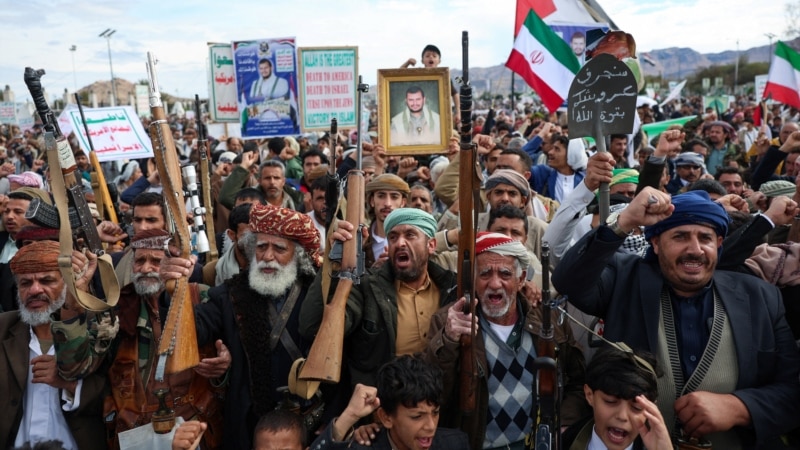
Yemen’s Houthi rebels on March 28 fired their first missiles at Israel since the Iran war began, but analysts warn the more consequential threat is not the projectiles aimed at Israeli territory — it is what the group could do to global energy markets.
A US-designated terrorist organization, the Houthis’ involvement risks prolonging a war that has already drawn in US forces, Gulf Arab states, and Israel across multiple fronts.
Their entry into the conflict, ending nearly a month of restraint since the war began, raised immediate fears of a simultaneous disruption to two of the world’s most critical shipping lanes. Iran has already effectively closed the Strait of Hormuz; the Houthis have now signaled they could move against the Bab al-Mandab Strait, through which roughly 10 percent of the world’s seaborne oil passes.
But analysts say the attack may have been less about Israel than about Riyadh. Michael Horowitz, an independent defense analyst based in Israel, noted that the Houthi military spokesman laid out specific conditions that would trigger full entry into the war, among them any countries actively participating in the US-Israeli war against Iran.
“This, in my opinion, is an indirect message to the Gulf and particularly Saudi Arabia, warning them against joining the war against Iran, or letting US forces use more of their bases,” Horowitz told RFE/RL.
The month-long delay in Houthi involvement, Horowitz said, likely reflected the group’s own calculations rather than Iranian direction. The Houthis may have been reluctant to jeopardize ongoing diplomatic efforts with Saudi Arabia that could yield economic incentives, he said, while Israeli strikes last year on civilian and economic targets in Houthi-controlled areas had already worsened conditions on the ground.
Energy Pain
Danny Citrinowicz, a security analyst at the Tel Aviv-based Institute for National Security Studies, said the broader threat lay in Iran’s economic campaign against the United States.
“While Houthi strikes against Israel should not be dismissed, from Iran’s perspective, as part of a broader economic campaign against the United States, the central issue lies in their demonstrated ability to threaten critical energy transit routes at both maritime chokepoints,” he wrote on X.
Horowitz outlined three scenarios for full Houthi entry into the conflict: a resumption of their Red Sea blockade similar to operations during the Gaza war; strikes on Saudi energy facilities on the Red Sea, including the port of Yanbu — an overland alternative that carries Saudi crude from the Persian Gulf coast to the Red Sea, bypassing Hormuz entirely; and potential strikes against the US aircraft carrier group in the Arabian Sea, though Horowitz said he doubted such efforts could succeed.
Energy markets research firm HFI Research put a number on the potential damage. A Houthi move on the Bab al-Mandab would put an additional 4 million barrels per day of Saudi crude exports at risk. “It won’t be as bad as the disruption in the Strait of Hormuz thanks to the Suez Canal,” the firm wrote, “but the market won’t care.”
Citrinowicz said the trajectory pointed in one direction. “With each passing day of the conflict, particularly in light of its expanding scope against Iran, the likelihood of this scenario materializing continues to grow. It is increasingly not a question of if, but when.”


