


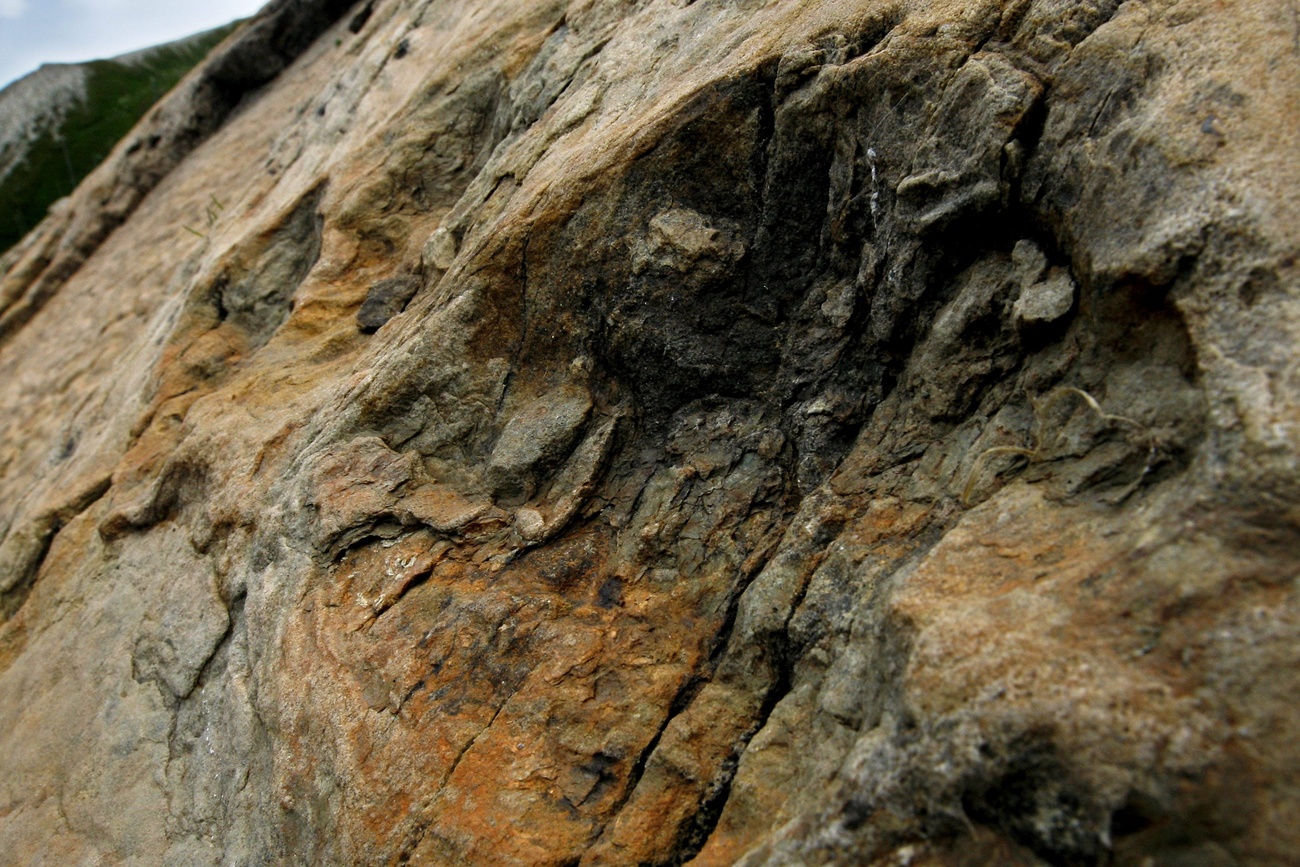
The tracks now visible on the sandstone slab at Vieux-Emosson were left by animals passing through the area 230 million years ago.
Keystone
Switzerland occupies a special place in the world of ichnology, the science that studies the fossilised remains of animals that have been extinct for millions of years. A book takes stock of the situation on the 50th anniversary of a major discovery in the Valais Alps.

In 1976, French geologist Georges Bronner discovered fossilised traces on a rock face in the Vieux-Emosson area of the Valais Alps, near the border with France. The fact that this discovery took place that year was no coincidence. Bronner was involved in organising an exhibition on the region’s geology as part of the construction of the Emosson Dam, which was due to be inaugurated on October 1, 1976.
In addition, 1976 was marked by an unprecedented drought. In the mountains, this “drought of the century” caused the snow cover to recede more sharply than usual, making it possible to see rocks that were usually covered in snow.
In his book Un dinosaure dans la montagne External link(A dinosaur in the mountain), Pierre-Yves Frei tells the story of this discovery. A member of the Geneva Natural History Museum, journalist, author and science populariser, he uses a method already tried and tested in previous works, such as Du pâté d’éléphant chez Calvin (Elephant pâté at Calvin’s): starting with a specific fact to provide a comprehensive, multidisciplinary overview of a subject.
In this case, the 1976 discovery provides an opportunity to discuss the history of palaeontology, plate tectonics and the classification of species.
Dinosaurs that aren’t dinosaurs
The discovery made by chance during a hike was exceptional. It is a 350m2 slab of sandstone with more than 800 fossil remains dating from the Triassic period. “Overnight, Emosson became a beacon of ichnology perched at an altitude of 2,400 metres,” notes Pierre-Yves Frei.
Research carried out at the time revealed images of animals – mostly dinosaurs – moving along a strip of sand by the sea. And dinosaurs are still the stuff of dreams. “200 million years ago, dinosaurs were grazing at Vieux-Emosson”, wrote the Valais daily Le Nouvelliste in 1979.
Very quickly, dinosaurs were even used to promote tourism in the region. “Beach, mountains, dinosaurs – the perfect recipe for a story that was bound to be a big hit,” says Pierre-Yves Frei.

The view of the Mont Blanc massif is already a great draw for tourists. But if there’s a dinosaur to boot, that’s even better. In Finhaut, in the Trient Valley, the tourism board has clearly got the message.
Keystone / Jean-Christophe Bott
But not everyone is convinced by this wonderful story. For example, the absence of shellfish or microalgae fossils in an area that is supposed to have once been by the sea is fuelling doubts. And this time it’s not a comet from outer space, but scientific research that is extinguishing the Valais dinosaurs.
In 2002, palaeontologists came to the conclusion that the traces found on the site were not those of dinosaurs, but of archosaurs, reptiles from the Triassic period that were the ancestors of crocodiles and dinosaurs. As for the beach by the sea, it is transformed into the shore of a river of Pangaea, the single continent that still existed at the beginning of the Triassic period.

“The title of this book is a bit clickbaity,” admits the author, Pierre-Yves Frei. “It promises a dinosaur in the mountains and then spends the whole book trying to prove there isn’t one.”
epflpress
Jurassic Parc is in… Jura
Switzerland has other Triassic sites. Ticino is even home to one of the world’s largest deposits of Middle Triassic fossils at the Monte San GiorgioExternal link site, which is a UNESCO World Heritage Site. This site even has its local star, the Ticinosuchus, a carnivorous archosaur close to the ancestors of crocodiles. But there are no traces of dinosaurs here either.
There are, however, traces of dinosaurs dating from the Triassic period in Switzerland. There are 200 of them in the Swiss National ParkExternal link, south of Graubünden. But here too there is a slight disappointment: the dinosaurs in the National Park were much smaller than those in Jurassic Park. Discovered in 1961, these traces have been dated to around 220 million years ago, which corresponds to a period when dinosaurs were still relatively modest and not very diverse. They are attributed to primitive herbivorous dinosaurs measuring between five and eight metres in length.
More
More
Switzerland, home of the original Jurassic park
So there are no traces in Switzerland of the enormous dinosaurs that make children – and adults – dream? Yes, in the Jura, in the heart of the mountain range that gave its name to the Jurassic period, the golden age of dinosaurs. As at Vieux-Emosson, the remains of these dinosaurs have been brought to light thanks to excavation work.
In the early 2000s, the construction of a motorway led to the discovery of dinosaur footprints that had been preserved since the Upper Jurassic period. At the time, the future Jura looked a bit like the Bahamas, with small islands and large sandbanks. Palaeontologists found some 14,000 footprints in a total of 637 tracks, an unusual density on a European scale. The discovery of this veritable “dinosaur highwayExternal link” was immediately hailed as exceptional in terms of its sheer size and the legibility of the tracks.
And this time, we’re talking about “real” dinosaurs. The surfaces uncovered during the motorway work show the footprints of sauropods – very large four-legged herbivores – and carnivorous theropods. Some of the footprints show animals up to 30m long, making them the largest dinosaurs recorded in Switzerland.
More than just tracks
Swiss soil has not yielded any large fossils of the kind found in abundance in the United States, Argentina or China. For the moment, the largest bone fossil is a plateosaurus measuring around eight metres found in Frick, canton Aargau, in northern Switzerland. It is therefore much smaller than the giants that left their mark in the Jura.
+ T. rex skeleton goes for CHF4.8 million at Zurich auction
Although it has few fossils, Switzerland occupies a special place in world of ichnology. Switzerland has an exceptional density of sites in a relatively small area. What’s more, the Swiss deposits contain some of the best-preserved fossil footprints in Europe, covering key geological periods for understanding the evolution of vertebrates: the Lower Triassic (first archosaurs), the Upper Triassic (diversification of primitive dinosaurs) and the Upper Jurassic (peak of the great dinosaurs).
Obviously, footprints are less impressive than the great fossils that are the pride of museums. But for those who know how to observe them, they are much more than just traces in the ground. Ichnology shows how extinct animals really lived: their tracks reveal their gait, their speed, their size, and sometimes their interactions. Footprints capture a moment in life – an animal walking, speeding up, gliding or following a group.
“Palaeo-ichnology opens up special windows onto the past, onto the behaviour of animals that have been dead for millions of years, whereas the analysis of fossil skeletons generally only provides anatomical information about an organism,” emphasises Pierre-Yves Frei.
Edited by Samuel Jaberg. Translated from French by AI/ts
More
How we translate with AI
We use automatic translation tools, such as DeepL and Google Translate, for some content.
Each translated article is carefully reviewed by a journalist for accuracy. Using translation tools gives us the time for more in-depth articles.
Learn more here about how we work with AI.


