


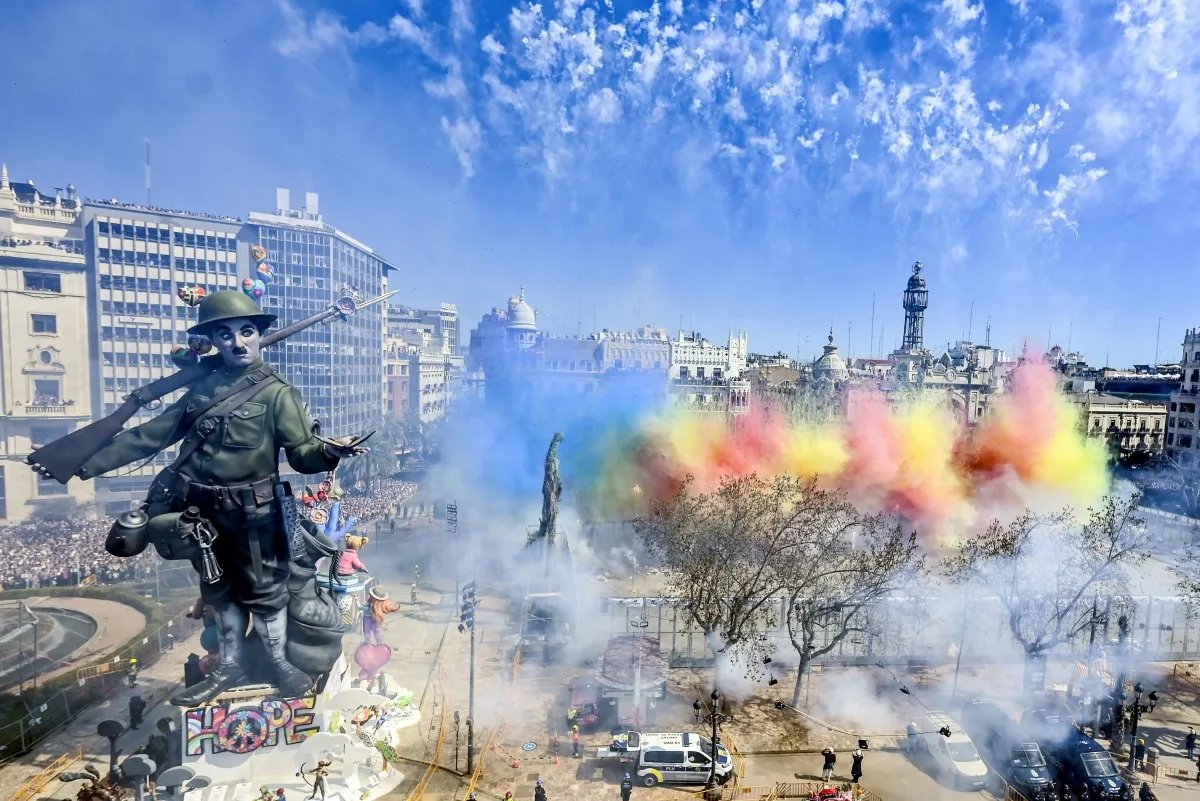
In this week’s Inside Spain, we look at how foreign troublemakers are using “extreme pyrotechnics” at Valencia’s Fallas festival, and why the UK and Spain’s strengthened business ties could be the start of dismantling Brexit.
Believe it or not, Valencia’s iconic Fallas celebration has become somewhat of a mecca for ‘pyrotechnic hooliganism’.
We say hooliganism rather than tourism because a small group of foreign visitors who head to the eastern Spanish city during this week of bangs and fire are not there to be spectators, but rather to take celebrations to the extreme.
On Tuesday night, Spanish and Dutch police apprehended 17 citizens from the Netherlands to “prevent the use of extreme fireworks”, handing them all fines but not carrying out any arrests.
Dutch police were deployed to Valencia because their countrymen have built up a bit of reputation for their love of dangerous homemade explosives while on holiday.
Advertisement
Last year, it was a similar story. Spanish national police arrested 12 men during the Fallas festival in Valencia who belonged to a criminal group that was in possession of illegal explosives, caused public disorder and assaulted officers.
The detainees travelled from different EU countries and coordinated through social networks, bringing with them homemade pyrotechnics meant to cause the greatest possible noise.
On the last night of the Fallas, another 18 people of Central European origin were apprehended in the early hours of the morning for using pyrotechnic material in Valencia’s old Turia riverbed.
Not long before in a nearby area, a huge explosion at nearly 1am woke up an entire neighbourhoods, shattered windows and caused a sinkhole half a metre deep.
You may be thinking to yourself that that’s what the Fallas – and especially the Mascletàs – are all about.
For those who don’t know, a Mascletá is a daytime fireworks display that happens everyday throughout the Fallas at 2pm.
Unlike most firework displays, the focus is on sound power and the synchronisation of gunpowder explosions at a constant rhythm, which creates an intense and engrossing experience.
Advertisement
Although this may seem like a health and safety risk, Valencians have been doing it since the 18th century and authorities know how to keep the bangs ear-splitting enough to shock but not cause harm, at a certain time and in a controlled space.
Not so for some of these clandestine pyrotechnicians from overseas, who police have accused of posing “serious danger to citizens” and are now being monitored more closely by police with drones and extra patrols.
To be clear, roughly as many Spanish nationals as foreigners get arrested for possessing and letting off dangerous explosives, but Valencia City Council are now warning of the “disproportionate” amount of uncivil behaviour by people from outside visiting the Fallas.
Unfortunately, this is a situation that often occurs when Spanish festivals become increasingly popular internationally. From carnival to the bull runs, they end up attracting some bad apples.
In completely unrelated news, the big story for The Local Spain this week has been the new work visa waiver for Brits heading to Spain for stays under 90 days, as part of strengthened business ties between the UK and Spain.
UK Chancellor of the Exchequer Rachel Reeves has been in the Spanish capital meeting with her counterpart Economy Minister Carlos Cuerpo and other Spanish business heads to sign deals and look for ways to break down post-Brexit bureaucratic barriers.
Many of our readers would have hoped that the deal offered British second home owners the possibility of spending 180 days in a row in their Spanish properties rather than having to abide by the 90-day rule for non-EU non-residents.
But these closer ties are still something to be celebrated. It’s been a decade since Brexit and this week’s agreements have been some of the most positive developments during that time for Remainers in Spain.
Advertisement
Whereas the Labour government previously seemed to be on the fence about how to reset its relationship with the EU, now it seems to be more assertive.
Reeves warned on Tuesday that Britain was at risk of being “stranded” between rival trading blocs if it didn’t look for a closer relationship with the EU.
That’s as clear as day now given that the ‘special relationship’ with the UK’s friend across the pond is at best tenuous under Trump.
“In an uncertain world, we must build growth that is secure and resilient. We do this best through partnerships with those who share our interests, our values, and our ambitions,” Reeves said.
“We count Spain amongst those partners – and the prize for doing more together is considerable.”
And there’s more. In an interview with El País, the UK Chancellor stated that “We want the relationship with Spain to be a trial run for what we can achieve with the EU”.
That will hopefully mean that the concerns of Britons living in Spain or with links to the country are heard first when paving the way towards a closer partnership with the bloc as a whole.
Advertisement
Could this mean the start of improvements to freedom of movement conditions or further visa exemptions?
There’s certainly some momentum building. Spanish Prime Minister Pedro Sánchez on Monday appeared on the podcast “The Rest is Politics” – hosted by former Conservative Minister Rory Stewart and Labour spin doctor Alastair Campbell – and said that “I would definitely like to have the UK on board again”.
“I think that societies can make mistakes, but also you can review those mistakes. And I think it was a mistake for the UK to leave the European Union,” Sánchez added.
“And today, I think that there’s a lot of data and facts that, of course, shows that that path was not the correct one.”
London mayor Sadiq Khan on Thursday also urged Labour to campaign on rejoining the EU at the next election.
And Sir John Curtice, Professor of politics at the University of Strathclyde, on Thursday had an article published in the BBC titled “Why Labour’s Brexit focus has shifted from Leavers to Remainers”.
It’s about time, some may say – but better late than never.


