


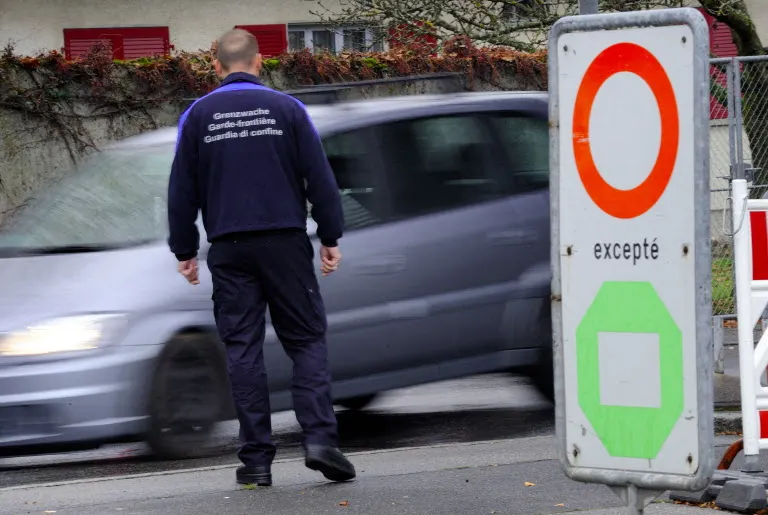
After a long-winded debate in the Parliament, deputies have voted in favour of introducing a fee for foreign drivers who merely transit through Switzerland without spending any time here.
Why is this transit tax being introduced?
The aim of this measure is to reduce peak traffic on the national road network with a traffic-dependent transit fee.
According to MP Marco Chiesa from the Swiss People’s Party, who instigated this move in the Parliament, “our national roads, especially the major Alpine routes, are congested with transit traffic that brings no benefit to our country. It is unacceptable that Switzerland continues to suffer the consequences of this parasitic traffic.”
Government figures confirm that in 2024 – the last year for which these statistics exist – over 55,000 hours of traffic jams were recorded on national motorways. The situation has not improved for years, especially the bottlenecks at the Gotthard Tunnel, which connects Switzerland with Italy and is therefore frequently used by south-bound tourists.
Another supporter of this measure, MP Stefan Engler from the Centre Party, added that “the protection of our population takes precedence over the desire to reach the Mediterranean beaches as quickly as possible.”
As for another Centre MP, Simon Stadler, who represents Uri, the canton situated at the northern end of the Gotthard tunnel, “we have practically an overload every weekend from spring to autumn,” he said. “On days when the mountain regions are congested, around 80 percent of the vehicles have foreign license plates.
Therefore, the amount to be paid would vary depending on traffic density, time of day, and day of the week.
Advertisement
‘Administrative burden’
Not everyone is on board with the new measure, however.
The Federal Council, the Green Liberals, as well as Liberal-Radicals have opposed the motion all along.
Green Liberal deputy Barbara Schaffner has pointed out that even if such a tax could be designed to comply with international law, it is unconstitutional, because the Constitution provides for toll-free use of motorways, with the exception of the vignette.
Furthermore, the measure would create an administrative burden, the opponents argued.
That’s because all border crossings would have to be closely monitored, even though they are equipped with cameras.
Advertisement
How will this work?
The idea behind te measure is relatively simple: to tax foreign vehicles which use Switzerland’s roads merely as an entry and exit point, to get from one country to another,
But the ‘instruction manual’ on how this will actually function in real life still has many empty pages in it.
That’s because many questions remain unanswered,
For instance, the motion specifically targets motorists who do not make a “substantial” stop in Switzerland.
According to Transport Minister Albert Rösti, whose department would have to shoulder the implementation of the new law, the definition of what constitutes ‘transit’ and what constitutes a ‘stay’ would have to be clearly defined.
If you stop for lunch on your way from France to Italy, will this count as transit or stop? If an overnight stay is required, how many nights must you spend in Switzerland to forego the fee?
“The question of what constitutes a substantial stay will likely be difficult to answer definitively for all conceivable transit routes,” Rösti conceded.
It also remains unclear how the registration of border crossings will technically work, and how the amounts of tax will be set and collected.
Additionally – and this is an important point – how will the European Union react to such a tax, even if it does not contravene existing or pending agreements between Bern and Brussels?
Advertisement
What’s next?
As with any new motion accepted by both chambers of the Parliament (the National Council and the Council of States), it will now be up to to the Federal Council to draft a bill to this effect. How long this process will take will depend of how quickly – or not – all the points are clearly defined.
Last but not least, it is not known yet whether this issue will need to be voted on in a referendum before being introduced.


