

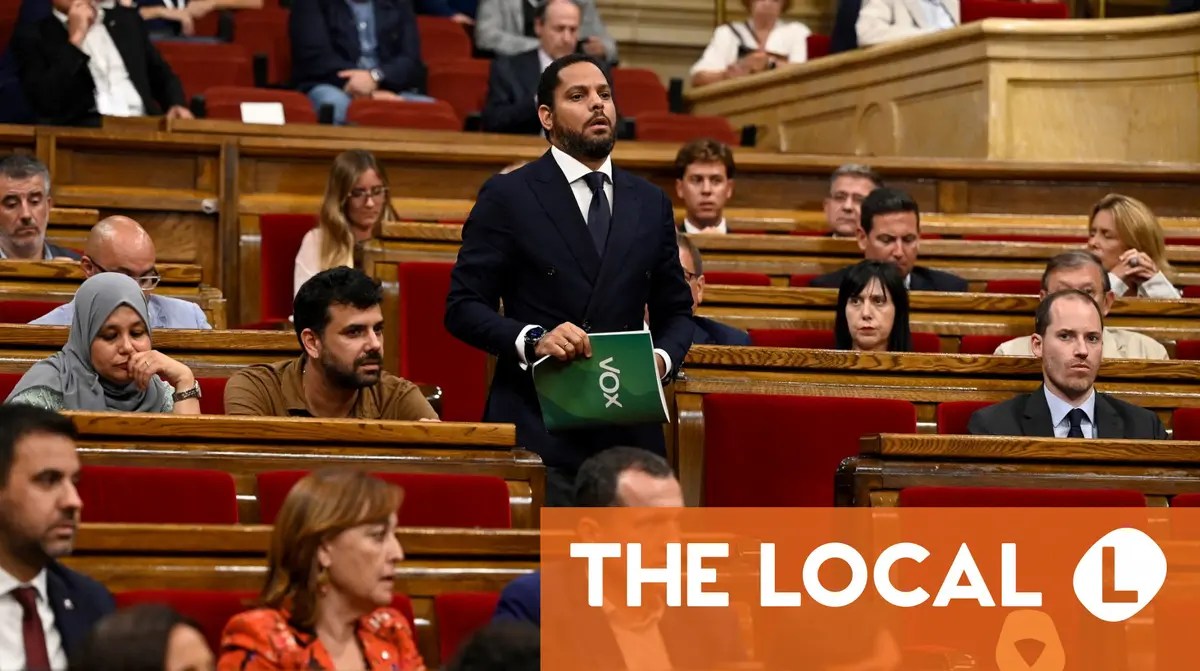
Despite Vox’s outspoken anti-immigration rhetoric, a surprising amount of the party’s top brass have non-Spanish surnames and foreign ancestry.
Spain’s hard-right political party Vox has long been an outspoken anti-immigration party.
Whether on a rhetorical level warning of ‘invasions’ or on a policy level, Spain’s far-right party has in recent years proposed “re-emigrating” up to 8 million foreigners living in Spain, including Spanish-born second generation immigrants.
This follows calls that all previously undocumented migrants who now have residency should be deported (around 1 million) and the potential citizenship revocation of naturalised foreigners in Spain.
Advertisement
The party has surprisingly also been a vociferous critic of the left-wing government’s mass regularisation of over 500,000 undocumented migrants.
However, the Vox spokesperson that presented (and quickly backtracked) on the short-lived 8 million ‘re-emigration’ idea, Rocío de Meer, drew criticism and ridicule in doing so.
READ ALSO: Vox proposes deporting more foreigners than are actually living in Spain
Not only because she made a fool of herself and the party with her poor maths skills, but because of her surname — de Meer.
Hardly a traditional Spanish name, some pointed out. De Meer, sometimes Van de Meer, has Dutch and German origins. This is despite the Vox politician’s family being in Spain long enough that her grandfather was a Francoist governor of the Balearic Islands.
De Meer has warned of the increase in migrants in Spain in recent decades and lamented that “all these millions of people who have arrived very recently have not adapted” to Spanish life and customs. The policy advocated deporting second-generation migrants born in Spain, so, one would assume, some visible Vox figures too.
But de Meer is not the only one. In fact, Vox has several high profile figures of migrant backgrounds, arguably more than any many other parties in Spain.
Ignacio Garriga Vaz da Conceição has been secretary general and vice president of Vox since 2022.
He is the son of a father of Belgian descent and a mother from Equatorial Guinea, and has made bold anti-migrant claims: “Out with illegal immigrants, out with criminals and out with incompatible cultures” he posted online in response to de Meer’s proposed re-emigration gaffe.
Javier Ortega-Smith was until very recently a key part of Vox’s leadership and was a long-time Secretary General of the party.
A former Deputy and Madrid council spokesman, Ortega-Smith also advocates for a very tough immigration policy despite the fact that his mother is from Argentina and of English descent, presumably hence the name Smith.

Javier Ortega Smith (C) greets Spanish policemen and civil guards sporting Guy Fawkes masks during a demo in Madrid. (Photo by OSCAR DEL POZO / AFP)
Ortega-Smith recently took to social media to criticise the mass regularisation of 500,000 undocumented migrants proposed by the Spanish government: “Mass regularisation poses a serious risk to Spain, and, like any sovereign nation, we have the right and duty to protect our borders, our cultural identity and our future,” he said.
Rocío Monasterio, a former president and parliamentary spokesperson for Vox in the Madrid region, was born to a Cuban father.
Outspoken Vox MEP Hermann Tertsch, meanwhile, is the son of Ekkehard Tertsch, an Austrian diplomat and journalist who was a member of the Nazi Party.
Advertisement
Bertrand Ndongo, while not a politician, is a political activist and media figure with close links to Vox. Born in Cameroon, Ndongo is known by some in Spain as ‘El Negro de Vox’ (the black guy from Vox) a nickname he himself has used on social media.
Of course, none of this is to say that ethnic minorities or those of migrant backgrounds should be any more or less likely to support any policy decision based solely on their background.
In fact, there’s evidence that migrants themselves embrace anti-immigration positions over time.
Research from the EUI has found that although “immigrants’ attitudes toward immigration are on average more favourable compared to non-migrants’ attitudes… they tend to become more negative with time spent in the country”.
This is also inter-generational, with second-generation migrants less favourable to immigration.
For some on the left it’s an uncomfortable truth that migrants, or those from migrant backgrounds, might support controls on immigration. In the UK, notably, almost 40 percent of British-Indians voted to leave the European Union.
Similarly, in Spain Vox has a not insignificant support base among some Latin American voters, notably Cubans and Venezuelans who arrive with incredibly sceptical views of ‘left-wing’ or ‘socialist’ politics and vote for Vox or the centre-right PP.
READ ALSO: What a Vox government could mean for foreigners in Spain


