


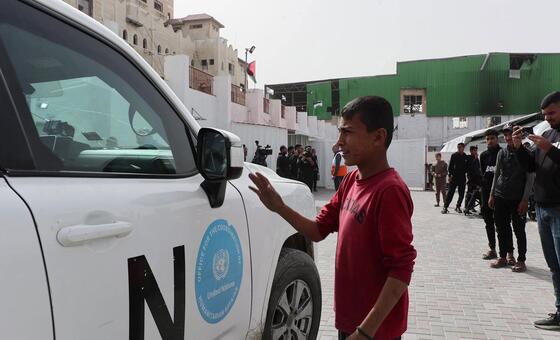
The World Health Organization (WHO) and its partners supported the medical evacuation of nine adult patients, most with trauma injuries, for treatment unavailable in Gaza.
OCHA said 18,000 patients in Gaza still urgently need treatment, while UN teams are preparing support for people returning through Egypt.
‘Major bottleneck’ in delivery of humanitarian supplies
“We need to be able to have rapid, safe and sustained and unimpeded access to be able to deliver assistance at scale and be able to scale up faster than we are doing,” OCHA Spokesperson Olga Cherevko said.
Aid officials also warned that Kerem Shalom remains the only operational crossing for incoming humanitarian and commercial supplies, creating a major bottleneck.
On Wednesday, three planned UN convoys were cancelled after Israeli authorities said only fuel would be allowed in, forcing agencies to leave food, fodder and other items behind.
Meanwhile, strikes reportedly hit residential areas in Gaza and the West Bank, causing casualties, according to UN humanitarian workers.
Gender inequality deepens global water crisis
A new UN report released on Thursday warns that the global water crisis is being made worse by deep-rooted gender inequality.
Across the world, women are responsible for collecting water in more than 70 per cent of rural households without a reliable supply, according to the report published by UN educational and cultural agency UNESCO ahead of World Water Day on 22 March.
“Water inequality has a strong gender dimension,” UNESCO Representative Bhanu Neupane told journalists at the United Nations in New York.
Climate change adding to inequalities
Across the world, women and girls spend an estimated 250 million hours every day fetching water. That is time they are prevented from going to school, paid work and other opportunities.
The report also highlights the impact of poor sanitation. In many places, women and girls still lack access to safe toilets and menstrual hygiene facilities, exposing them to shame, health risks and missed days of school or work.
The UN says climate change, water scarcity and disasters are making these inequalities worse. It is calling for urgent action to remove barriers to women’s equal access to water, land and services, and to ensure they are fully included in water governance and solutions.
Human rights defenders in Colombia face persistent deadly violence
Meanwhile in Colombia, human rights defenders have faced relentless violence over the past decade, with nearly 100 killed on average each year, according to a new report from the UN human rights office, OHCHR.
High Commissioner Volker Türk said it was “heartbreaking” that it remains one of the world’s deadliest countries for those defending human rights.
He acknowledged efforts by the current Government, including dialogue with civil society and work on a national protection policy, but warned that far more is needed.
Indigenous defenders disproportionately affected
The report says that between 2016 and 2025, the UN documented 972 killings of rights defenders. From 2022 to 2025 alone, 410 were killed, while more than 2,000 threats and attacks were recorded.
It links the violence to the continued presence of non-State armed groups, criminal networks involved in drug trafficking, illegal mining and logging, and weak state institutions. More than 70 per cent of perpetrators were believed to be non-State armed actors.
Indigenous defenders were disproportionately affected, accounting for 23 per cent of victims, despite making up less than five per cent of Colombia’s population.
The UN is urging urgent reforms to strengthen prevention, protection and criminal investigations, while warning that funding cuts have reduced its own ability to monitor abuses in high-risk areas.


