


Jakob Morf, Untitled (between 1985 and 1998).
Collection de l’Art Brut, Lausanne
The Collection de l’Art Brut in Lausanne is turning 50 – and is marking the occasion with an exhibition. It tells the story of how an untamed art form found fertile ground in Switzerland. Art Brut en Suisse takes visitors back to the early days, when art created in psychiatric clinics went unseen for a long time.
Art Brut exists everywhere. It refers to art created by people without formal artistic training: amateurs, children, social outsiders and people with mental illness or intellectual disabilities. The discovery of Art Brut and its recognition as art, however, are closely linked to Switzerland.
The term Art Brut was coined by French artist Jean Dubuffet, who saw in this art a raw power untouched by the art world. In July 1945, Dubuffet travelled through Switzerland. He visited mental hospitals and prisons – places where some doctors and therapists had begun to view, and collect, pictures and objects created by patients with curiosity.
Adolf Wölfli: from indentured boy to creator of worlds
Psychiatrist Walter Morgenthaler observed, for instance, the patient Adolf WölfliExternal link at what was then the Waldau mental hospital (now the University Psychiatric Services Bern). The former indentured child was diagnosed with schizophrenia – and created thousands of drawings and collages in which he not only reimagined his childhood but also invented an entirely new world order. Morgenthaler recognised the artistic value of Wölfli’s work and published a book about him.
![Adolf Wölfli (1864–1930) was discovered by his psychiatrist and supported by Jean Dubuffet. (Image: Untitled [The Lake and the Islands], 1916).](https://www.swissinfo.ch/content/wp-content/uploads/sites/13/2026/03/wolfli_cab-a711.jpg?ver=ad8263d3)
Adolf Wölfli (1864–1930) was discovered by his psychiatrist and supported by Jean Dubuffet. (Image: Untitled [The Lake and the Islands], 1916).
Collection de l’Art Brut, Lausanne
Jean Dubuffet was also fascinated by Wölfli. In 1948 he exhibited some of his drawings in Paris. At the Collection de l’Art Brut’s anniversary exhibition in Lausanne, two large sections are dedicated to Wölfli. No wonder: Wölfli became a cornerstone of Dubuffet’s Art Brut collection, which began to take shape in the 1940s.
In 1971 the collection was donated to the city of Lausanne. In February 1976 the Collection de l’Art Brut was founded – the first institution of its kind in the world.
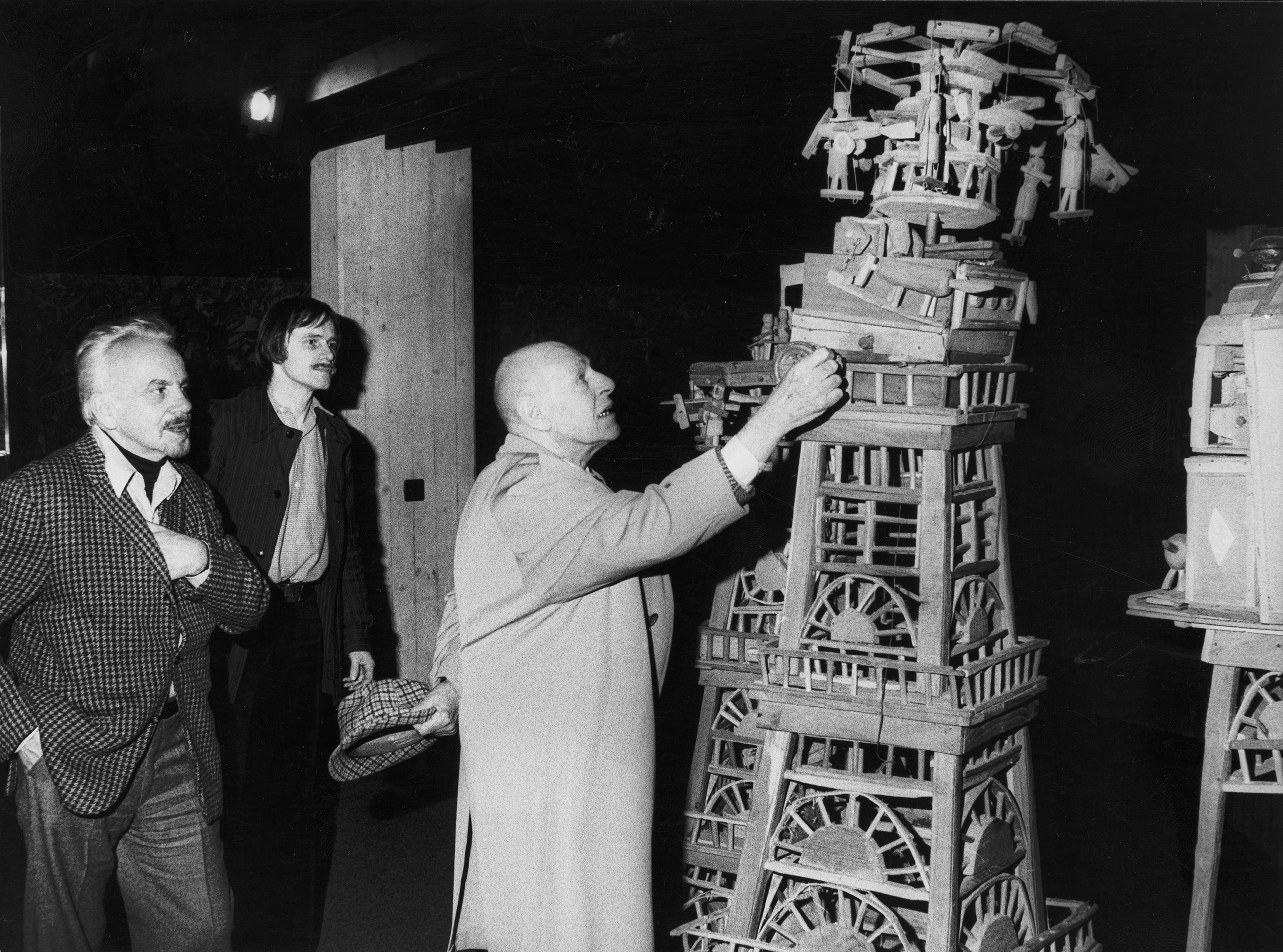
Jean Dubuffet (right) with art historian Michel Thévoz (centre) and artist Slavko Kopac during a visit to the Collection de l’Art Brut in February 1976.
Jean-Jacques Laeser/Collection de l’Art Brut
The spirit of the times also shapes Art Brut
The exhibition Art Brut en Suisse brings together historical and contemporary works from the collection. It offers insight into how the definition of mental illness – and the treatment of those affected – has changed over the decades. It also shows that people who were already disadvantaged often ended up in psychiatric institutions. One example is Aloïse Corbaz from Lausanne.
She wanted to train as a singer but was forced to work as a maid. In rosy-hued paintings she depicted success and romantic happiness that were denied to her in real life.
![Aloïse Corbaz’s (1886–1964) early works were discovered by Jean Dubuffet in 1947 and added to the Compagnie de l’Art Brut collection in 1948. (Image: Untitled [The Man with the Crest and the Blonde Woman].](https://www.swissinfo.ch/content/wp-content/uploads/sites/13/2026/03/aloise_cab-2148bis.jpg?crop=0px,2px,1317px,2124px&w=405&ver=ad8263d3)
Aloïse Corbaz’s (1886–1964) early works were discovered by Jean Dubuffet in 1947 and added to the Compagnie de l’Art Brut collection in 1948. (Image: Untitled [The Man with the Crest and the Blonde Woman]
Collection de l’Art Brut, Lausanne
![Following the outbreak of the First World War, she was forced to return to Switzerland, where her deeply held religious and pacifist convictions led to her being admitted to psychiatric hospitals in 1918. It was there that she began to draw and write. (Image: Untitled [Enlèvement d’une mariée de Gaule], between 1946 and 1947).](https://www.swissinfo.ch/content/wp-content/uploads/sites/13/2026/03/aloise_cab-a207_r.jpg?crop=0px,0px,1485px,2126px&w=456&ver=ad8263d3)
Following the outbreak of the First World War, she was forced to return to Switzerland, where her deeply held religious and pacifist convictions led to her being admitted to psychiatric hospitals in 1918. It was there that she began to draw and write. (Image: Untitled [Enlèvement d’une mariée de Gaule], between 1946 and 1947).
Collection de l’Art Brut, Lausanne
![Corbaz paints couples basking in the bliss of love in bold colours. Following a disappointing romantic experience, she once worked as a governess at the court of Emperor Wilhelm II in Prussia and developed a fantasy love affair with him. (Picture: Untitled [Couple princier], c. 1947).](https://www.swissinfo.ch/content/wp-content/uploads/sites/13/2026/03/aloise_cab-a196.jpg?crop=0px,0px,1618px,2125px&w=497&ver=ad8263d3)
Corbaz paints couples basking in the bliss of love in bold colours. Following a disappointing romantic experience, she once worked as a governess at the court of Emperor Wilhelm II in Prussia and developed a fantasy love affair with him. (Picture: Untitled [Couple princier], c. 1947).
Collection de l’Art Brut, Lausanne
The exhibition reveals something else: how strongly Art Brut is shaped by the spirit of the times. Having a mental illness does not mean artists are unaware of the world around them. Some works displayed at the end of the exhibition could easily have come from the studios of trained artists or graphic designers with no psychiatric diagnosis.
Take the acrylic paintings by Clemens Wild. The Bern-based artist paints almost life-size women in work coats – cleaners, craftswomen – on packing paper, and writes short texts alongside them in which the fictional women introduce themselves. The stylised depictions feel strikingly lifelike. One could easily imagine them in a graphic novel or on an advertising poster.
The exhibition “Art Brut en Suisse” can be seen at the Collection de l’Art Brut in Lausanne until September 27, 2026.
Translated from German by AI/amva/ds
How we translate with AI
We use automatic translation tools, such as DeepL and Google Translate, for some content.
Each translated article is carefully reviewed by a journalist for accuracy. Using translation tools gives us the time for more in-depth articles.
Learn more here about how we work with AI.


