


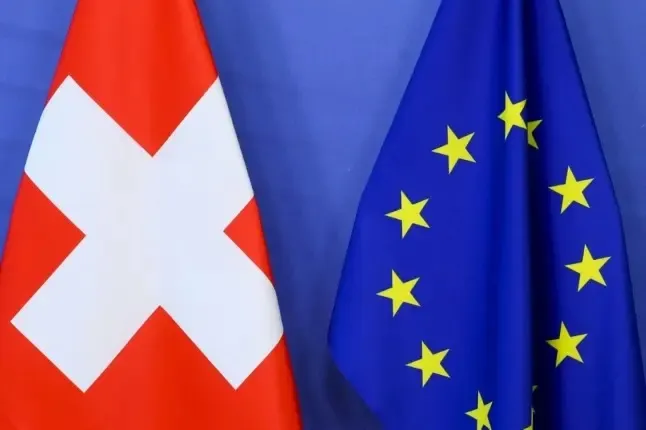
On March 2nd, Bern and Brussels signed a package of agreements intended to ‘deepen and harmonise’ ties between the two sides. But right-wingers are sounding the alarm about the potentially disastrous consequences for Switzerland if the treaties are ratified. Do their warnings have any merit?
The agreements cover a wide spectrum of topics, such as electricity supply, food safety, air and land transport, as well as healthcare.
They also ensure Switzerland’s participation in EU programmes: research, innovation, education, youth, sport, culture, and other areas.
Last but certainly not least, Bilaterals III – as the new package is known – also address the Free Movement of Persons – that is, issues related to immigration.
READ MORE: How will Switzerland benefit from new pact with the European Union?
While the government is urging both the Parliament and the voters – who will have to weigh in on the package in a referendum – to approve it, the Swiss People’s Party (SVP) has staunchly opposed Switzerland’s relations with the European Union, and the new batch of agreements has made their stance even more radical.
What are they complaining about?
Their main argument is that if the agreements are ratified, Switzerland will lose its sovereignty and will, for all intents and purposes, become Brussels’ lackey.
For this reason, they are calling the package “a treaty of submission,” arguing that Switzerland will lose much and gain nothing (except problems) if the pact goes into effect.
But do any of their claims have a grain of truth in them?
Advertisement
‘A vastly exaggerated statement’
To find out, The Local asked Francesco Maiani, professor of European Law at the University of Lausanne and expert in EU Migration Law and Policies to comment of the SVP’s position.
The concrete question put to him is about a clam made by the SVP on its website, namely, “With this EU accession treaty, the Swiss people would no longer have a say in their own country.”
“From a legal standpoint, this is a vastly exaggerated claim,” Maiani said.
“First, wide-ranging areas will be untouched by the agreements – such as State authorities and political rights, general administrative law, and civil law outside of limited points.
“Second, even for matters covered by the agreements (most of which are already part of the existing treaties, and therefore already subject to rules derived from EU Law), Switzerland will still have the ultimate right to decide whether it wants to take on new EU Law.”
“If there is a popular initiative – and the new agreements in no way restrict the scope of direct democracy – it will still be voted on, just as it is today, even if it runs counter the the EU treaties,” Maiani added.
Advertisement
Debunking another SVP argument
The hard-right SVP party also claims that Switzerland would be obliged to transpose European law and submit to EU jurisdiction, amounting to “existential violations of our Constitution and seriously undermining the fundamental values of the Swiss Confederation.”
Is this true?
“Of course, this could give rise to violations of the treaties and to newly-introduced dispute settlement procedures,” Maiani said.
“But even if the foreseen arbitral tribunal found against Switzerland, Switzerland would still have a choice between complying and keeping its course, while accepting counter-measures from the EU.
“And contrary to what is the case today, it would have the right to have the proportionality of such counter-measures verified by an arbitral tribunal. This cannot be a bad thing for the smaller party in a close and economically asymmetrical relation such as the one between Switzerland and the EU.”
Finally, “should Switzerland and the Swiss voters find that, in light of the experience, the new agreements are too constraining, they would still retain the right to denounce them,” he added.
READ MORE: What happens next with the landmark Swiss-EU agreements?


