


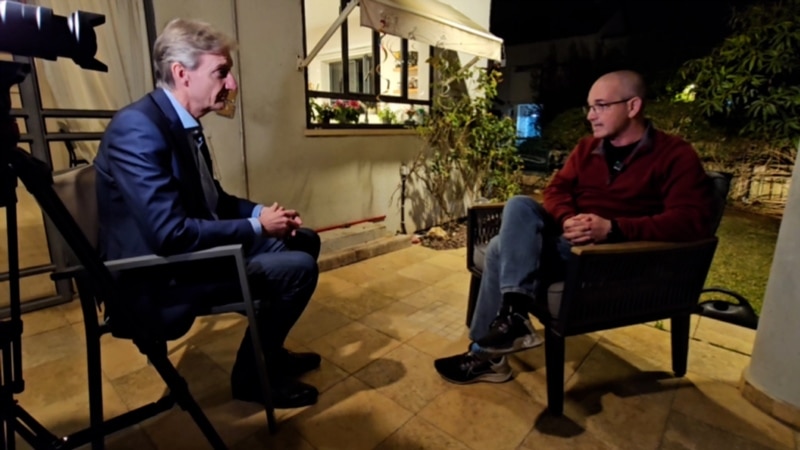
TEL AVIV — The Iran war offers huge lessons for the effectiveness of Chinese military doctrine and hardware, both used by the Iranian military, according to Eran Ortal, a reserve Brigadier General in the Israel Defense Forces (IDF).
Speaking to RFE/RL from a location near Tel Aviv late on March 14, Ortal said Iranian tactics around the Strait of Hormuz were very similar to those that China would be expected to employ in a future conflict around Taiwan.
The US and Chinese military would be “taking notes” as the current conflict played out, he added.
Ortal was previously commander of the IDF’s Dado center, a military studies unit at the General Staff. He is now head of the military program at the Begin-Sadat center (BESA) at Bar-Ilan University and a visiting scholar at the American Foreign Policy Council (AFPC).
RFE/RL: Iran has blocked the Strait of Hormuz. Is there a military solution, and if so, what does it look like?
Eran Ortal: Well, that’s the nature of asymmetric warfare. You can take out the Iranian fleet and the entire Iranian Navy, and the Fifth Fleet has done that. But the asymmetric capabilities, the speed boats, the unmanned boats, the mines and the coastal missiles will still be there. And this is a threat you cannot just totally remove. It’s just like we have the anti-tank missile problem in Lebanon. You can take some of them out, you can have countermeasures, but they will always be able to snipe away.
You can protect the vessels going through the Hormuz Straits and you can win the war. That’s basically the tactic and the strategy to maneuver around this problem. And I guess this is the American strategy.
RFE/RL: You’re saying basically that they could protect shipping to some degree but there’d be no guarantee and that ships could be lost?
Ortal: Yes, but to a sufficient degree, to a good degree. But then again, it’s not just a tactical question. And you can see the Iranians realize that. So, they went after the UAE oil facilities that go around the straits, directly to the Strait of Aden. A big chunk of the oil is going out through other ways, and they’re trying to sabotage that too.
RFE/RL: The United States has decided to move forces from Asia. This includes 2,500 Marines, a naval assault ship. What do you think that’s for? Is it maybe for Kharg Island?
I think this really can benefit the Americans with a learning experience viewing a possible future conflict in the South China Sea. I’m sure the American team is taking notes.”
Ortal: The first meaning is deterrence: “We’re all in, we can keep that on, and we can escalate.” The next thing is the operational intent. I guess it can mean that CENTCOM (US Central Command) might have some operations regarding the opening of the Hormuz Straits on the Iranian coastline. It can also mean that we can take the Kharg island.
And maybe another operational intent might be the 440 kilos of enriched uranium somewhere out there buried in one of the Iranian mountains that only a ground operation can remove if the Iranian regime is not taken out by the end of this war.
RFE/RL: This is the 450 kilograms of enriched uranium that Steve Witkoff, the US special envoy, spoke about. Let’s look at the air campaign. There have been some discussions in Israeli media that Iran could end up looking like Gaza, that there could be that level of destruction and civilian death. Do you think that’s a possibility?
Ortal: If that phrase means that Iran can be deeply hurt and much of its infrastructure is ruined, then yes. But Gaza is totally ruined not because of bombings from the air. It’s totally ruined because it was a battle space prepared by Hamas to repel any future Israeli offensive. That is far from being the situation on the ground in Iran. That’s a 90-million country. It’s so much bigger than Gaza. So no, this kind of space cannot be as ruined as Gaza.
Chinese Tech And Tactics
RFE/RL: Turning to a different aspect of this, what military lessons do you think that Israel and the United States are learning from this current conflict? One thing that occurs to me is that Iran has a lot of Chinese military tech, for example.
Ortal: Iran’s strategy is what the American military would call A2AD, anti-access area denial. It means that with long-range precision missiles and other kinds of capabilities, you deter the other side from coming into the theater. That’s the anti-access part.
The area denial part is what you see in the Hormuz Straits. They cannot compete with the Americans about control of the sea and control of the air. But they can try to deny the free use of these two spaces from the Americans.
The Chinese strategy for its own future theater of war is very similar. They would push to Taiwan and then try to deter the Americans from coming in with that strategy exactly.
So, the fact that this is the strategy and the weapons used, the weapon systems the Iranians used are very much Chinese, Russian, and Iranian copies of Chinese and Russian capabilities, with the same tactics and the same command-and-control methods, I think this really can benefit the Americans with a learning experience viewing a possible future conflict in the South China Sea. I’m sure the American team is taking notes.
RFE/RL: I guess the caveat would be that the Chinese armed forces operate on a significantly higher level in terms of the equipment they’ve got and the organization, than the Iranian.
Ortal: Absolutely. And surely the Chinese are (also) taking notes. And, surely, they must be thinking, well, they are so much better than the Iranians, as you’ve just put it. But, on the other hand, they’re also thinking to themselves, “this is my equipment. This is my doctrine.”
I think they must reflect on the current events, especially in the context of their 2027 readiness year that they have declared, as a target, to be ready for a future conflict around the Taiwan straits and islands.
RFE/RL: If we can bring it back to this conflict, if it ends with Iran weakened, but without regime change, where does that leave the Middle East, the balance of power? Does it mean, X months down the line, there’s another war?
Ortal: For the removal of this regime, we can only create more comfortable conditions for the Iranians to exploit. Whether that happens or not, stripping Iran of its military capabilities, of its protection system, in our region is essential. It’s essential not just to stabilize this region, it’s essential also in the larger frame like, as I’ve said, a future possible war between the United States and China.
The Americans wouldn’t want Iran at the southern flank of the Pacific in this kind of scenario. So, stripping Iran from its capabilities is a good thing.
There is a risk because a wounded beast, a wounded revenge-seeking beast in this region is a dangerous thing. But still we have created a window of years for this weakened Iran to be dealt with in the worst-case scenario.
What About Iranian Civilians?
RFE/RL: I want to bring it back to Iran for the final question. What would you say to people in Iran who have been protesting against their government, the clerical authorities? They’ve been risking their lives. They’ve been shot at. They’ve lost loved ones that way, perhaps. And now they are absolutely terrified by this Israeli and US campaign.
Ortal: What I’ve heard from Iran, what we can see from Iran is those very same people cheering on the rooftops, begging for the offensive to go on until this regime is gone. I don’t think the United States and Israel can responsibly promise anything to these people. But surely the goal of this war is common to that group and to the allies fighting this war in Iranian skies.
Bombs falling is a very scary thing. But as you know, missiles fall on Israeli cities and towns and communities and in the Gulf, and they fall indiscriminately. Their purpose is to kill civilians.
The American and Israeli bombings in Iran specifically target very intelligence-acquired targets. Some mistakes can happen and some collateral damage always occurs in war.
I’m sure and I can see that those Iranians that you speak of realize that because we can see them walking in the streets, sending pictures of the Basij post-points in Tehran, and begging for those posts to become next-day targets.


