


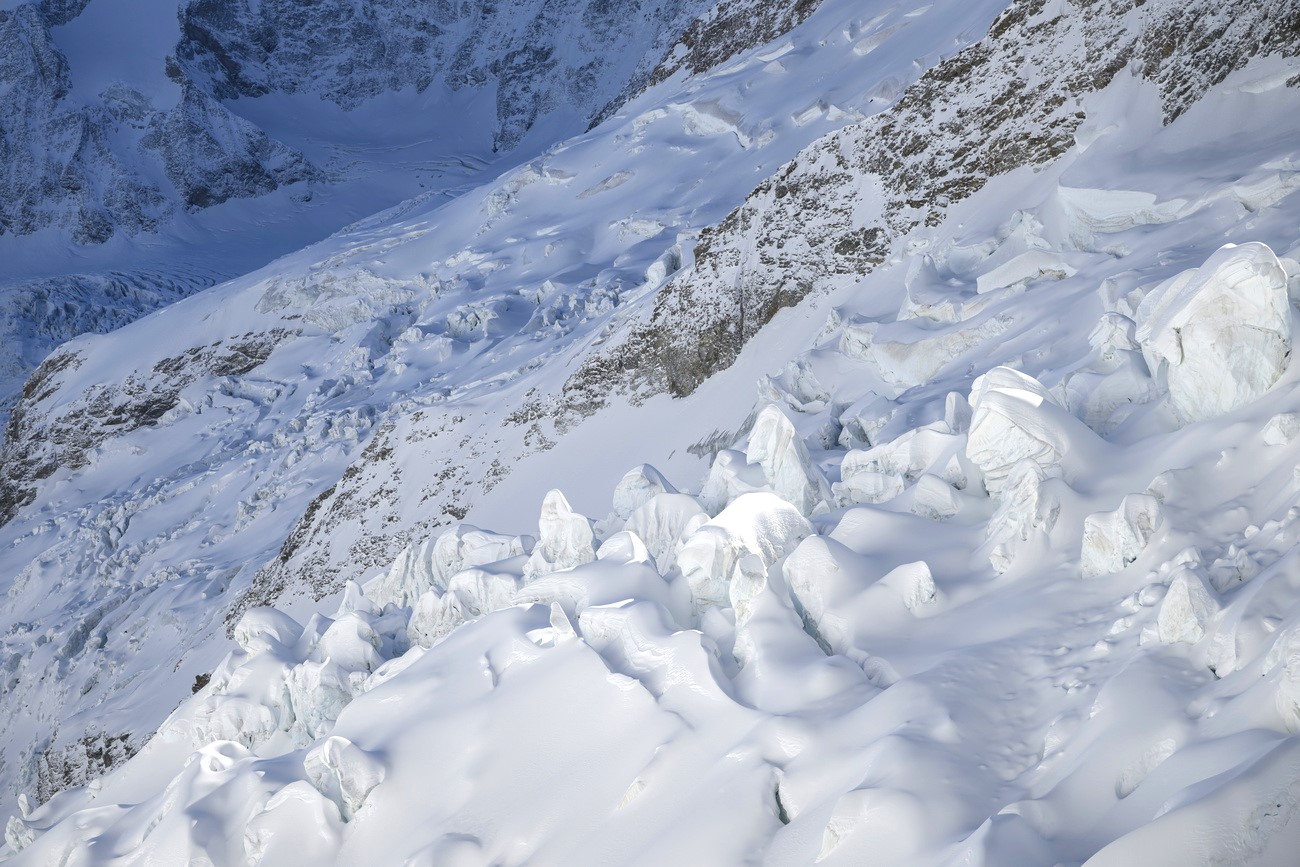
Fresh snow has resulted in a level 4 avalanche risk on the southern slopes of the Alps in Switzerland.
Keystone-SDA
Heavy snowfall on Saturday and during the night of Saturday to Sunday, particularly in the southern Alps, means that the danger of avalanches is high. Many spontaneous avalanches can be expected, say meteorologists.
+Get the most important news from Switzerland in your inbox
More than a metre of snow has fallen in places south of the Alps, according to the Meteonews website on Sunday morning. At Bosco-Gurin, in southern Switzerland, up to 116cm of fresh snow accumulated in 24 hours, a new record for this station in Ticino, said Météosuisse in a post on X.
Some valleys to the north of the Alps were also affected by heavy snow, notably in the Bernese Oberland and the cantons of Uri and Glarus. Snow reached the plains mainly in Central Switzerland, but spring-like weather is expected to set in from Monday.
More
More
The beneficial effect of avalanches on Alpine glaciers
This fresh snow has resulted in a level 4 (or high) avalanche risk on the southern slopes of the Alps and on the adjacent ridge to the north, said federal authorities. This means that avalanches can easily be triggered. Traffic routes could also be at risk.
The A9 motorway has been closed to all traffic around the Simplon Pass, the Touring Club of Switzerland (TCS) said on its website. The same applies to the roads leading to the Saas Valley in canton Valais. Many roads in Graubünden in eastern Switzerland are also impassable due to the risk of avalanches.
In Saas and Küblis (canton Graubünden), heavy snowfall caused power cuts on Saturday night. Several hundred homes were affected and had to go without electricity temporarily.
In the rest of the Alps, a level 3 avalanche risk is in force. In the Valais, even with a marked danger, a great deal of pre-emptive blasting to trigger avalanches could be heard on Sunday morning.
Translated from French with AI/gw
We select the most relevant news for an international audience and use automatic translation tools to translate them into English. A journalist then reviews the translation for clarity and accuracy before publication.
Providing you with automatically translated news gives us the time to write more in-depth articles. The news stories we select have been written and carefully fact-checked by an external editorial team from news agencies such as Bloomberg or Keystone.
If you have any questions about how we work, write to us at english@swissinfo.ch.


