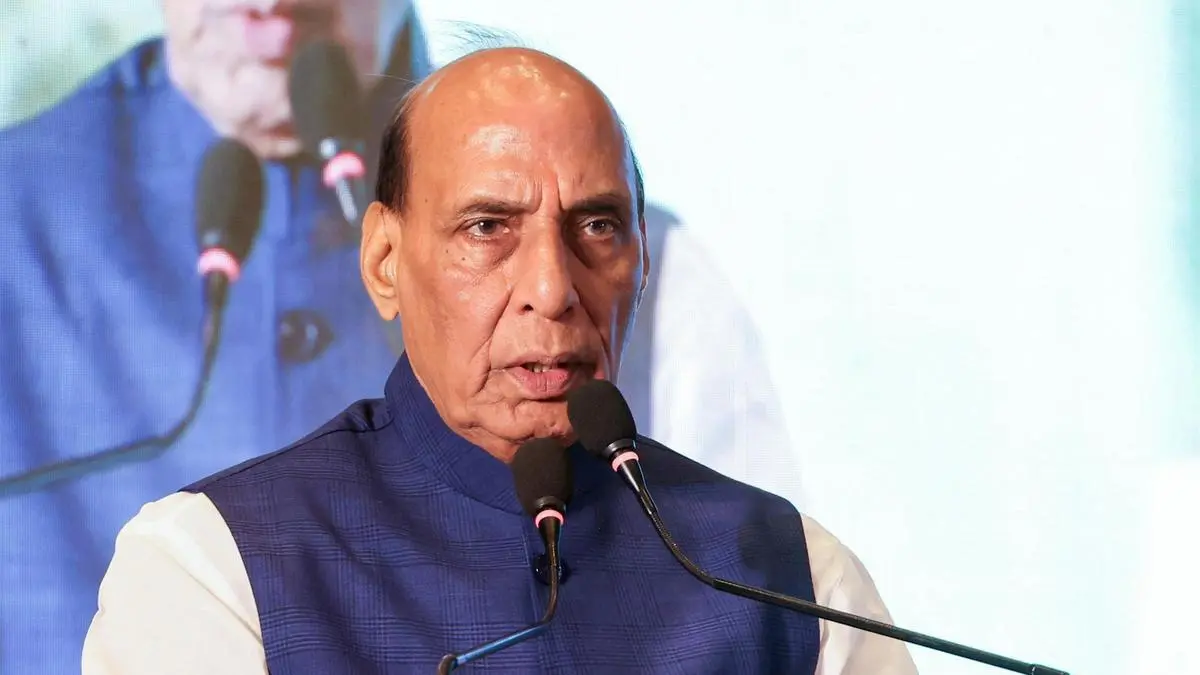
Union Defence Minister Rajnath Singh addresses at the inauguration of Sagar Sankalp – Reclaiming India’s Maritime Glory, a defence and maritime dialogue jointly organised by Garden Reach Shipbuilders & Engineers (GRSE) Limited and a private media organisation, in Kolkata on Friday.
| Photo Credit:
ANI
Defence Minister Rajnath Singh on Friday said that under the Maritime India Vision 2030 and Maritime Amrit Kaal Vision 2047, investments worth approximately ₹3 lakh crore have been planned to develop world-class shipbuilding clusters.
Reiterating self-reliance as the only solution to remain relevant in today’s abnormality, which has become the new normal, Rajnath Singh stated that the disturbance in West Asia following the US-Israel-Iran war will directly impact the supply of oil and gas owing to disruptions in the global supply chain.
Kolkata maritime dialogue
He said this in his inaugural statement at “Sagar Sankalp – Reclaiming India’s Maritime Glory,” a defence and maritime dialogue jointly organised by Garden Reach Shipbuilders & Engineers (GRSE) Limited and a private media organisation in Kolkata.
Defence export surge
According to him, the government’s efforts are yielding positive results, as in the Financial Year 2024-25, domestic defence production surpassed a record figure of ₹1.50 lakh crore, with defence exports reaching an all-time high of approximately ₹24,000 crore. He stated that by April 2026, the defence exports are poised to reach approximately ₹29,000 crore, and the government has set a target to export defence equipment worth ₹50,000 crore by FY 2029-2030.
“It is difficult to make concrete comments about the future course of events in the Middle East or in our neighborhood. The Strait of Hormuz or the entire Persian Gulf region is crucial for global energy security. When there is disturbance in the region, it directly impacts the supply of oil and gas. Moreover, we’re witnessing supply chain disruptions in other sectors as well. These uncertainties have a direct impact on the economy and global trade. The global scenario is an abnormal situation. What is more worrying is the fact that this abnormality is becoming the new normal,” said Rajnath Singh as he reiterated that self-reliance is the only solution to stay relevant.
Describing “technological dynamism” as another crucial element in a fast-changing world, the Minister stated that technology is bringing about unprecedented changes across every sphere of life, and this is even more evident in the defence sector.
Modern shipbuilding push
He stated that in the shipbuilding sector, GRSE and other shipyards, have also been given special focus to make the domestic industrial ecosystem strong and futuristic. “The goal is to develop ships into technology hubs, not just production units. Efforts are being made to bring them up to the global standards through infrastructure modernisation, digital ship design tools, modular construction techniques, and supply chain integration,” he said.
MSME innovation ecosystem
Singh also praised the contributions of MSMEs, start-ups, and indigenous vendors in the construction of large platforms, asserting that a warship is a product of joint efforts, a phenomenon known as the Conglomerate Effect. This conglomerate effect creates synergy, increases efficiency, mitigates risk, and creates an ecosystem of innovation, he said.
He emphasised that the Government has introduced several financial assistance schemes to advance India’s shipbuilding landscape, including the creation of a dedicated mechanism for long-term funding, liberalised FDI norms, and the encouragement of the PPP model.
Published on March 6, 2026