


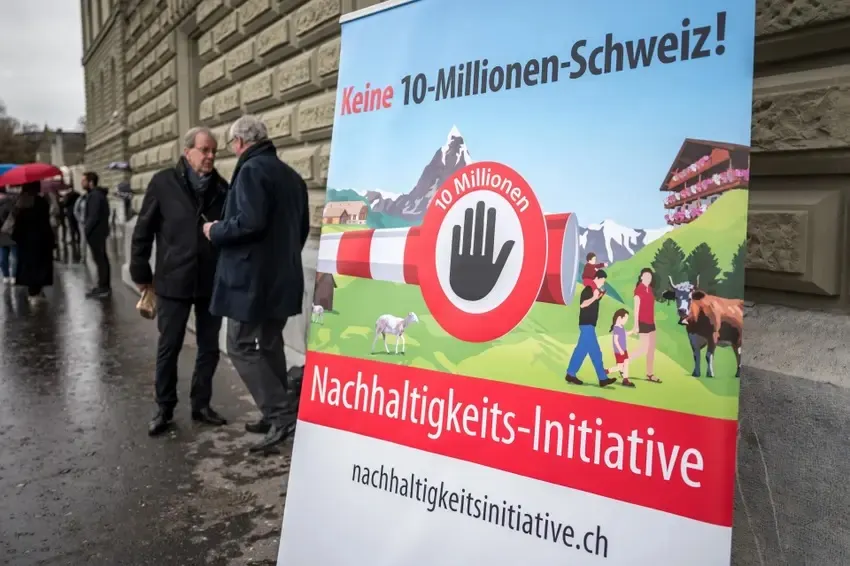
On June 14th, Swiss voters will have their say on the hard-right’s push to drastically limit the influx of EU workers into Switzerland – a move that business associations strongly oppose.
Arguably one of the most contentious political efforts in Switzerland of the past decade, the ‘No to 10 million people’ initiative is continuing to spark controversy ahead of the June referendum.
Its instigators, the right-wing Swiss People’s Party, are insisting that curbing immigration is essential for slowing down population growth and, consequently, protecting the country’s key infrastructure – including housing, health system, public transport, and schools – from being overburdened.
The proposal stipulates that “Switzerland’s permanent resident population must not exceed ten million people before 2050. From 2050 onwards, the Federal Council may adjust this limit annually.”
Currently, the country’s population stands at just over 9 million, including nearly 2.5 million foreign nationals – that is, over 27 percent of the population.
READ MORE: What exactly does the Swiss ‘no to 10 million’ anti-immigration proposal aim to do?
Threat to security and prosperity
The Federal Council, the parliament, as well as all political parties (with the exception of the SVP, that is) have spoken against this move, urging the voters to reject it at the ballot box.
Outside of the political arena, business and economic circles are also throwing their support behind the ‘no’ camp.
In a position paper it recently published jointly with the Swiss Employers Association, the umbrella organisation for the Swiss business sector, Economiesuisse, refers to the SVP’s effort as a “Chaos Initiative.”
That’s because, the two groups argue, this move “solves no problems but creates a multitude of others” – including these:
Advertisement
‘Decline in prosperity’
The report points out that currently, the number of retiring workers in Switzerland exceeds the number of young people entering the labour market.
“This demographic trend will only intensify. Without the EU/EFTA workforce that our country so desperately needs, Switzerland risks halting the development of businesses within its borders, seeing its tax revenues decline, innovation slump, and the organisation and quality of services deteriorate,” the position paper states.
“This would result in a loss of prosperity and a decline in the quality of life for everyone.”
Less funding for social insurance
Right now, employed foreigners are paying into Switzerland’s obligatory social security scheme (KVG/AVS), thus boosting state pensions.
Without the contribution of foreign workers, however, the social insurance system would have financing shortfalls, which would impact the entire population, including Swiss citizens.
READ MORE: How immigrants keep Switzerland’s economy running
Advertisement
Weaker ties with the European Union
Just as relations between Bern and Brussels are being strengthened with the recent signing of the new package of agreements, the SVP’s initiative “deliberately jeopardises the bilateral path with the EU, even though these agreements are a decisive factor in Switzerland’s prosperity,” the group noted.
What do others say?
In an interview with The Local, Patrick Leisbach, migration and labour market expert at Avenir Suisse think tank, also said that rigid population limits sought by the SVP “would likely weaken Switzerland’s long-term growth, innovation, and prosperity, stifle economic dynamism, and gradually erode one of Switzerland’s key competitive advantages.”
He did concede however, that “concerns about rapid population growth and the effects of immigration should be taken seriously.”
“Land is becoming scarcer, infrastructure is under strain, and housing is increasingly expensive.” Leisbach said.
In his view, however, “the answer cannot be a hard population cap. Instead, a more sensible, market-based approach would be a better option.”


