


From biometric grain dispensers and smart warehouses to crisis-mapping platforms and humanitarian communication avatars, the UN World Food Programme (WFP) showcase at the Artificial Intelligence Impact Summit demonstrated how data and machine learning are being applied to strengthen food and nutrition systems at scale.
Among the most visible innovations is Annapurti – a “grain ATM” – that allows beneficiaries of public food programmes to authenticate with biometrics and collect rations quickly and accurately.
Fast access to grain
WFP India Representative Elisabeth Faure explained its impact: “They put their finger, they collect their grain very quickly and in a dignified way, and it’s accurate and provides 24/7 access.”
The system means families no longer need to sacrifice a day’s wages to receive their entitlements. It is already being scaled nationally and has expanded to neighbouring Nepal.
Another solution focused on smart warehouses, where sensors track moisture, pests and stock levels in real time, helping prevent food spoilage and improve supply-chain decisions.
Route-optimization tools were also highlighted, supporting India’s vast public distribution network that delivers food to more than 800 million people each month through over 600,000 shops, reducing both delivery times and carbon emissions.
Parvinder Singh, Head of Communications and Media at WFP India, said the summit’s significance lay in both its location and its purpose.
“This event is very important because it is happening in the Global South and in India,” he said, noting that the exhibition demonstrates how artificial intelligence can be applied to humanitarian and development work, especially to address food security challenges.
In this interview, Amandeep Gill, UN Special Envoy for Digital and Emerging Technologies, explains why managing the risks of AI and harnessing the opportunities must involve everyone.
Integrating AI and data
Global-level tools were also featured, including platforms that help agencies rapidly assess crises and determine what supplies are needed and how to deliver them via the shortest routes. These systems reflect WFP’s broader push to integrate data and artificial intelligence across operations.
“AI can transform data into a strategic asset to enhance operational efficiency, accelerate emergency response, and strengthen global food systems,” said Magan Naidoo, the Chief Data Officer at WFP.
Through predictive analytics, early-warning systems and optimized logistics, WFP estimates such technologies can boost operational efficiency and forecasting accuracy by as much as 30 to 50 per cent.
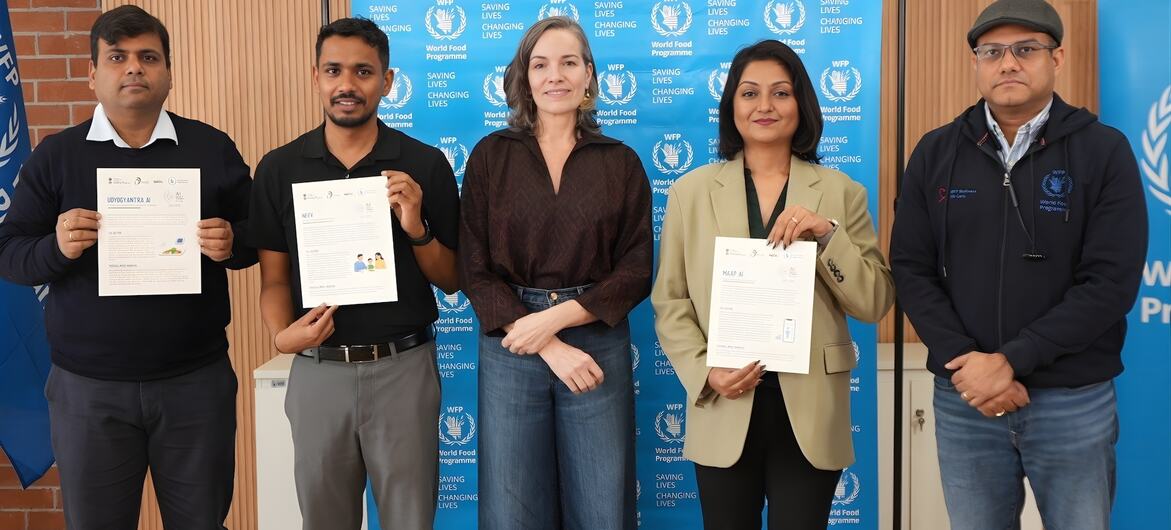
Hackathon Winners at World Food Programme Event.
Local innovation for last-mile nutrition
While the exhibition highlighted global technologies, a parallel hackathon focused on local solutions to close nutrition gaps at the community level.
The challenge, titled “AI Powered Nudges: Bridging the Last-Mile Nutrition Gaps through Intelligent Local Solutions,” invited innovators to design tools that could integrate with existing government programmes such as school meals, community nutrition services and supply chains.
Three winning ideas were honoured. One linked school meals with community nutrition gardens. Another proposed a mobile nutrition application. A third developed a system that scans and predicts child malnutrition risks. Mr. Singh stressed that such grassroots innovation is essential because, despite strong safety-net programmes, last-mile challenges remain.
India as a testing ground for global solutions
UN Resident Coordinator in India Stephan Priesner highlighted the broader significance of the collaboration.
“We are applying innovation and artificial intelligence for good, in an inclusive way, to enhance the efficiency of these massive food distribution systems,” he said, adding that India’s digital innovation leadership means solutions developed here can be adapted and scaled in other countries through South-South cooperation.
For WFP, the message of the expo was clear: artificial intelligence alone will not end hunger, but when combined with partnerships, policy support and local ingenuity, it can dramatically expand the reach and effectiveness of humanitarian action.


