

As numerous familes are hitting the slopes during this hihh-peak ski holiday week, fresh snow and storms are triggering avalanches in some regions of Switzerland.
According to information released on Monday February 16th by the Swiss Federal Institute for Snow and Avalanche Research (SLF), “large spontaneous avalanches” could occur north of the Alps and in the Valais region.
Due to fresh snow and storms, numerous snowdrifts have formed in those areas, which can easily trigger avalanches. And if deeper layers of snow are swept away, the avalanches can reach considerable sizes, the bulletin reports.
In fact, an avalanche has already occurred on Monday morning near Goppenstein (Valais), interrupting rail traffic on the line between Brig (Valais) and Frutigen (Berne).
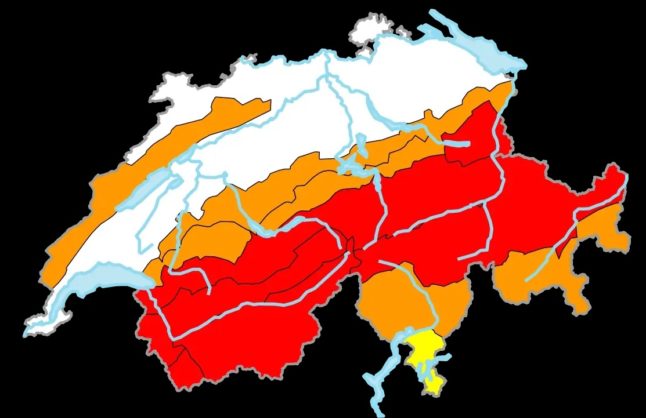
The avalanche risk is expected to continue increasing on Tuesday February 17th, with the danger level of 4 (high) to extend to the entire canton of Graubünden:
SLF
(Red areas indicate ‘high’ danger, orange ‘ considerable’, and yellow ‘moderate’
Staying safe
Each year, dozens of people die in avalanches in the Alps.
The SLF reports that at least 11 people have been killed in avalanche accidents in Switzerland during the current 2025/2026 winter season; by the time you are reading this, even more people could fall victim to these sliding masses of snow and ice in the Swiss Alps.
The common-sense advice is to keep away from unmarked pistes and areas designated as avalanche risks.
These areas are always clearly marked, but you can also do your own homework before you venture out on th slopes.
Advertisement
The best source of this information is the constantly updated Avalanche Bulletin.
Besides giving specific information about risk areas, the bulletin also includes detailed snow maps, including how its depth varies from one area to another.
The Swiss government also gives up to date avalanche information on its own website.
With these sources, you have all the tools you need to ensure your safety in the mountains.


