


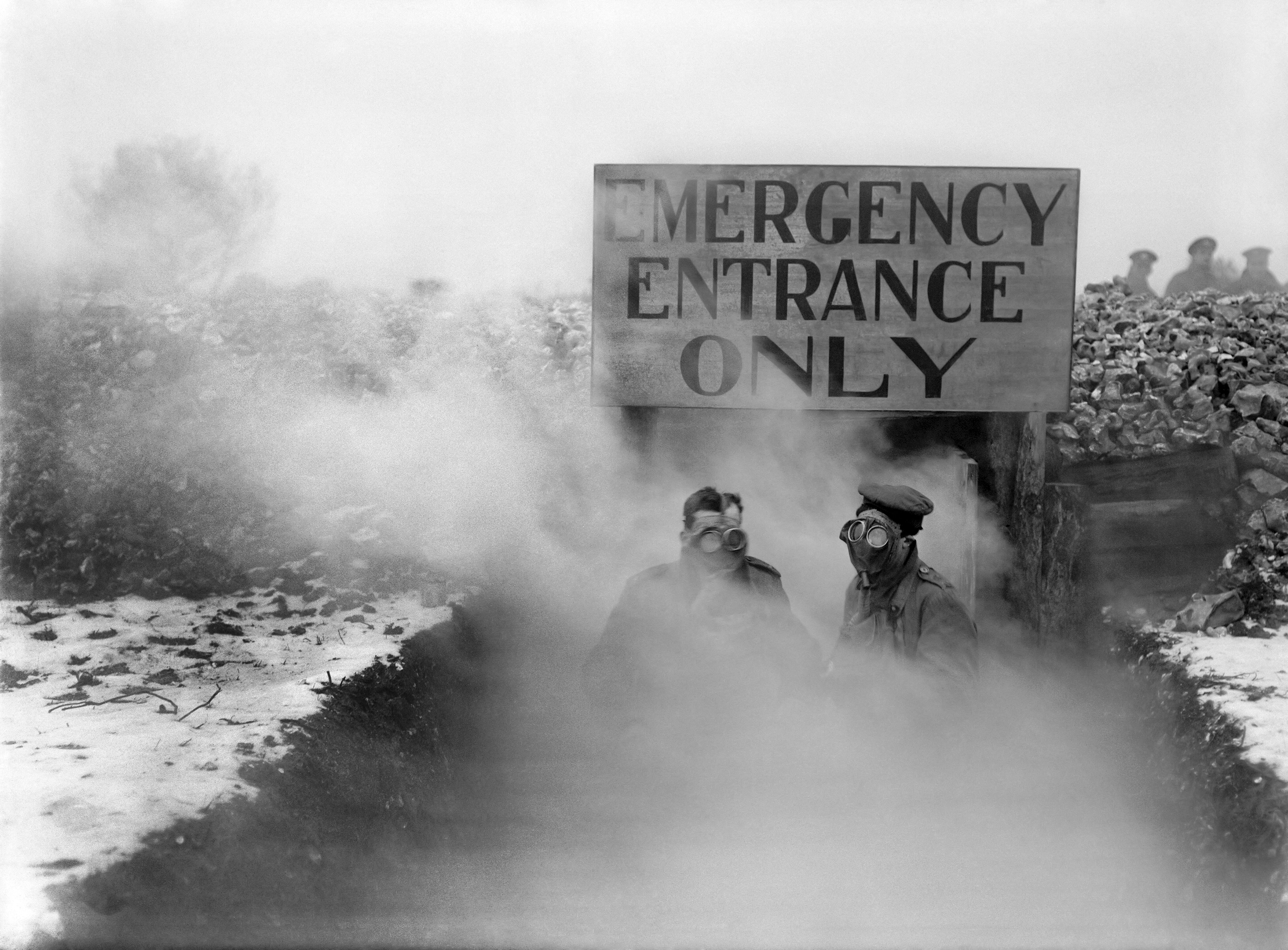
Soldiers wearing gas masks emerging through the deadly fumes of a gas attack with a board in the background proclaiming Emergency Entrance Only.
AFP
Using chemical weapons has long been regarded as overstepping the boundary of acceptable warfare. As early as 1675, France and Germany agreed in Strasbourg to ban poisoned bullets.


Large-scale chemical warfare began on 22 April 1915, when German forces released chlorine gas near Ypres in Belgium, the world’s first use of a weapon of mass destruction. Decades of international efforts to ban such acts culminated in the Chemical Weapons Convention, which entered into force on 29 April 199Large-scale chemical warfare began on April 22, 1915, when German forces released chlorine gas near Ypres in Belgium, the world’s first use of a weapon of mass destruction.
Decades of international efforts to ban such acts culminated in the Chemical Weapons Convention,External link which entered into force on April 29, 1997.

From the Berliner Illustrierte Zeitung in 1916, the caption reading: “Gas attack, photographed out of a Russian aircraft. Published in a British magazine.”
Keystone / Archiv für Zeitgeschichte

First World War gas treatment. A soldier is decontaminated at American Evacuation Hospital No. 2 in Baccarat, France, on 8 June 1918. Chemical weapons were first used on a large scale at Ypres in April 1915, and about 85,000 soldiers died from gas attacks during the war.
Keystone

First World War (1914–1918): Nurses put on gas masks in woods near Couville, Normandy, France, May 1917. Anonymous photograph.
AFP

Blinded by poison gas, soldiers return from battle during the First World War near Béthune, 10 April 1918.
Keystone

Five C-123 aircraft spray chemical defoliant over jungle west of Huế, Vietnam, on 14 August 1968, flying low to strip foliage hiding enemy routes and bases.
Keystone / AP

Nguyen Thi Tai and Nguyen Thi Thuyet sit outside their home in Cam Tuyen, Vietnam, on 5 October 2009. Their family says their severe disabilities were caused by their parents’ exposure to Agent Orange.
Keystone / AP

A napalm strike explodes near U.S. troops on patrol in South Vietnam, 1966.
Keystone / AP

Terrified children, including 9-year-old Kim Phuc, flee a napalm attack near Trang Bang, South Vietnam, 8 June 1972.
Keystone / AP

A Soviet officer displays chemical munitions at the Shikhany weapons facility, Russia, 4 October 1987 — a key site in developing Novichok nerve agents.
Keystone / AP

Iraqi Kurd Ali Haver holds his one-month-old son after a chemical gas attack in Halabja, 17 March 1988, which killed about 5,000 civilians.
Keystone / AP

Laboratory staff in protective suits hold a rabbit injected with an antidote during a demonstration of Russian chemical weapons destruction technology.
Keystone

French Foreign Legion soldiers train in full chemical gear in Saudi Arabia ahead of Operation Desert Storm, 23 October 1990.
Keystone

Bodies lie in rebel-held Douma, Syria, after an alleged chemical attack on 7 April 2018 that killed at least 70 people. Syria and Russia denied responsibility.
Keystone

Army officers remove the bench where Sergei Skripal and his daughter were found in Salisbury, UK, 23 March 2018.
Keystone

U.S. soldiers remove mock chemical agents during a joint drill with South Korea in Paju, 16 March 2023.
Keystone / AP
From the First World War to Vietnam, the Iraqi city of Halabja to Syria and Russia, the following images document more than a century of chemical warfare and its human cost and are a reminder of why the ban exists and what is at stake when it is violated.
Edited by Tony Barrett/ts
More

More


