


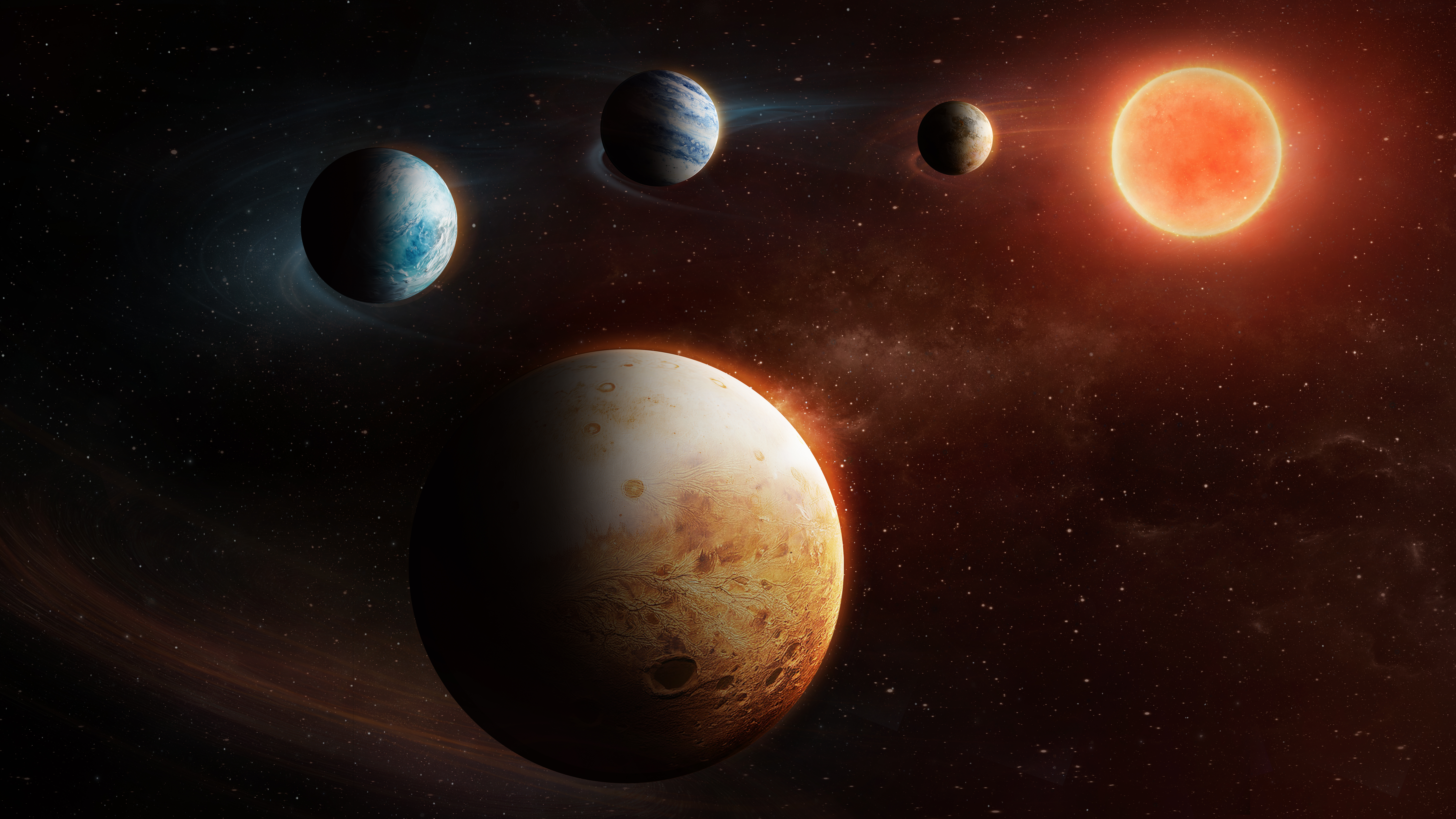
Artist impression of the planetary system around the star LHS 1903
ESA
A rocky planet has been discovered in the “wrong” place by the Swiss space telescope CHEOPS. The find forces scientists to rethink current theories on the formation of planetary systems.
+ Get the most important news from Switzerland in your inbox
Scientists had assumed that planetary systems follow a clear architecture: smaller rocky planets orbit close to the central star, while large gas giants orbit further out.
But the planetary system around a star called LHS 1903, located 116 light-years from Earth, apparently does not follow this order, according to the University of Bern.
Using CHEOPS, the international research team, which includes researchers from the universities of Bern and Geneva, discovered a rocky planet in a location where, according to current theories, a gas giant should have formed. The results were published in the journal Science.
More

More
How a special telescope learns about new planets
To explain this anomaly, researchers first examined various hypotheses that could also be reconciled with established theories. They considered, for example, a collision that might have stripped the planet of its atmosphere, or a subsequent change in its orbit. However, none of these explanations were conclusive.
New theory formed
Instead, the team proposes a new theory. According to this theory, the planets in the system did not form simultaneously, but sequentially. Current theories on planet formation assume that planets in a planetary system always form at the same time.
According to the new theory, the planets around the star LHS formed from the inside out in 1903. The two gas giants in the system’s interior thus formed when the protoplanetary disk was still rich in gas. The outer rocky planet formed much later.
By that time, the gas in the disk had already disappeared, so it could no longer accumulate a massive gas envelope and remained a rocky planet.
According to the University of Bern, this discovery joins a growing number of observations of”strange planetary systems that challenge established theories. The researchers say this shows that our solar system is not a universal model and that the diversity of planetary systems is greater than previously thought.
More

More
Swiss space telescope CHEOPS discovers ‘suicidal planet’
Adapted from German by AI/mga
We select the most relevant news for an international audience and use automatic translation tools to translate them into English. A journalist then reviews the translation for clarity and accuracy before publication.
Providing you with automatically translated news gives us the time to write more in-depth articles. The news stories we select have been written and carefully fact-checked by an external editorial team from news agencies such as Bloomberg or Keystone.
If you have any questions about how we work, write to us at english@swissinfo.ch.


