


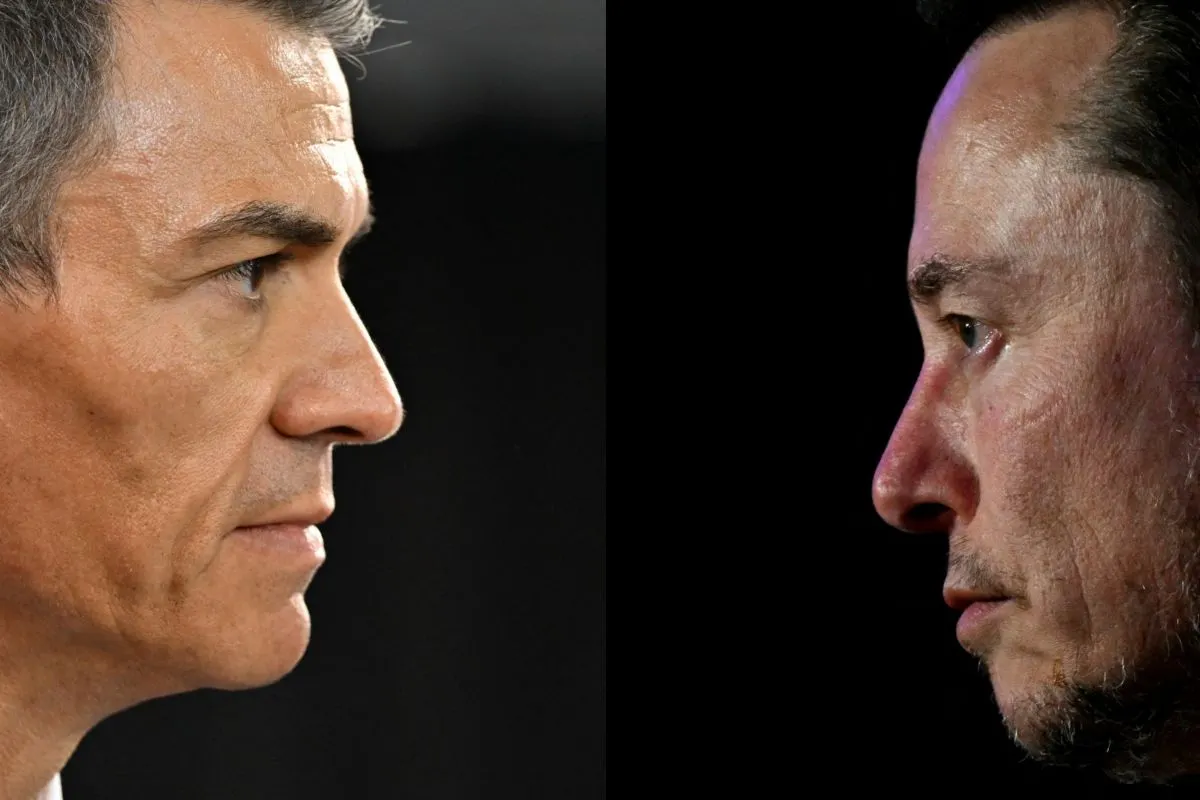
The world’s richest man has called Pedro Sánchez a “tyrant” and a “fascist totalitarian” after Spain’s prime minister announced a planned social media ban for teens. Why is the tech billionaire – and father of 14 children – so opposed to the move?
Tech billionaire Elon Musk has again intervened in Spanish politics, this time in reaction to Prime Minister Pedro Sánchez’s proposed ban on social media for under 16s.
The Spanish prime minister recently outlined proposals for these age restrictions, citing dangers online and safeguarding measures along with potential bolstered legal accountability for platform owners. Brussels, however, has already backed away from the idea until a draft law is produced.
“Spain will ban access to social media for minors under the age of 16. Platforms will be required to implement effective age verification systems, not just checkboxes, but real barriers that work,” Sánchez said when announcing the measure at a summit in Dubai this week.
“Today, our children are exposed to a space they were never meant to navigate alone. Space of addiction, abuse, pornography, manipulation, violence. We will no longer accept that,” he added.
READ ALSO: Spain plans social media ban for under-16s
The Socialist leader also pledged to change Spanish law to make the chief executives of tech platforms “face criminal liability for failing to remove illegal or hateful content”.
READ ALSO: Spain’s clampdown on child YouTubers and parent influencers
Perhaps it was this last part that triggered Musk.
Whatever it was, the world’s richest man quote tweeted a video of Sánchez’s speech, saying: “Dirty Sánchez is a tyrant and traitor to the people of Spain.”
He wasn’t alone in his reaction. Telegram founder Pavel Durov on Wednesday joined Musk in slamming Sánchez over his “dangerous” plan to ban social media for under-16s.
Advertisement
But this is far from Musk’s first foray into Spanish politics, however.
Musk recently reposted a message on X written by a right-wing influencer that described the Spanish government’s mass regularisation of 500,000 illegal immigrants as “electoral engineering”, reacting with the comment: “Wow”.
The post, viewed millions of times, suggests that Sánchez is trying to import 500,000 loyal voters in an attempt to rig democracy.
Last year, Musk even retweeted a post in which US President Donald Trump praised far-right leader Santiago Abascal. Musk’s retweet included the message “Vox will win the next election”.
With these repeated interventions in Spanish politics, one wonders if his dislike is personal with Sánchez. But with this social media crackdown, however, Musk appears to be mixing his professional and personal lives. So, what’s going on here?
Advertisement
Threat to American tech dominance (and bottom line)
In a word: business. Or rather, money. American tech companies, whether Musk’s X or AI companies or defence tech infrastructure, dominate the European market. It’s therefore no surprise that some of its major players are reacting towards Europe’s pivot away from American tech and Washington, politically and militarily speaking.
The extent of European tech dependence is striking. In 2024, European customers spent nearly $25 billion on infrastructure services from the five largest US cloud providers, representing 83 percent of the European market according to the International Data Corporation (IDC).
This not only strengthens American tech supremacy, but it also potentially limits the political autonomy and strategic decision-making capacity of European states dependent on American systems.
In this context, Sánchez’s social media proposals are in keeping with the new logic of European digital sovereignty. It’s not only a child protection policy, but an affirmation of regulatory autonomy against American platforms whose business model is based on capturing attention, data and behaviour from increasingly younger ages.
The owners of these technology companies, such as Musk, have been reacting to regulatory announcements across Europe.
It’s not only Spain. French prosecutors recently searched X’s Paris offices as part of a probe into sexual deepfakes and suspected political interference, summoning the Tesla tycoon for interviews.
READ ALSO: X slams ‘politicised’ France after French prosecutors summon Musk
Advertisement
Limiting minors’ access to social media directly challenges the power of large US technology companies and, above all, their bottom line.
The Spanish initiative reinforces a central idea that this European strategic autonomy, whether online, financially or in terms of military capability, must cater to European interests rather than the commercial incentives of Silicon Valley billionaires close to Washington.
Potential legal consequences
Of course, Sánchez’s proposal also includes potential legal consequences for Musk and other social media barons. One measure could impact him directly, notably legal accountability for their platforms.
“We will change the law in Spain to hold platform executives legally accountable for the many infringements taking place on their sites,” Sánchez has said. “This means that CEOs of these tech platforms will face criminal liability for failing to remove illegal or hateful content”.
Or is it personal?
Then there’s the personal angle. Sánchez is arguably the world’s best known left-wing leader, and he has not been afraid to stand up to Washington or Nato.
Sánchez’s public pro-Palestinian and pro-migration positions have been praised by some by go directly against the right-wing talking points Musk and other ‘tech bros’ subscribe to.
Whether being called a “left-wing icon” in international media or writing op-eds in the New York Times, Pedro Sánchez has for many become the most high profile opponent to American geopolitical dominance and far-right rhetoric.
Advertisement
Sánchez not only stands up to American hegemony but the corporate interests underpinning it, something that makes him an easy target.
There’s also some delicious irony to Musk’s criticisms of the proposed social media ban. Just a few short years ago, the mogul himself stated in an interview that it “might have been a mistake” not to regulate his own children’s social media use, exactly what the Sánchez ban is trying to do.
“I think, probably, I would limit social media a bit more than I have in the past and just take note of what they’re watching, because I think at this point they’re being programmed by some social media algorithms, which you may or may not agree with,” he said.
“So, I think one needs to supervise one’s children’s views of social media and be wary of them being programmed by some algorithm.”
READ ALSO: Spain’s clampdown on child YouTubers and parent influencers


