

Being able to speak one of Switzerland’s national languages is a must for a number of companies, sectors, and positions. But how you go about learning it matters more than the certificate you get, one expert explains.
The State Secretariat for Migration (SEM) requires a certain level of proficiency in one of the national languages to obtain a work permit, permanent residence status, and citizenship:
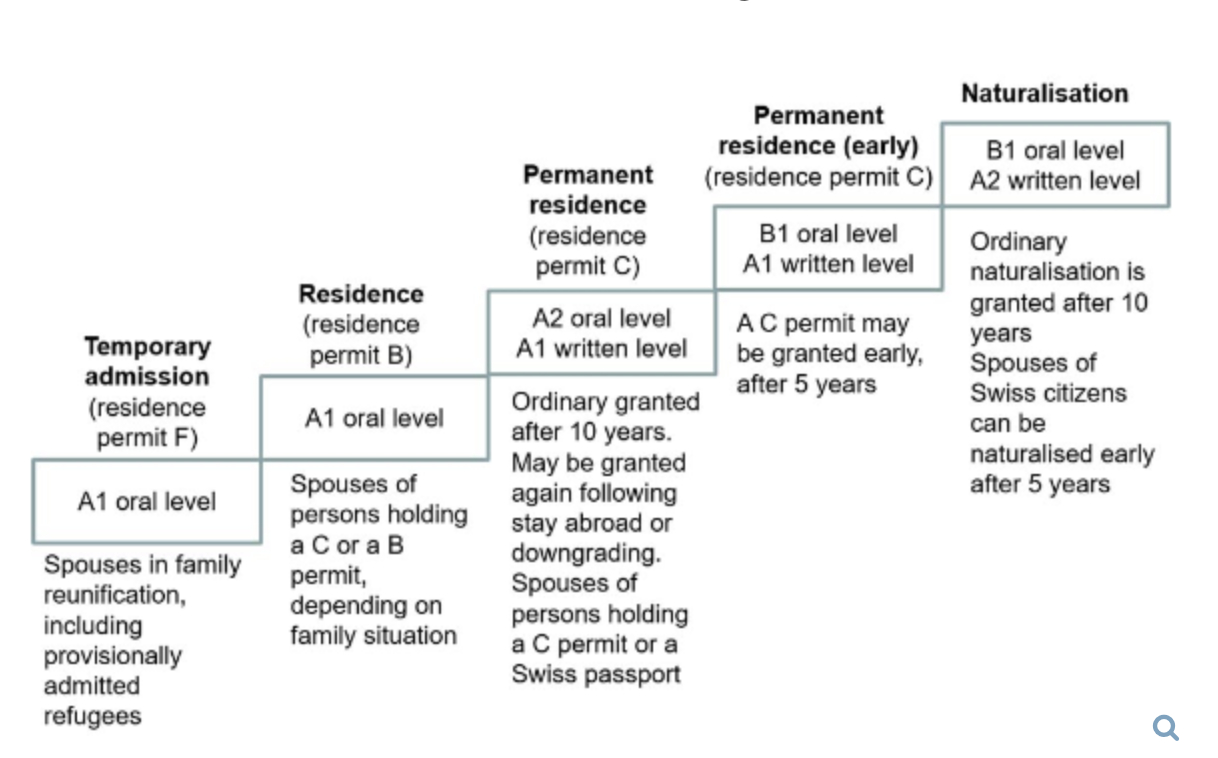
SEM
But will attaining a required level actually allow you to communicate easily and effectively in the German, French, or Italian-speaking work environment?
Many foreign nationals report that even though they have passed the SEM-certified language exams, they still have difficulties conveying their thoughts clearly during a business meeting or even in informal conversations with native speakers.
Why is that?
Academic versus performative
Most of us have heard people say (or maybe you said it yourself) that they had X years of X language at school, but they still can’t string a coherent sentence together.
The main reason for this phenomenon is that language instruction at many schools in many countries is oriented heavily toward learning grammar, tenses, and sentence structure, while ignoring active speaking skills.
And the same approach is also common in language schools – including those in Switzerland.
This method works for passing tests, but not for real-life situations.
Advertisement
Whether in business or social life, “language isn’t academic, it’s performative,” Eveline Rosa, founder of XLINGUA, a Zurich-based language learning startup, tells The Local.
And though purists may disagree, in reality language training for career purposes should not be based on perfect grammar, she said.
“After years inside traditional language schools, I realised that many highly qualified expats pass German exams but still lose promotions, leadership opportunities, and social integration because they freeze when speaking under pressure.”
At least part of the blame is due to the structure of typical language lessons – both physical and online ones, Rosa noted: “Big classes, grammar-heavy curricula, and passive learning. That works for passing tests, but not for high-stakes speaking moments like meetings, negotiations, or networking.”
Therefore, attaining a language level mandated by SEM and taught in schools “creates a false sense of readiness,” Rosa says. “People realise too late that certificates don’t equal performance.”
For instance, she points out that B2 proficiency level is “the most expensive lie.”
That’s because “people are told that when they reach that level, they will be fluent.”
In reality, however, “many professionals reach the B2 level, get promoted, move to Switzerland and then discover they still freeze in meetings and daily interactions.”
But there is a “hidden career cost” for foreign professionals in Switzerland and for job opportunities that may not come their way, she says.
“Many highly qualified expats pass German exams but still lose promotions, leadership opportunities, and social integration because they freeze when speaking under pressure,” Rose says.
“People realise too late that certificates don’t equal performance. Careers stall, integration slows, and confidence drops,” she says.
Advertisement
Tongue-tied no longer
For foreign nationals who want to build a successful career in Switzerland (whose native languages are not German, French, or Italian), these three tips are “critical to bridge the language gap,” Rose says.
Don’t wait to speak perfectly
Forget textbook grammar at first and focus on communication. “The goal is to break the psychological barrier, not to ace a grammar test. Choose a learning environment where speaking from day one, in the target language, is the priority.”
Train for real situations, not textbook language
Practice for what you will actually face: meetings, feedback sessions, presentations, and small talk. “Context-based learning builds automatic responses—exactly what you need under pressure. You’re learning the language for life, not for a classroom,” she says.
Advertisement
Learn the cultural layer
In Switzerland, you navigate High German (or French or Italian) at work, a dialect socially, and nuanced communication norms everywhere.
“Mastering these layers builds trust and creates true leadership presence.”
READ MORE: Is it now more important for foreign job seekers to speak a Swiss language?


