


The organist Edmond Voeffray is responsible for the group of certified organists in Valère.
Céline Stegmüller / SWI swissinfo.ch
The organ at Notre-Dame de Valère cathedral in Sion dates back to the 15th century, making it the oldest playable organ in the world. Spared by fire and war, it still attracts enthusiasts from all over the world.
Standing majestically on top of a hill, the Basilica of Notre-Dame de Valère, a former residence of canons, dominates the city of Sion, the capital of canton Valais, southwestern Switzerland. Here, history unfolds in a mystical and sacred geography.
Built in the 12th century, Notre-Dame holds a treasure: the oldest playable organ in the world. This instrument, which dates back to the 1430s, owes its survival to what might be called a miracle.
Restored and embellished over the years, like the basilica that houses it, it is the object of international curiosity. “If I say I’m from the Valais, people will say, ‘Ah, Valère’,” says Edmond Voeffray, organist at Notre-Dame and co-author of the guide published by Swiss History of Art Society last August under the title “Les orgues du Valais: itinéraire d’un patrimoine vivant” (The organs of the Valais: a living heritage itinerary).
Manufacturer unknown
Canton Valais has 250 organs. The guide highlights 20 of them, witness to 600 years of history. Among the 20 highlighted is the Valère organ, of course, which catches the eye of readers and visitors alike.
“It’s the destiny of this organ that makes it an exception in Switzerland, and even beyond our borders. It has a Burgundian tradition, but we don’t know who made it. We have few records on the subject,” Voeffray explains.
“What we do know is that it was saved from fire, along with the basilica, by a meteorological factor: the wind direction that spared the hill of Valère, but destroyed Sion, during a fire at the end of the 18th century.”
The organ was spared by the flames, but also by the wars and internecine divisions that ravaged Europe. “Especially the French Revolution, which led to the destruction of many churches and their organs. Switzerland also suffered, but access to the hill of Valère was very difficult at the time, which in a way protected the basilica and its works of art,” he says.
The organ’s heritage value is not limited to its age. It is also iconographic. With its two panels, one to the left and the other to the right of the pipes, the organ reflects a part of the Christian faith. On the left, the mystical marriage of Saint Catherine, patron saint of Valère. On the right, Mary Magdalene meeting the risen Christ. The author of these paintings was Peter Maggenberg (c. 1380-1463) from Fribourg.

In 2022, the organ was tuned to mean-tone temperament, a distinctive feature of this instrument.
Céline Stegmüller / SWI swissinfo.ch
The Carlens and the Walpens
The Germanic countries have a great organ tradition. “That said, the Protestant Reformation in our country did a great deal of damage to organs, going so far as to describe them as the ‘devil’s bagpipes’. Worse still, Calvin and Ulrich Zwingli had organs destroyed in Geneva and Zurich respectively,” Voeffray says with regret.
More
More
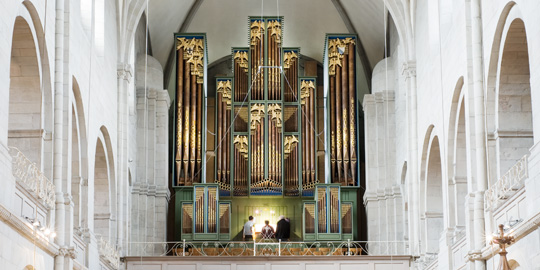
The organ that went back to the future
Valais, a very Catholic canton, saw organ building flourish, particularly at the dawn of the 18th century. Two Valais families, cousins of each other, distinguished themselves in this field: the Carlens and the Walpens. They “took on almost all the orders and established a genuine Valaisan tradition, which was exported as far as Savoy and neighbouring Italy”, according to the guide. The Carlen dynasty continued to operate across the Atlantic in Chicago, where one of its descendants had settled. It ended in 1960.
That same year, Hans-Jakob Füglister from Zurich founded the Fuglister organ factory in Arbaz, above Sion. To this day, it enjoys an international reputation for restoring old instruments and building new organs.
Religious and secular scores
Numerous faithful and visitors of all nationalities flock to Notre-Dame, attracted in particular by the organ. An International Valère Organ Festival was created in 1969. Every year, it welcomes numerous fans.
“During the festival, we receive requests from organists from all over the world who want to perform here,” Voeffray says.

Every year, the Basilica of Valère welcomes an international audience for its organ festival.
Festival international de l’orgue de Valère
What kind of music does he play on the organ, secular or sacred? “The boundary between the two remains blurred,” he replies, citing Mendelssohn’s “Wedding March”, often performed at church weddings. “People think it’s religious music, but Mendelssohn composed it for a performance of Shakespeare’s A Midsummer Night’s Dream,” he explains.
Almost all the great European composers, especially those of the 17th and 18th centuries, were organists. But not all of them wrote exclusively religious scores. “In Switzerland, organ composers are contemporary. It’s difficult to find them if we go back in time. When I want to play music from the Valais for organ, I have to look for it in the 20th-century repertoire,” Voeffray says.
More
More
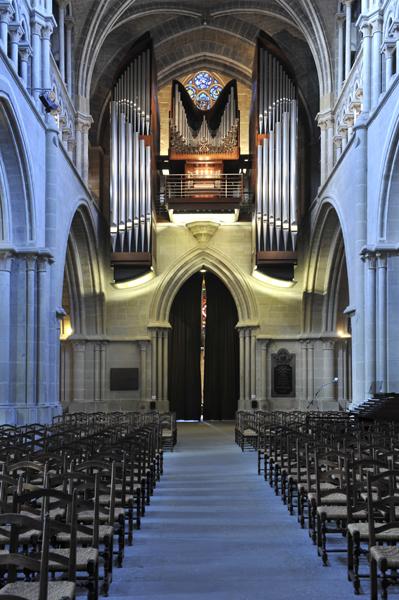
Lausanne organ pulls out all the stops
Edited by Samuel Jaberg. Translated from French by AI/ts
How we translate with AI
We use automatic translation tools, such as DeepL and Google Translate, for some content.
Each translated article is carefully reviewed by a journalist for accuracy. Using translation tools gives us the time for more in-depth articles.
Learn more here about how we work with AI.


