


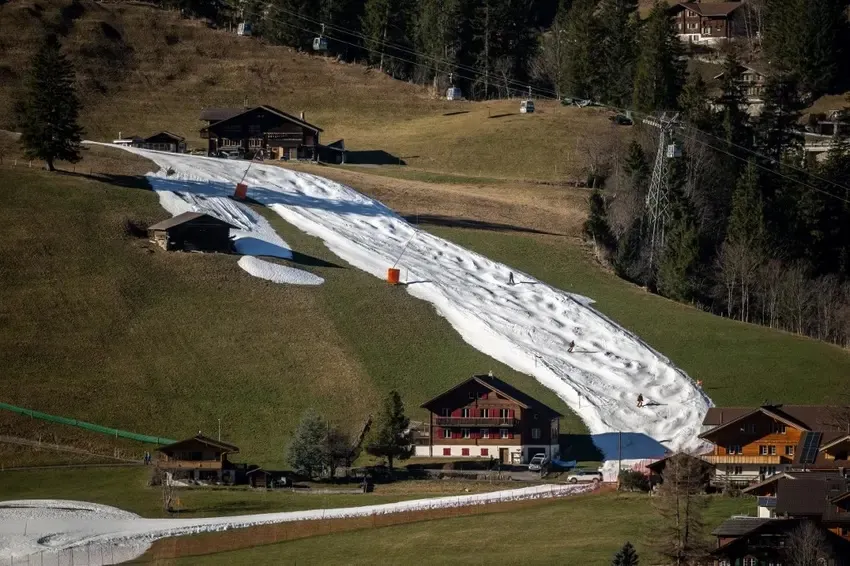
The climate crisis is hitting Switzerland particularly hard, and the situation will deteriorate further, a government study reveals.
According to the Federal Office of Meteorology and Climatology (MeteoSchweiz), climate warming is proceeding twice as fast in Switzerland as the global average.
United Nations data also shows that Switzerland is among the world’s fastest-warming nations.
The reason is that Switzerland is landlocked so it doesn’t benefit from the buffering effect of the oceans, which are able to absorb large amounts of heat.
READ MORE: Why is Switzerland warming faster than most countries in the world?
What does the future look like?
In its study, carried out jointly with scientists from the Federal Polytechnic Institute in Zurich (ETH). MeteoSchweiz forecasts these scenarios:
More extreme heat
“Heat events such as hot days and tropical nights will become even more frequent and intense in the future,” the study says.
The effects will be most felt at low elevations – that is, below 1,000 metres.
“In urban areas, the effects of climate change will be further intensified due to the ‘urban heat island effect’,” .when a city’s temperature is significantly warmer than its surrounding rural areas.
Advertisement
Drier summers, more droughts
“A summer drought currently expected once per decade would occur every three years,” the study found.
This would cause water deficits to intensify by approximately 44 percent.
“As a result of further drying and rising temperatures, a significant increase in fire hazards is also projected-“
More frequent and intense heavy precipitation
This phenomenon is expected to occur – on daily and even hourly basis – in all seasons.
Therefore, there will be more incidents of flash floods, and “stronger thunderstorms are expected to lead to more hail events,” the study found.
Advertisement
Less snow and a higher zero-degree line
Natural snow covers at low elevations will continue to decrease in the future as a result of increased warming.
The expected rise in temperatures will also lead to a more intense snow melt.
“This will significantly shorten the duration of the snow season, especially at low and medium altitudes.”
Advertisement
What about the glaciers?
Switzerland’s glaciers, which are disproportionately impacted by climate change, have already lost a quarter of their volume in the past decade, sparking concerns over accelerating melting.
Faced with this scenario, scientists are sounding the alarm, warning that Swiss glaciers could all but disappear by the end of this century without more action to rein in global warming.
READ MORE: Switzerland’s glaciers shrink by a quarter in just a decade


