

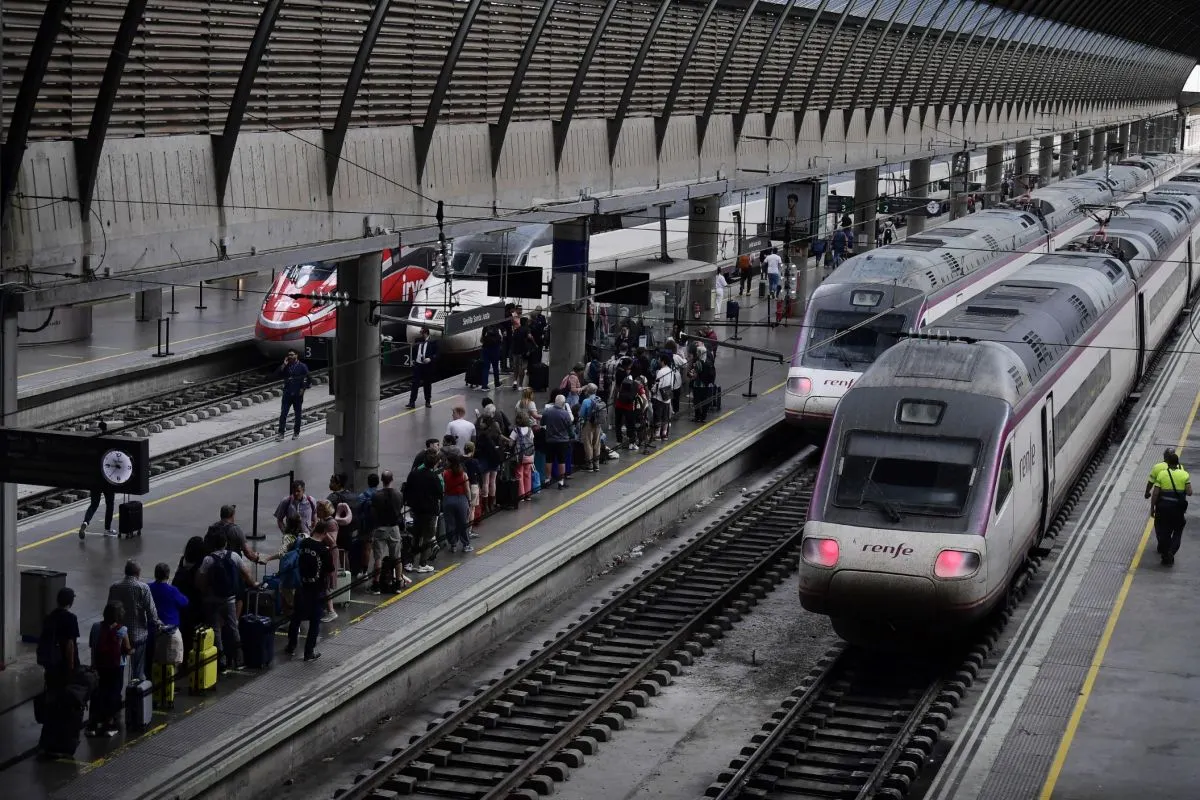
Following news of the high-speed train crash near the Spanish city of Córdoba on Sunday night, many people have been asking the same question: How safe really is train travel in Spain?
Spain has the largest high-speed rail network in Europe and the second-largest in the world after China.
Its nearly 4,000 km of track connecting major Spanish cities at speeds of up to 320 km/h have made it highly regarded internationally.
Spain’s state-owned rail company Renfe reported its highest recorded travel volume to date in 2025, with a total of 37.3 million passengers on high-speed trains. The number of passengers is much higher when including all Renfe trains (commuter, mid-distance etc): 537 million in 2024. The vast majority of these had no incidents at all.
Spanish authorities have been attempting to incentivise train travel among Spaniards through discounts, but the larger volume of travellers has come with more breakdowns and cancellations.
However, there are fears that January 18th’s deadly train collision in Córdoba, which killed at least 39 people, will have a more long-lasting negative impact on train travel in Spain.
Following the incident, Pedro Gómez, railway secretary for UGT union in Andalusia, insisted that “the train is a safe mode of transport, but when a lot of things go wrong at the same time a tragedy can happen”.
Advertisement
He also assured passengers that the accident is being investigated and they are making sure that it never happens again.
Andalusian regional president Juanma Moreno echoed Gómez’s words when saying “we shouldn’t fear train travel”, “high-speed train travel is safe”.
READ ALSO – Q&A: What we know about the cause of Spain’s deadly train collision
Sunday’s collision was the worst rail accident in Spain since 2013, when an Alvia train connecting Madrid with Ferrol went off the rails in Angrois, near Santiago de Compostela in Galicia (northwest Spain). A total of 80 people died and another 145 were injured. It was also the sixth worst rail accident in Europe since 2000.
In the last 10 years since 2016, there have only been a total of six train crashes in Spain in which one or more people died.
In 2016, four people were killed when a train derailed in the town of O Porriño in Galicia.
In 2018, one person died and more than 40 were injured, when a commuter train derailed in Vacarisses near Barcelona.
READ ALSO: How has the Andalusia train crash affected rail in Spain?
Advertisement
Then in 2019, a commuter train and a regional train collided head-on in Castellgalí (Barcelona), causing one death. Approximately 100 people were injured, three of them seriously.
In 2020, two people died near Zamora after the rain ran over the vehicle on a level crossing, while in 2022, one person lost their life during a collision between a freight train and a passenger train near Barcelona.
Therefore, it’s important to keep in mind that of the hundreds of millions of passengers using Spain’s rail network every year, only a handful are ever involved in serious accidents.
When compared with other EU countries, Spain comes nowhere near the top of the list for the number of rail accidents in 2024 – the year in which the latest stats are available for.
Germany registered 366 accidents, the highest number of railway accidents among the EU countries, followed by Poland with 220. Together those two countries had than one-third of all significant railway accidents in the EU in 2024. France recorded 140 accidents, Italy 103 and Romania 90.
When it comes to the number of rail deaths per thousand kilometres of railway tracks, a total of five EU countries registered four or more deaths in 2024. Spain was one of the five countries that registered one or less fatality per thousand kilometres of railway tracks.
Advertisement
Having said that, the rail crash in Galicia in 2013, remains one of the deadliest in Europe in the last 20 years. An investigation after the tragedy, revealed that the train was speeding, travelling at 179 km/h along a stretch of track with an 80 km/h speed limit.
Spain was also home to one of the worst underground metro accidents in Europe, when a metro train derailed in 2006 in Valencia. The accident killed 43 people and left 47 injured.
READ ALSO: The 2006 Valencia metro crash you’ve probably never heard of
Travelling both by train and metro in Spain is still much safer than travelling by road.
For example, Spain’s General Directorate of Traffic (DGT) confirmed that there were 1,028 deaths on the roads in 2025 alone and 4,926 injuries which required hospitalisation.
Spain also pumps billions into upgrading and maintain its vast network, expected to €24 billion from 2022 to 2026. In fact, it had recently invested €700 million in the line Madrid-Andalusia line where the accident occurred on Sunday, the oldest of all high-speed tracks in the country.
This was done to ensure the infrastructure remains at the forefront of technology and offers the highest standards of quality and reliability.
Renfe and Adif – Spain’s rail infrastructure manager – are also in the process of changing over to the new ERTMS 2 signalling system, which is the standardised system used on the rest of the rail networks in Europe, and which the EU has asked Spain to migrate to. It is also currently the most advanced system in the world, according to Spain’s Transport Ministry.
This shows that Spain is committed to rail safety and is constantly updating and improving its network, which puts it in good standing moving for forward.


