


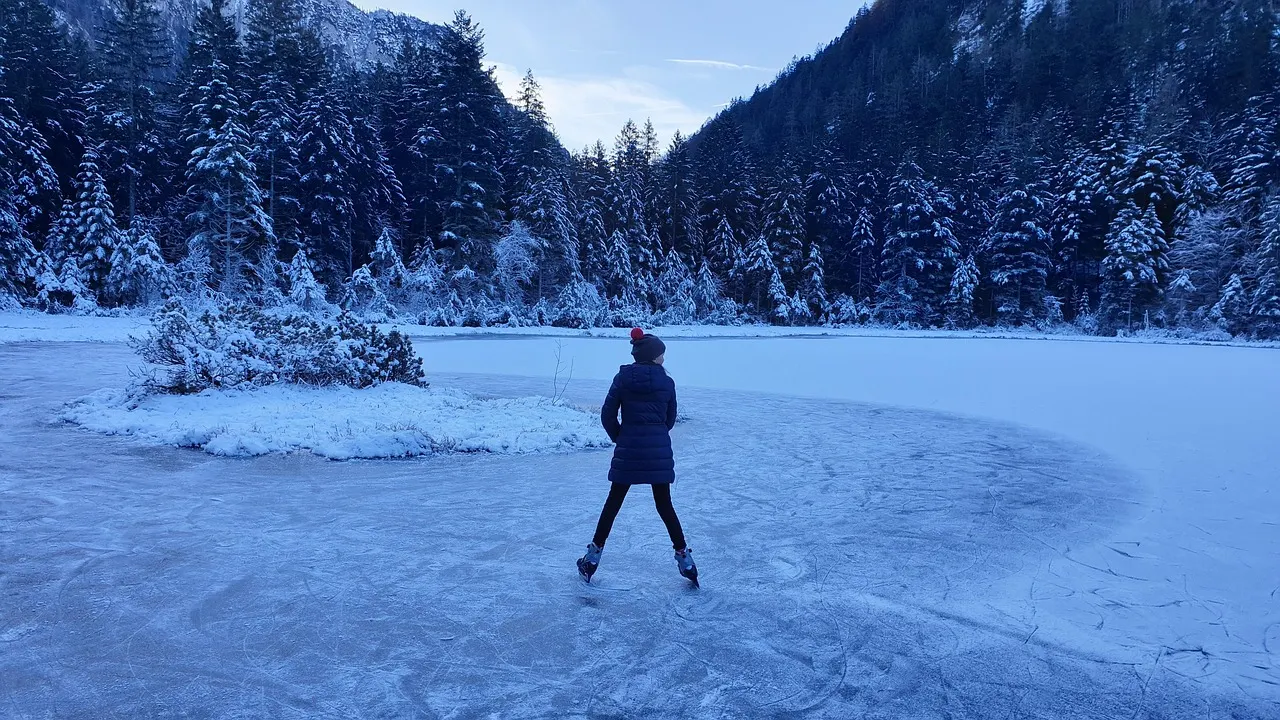
When the temperature falls below zero and the water in some Swiss lakes turns to ice, you may want to put on your skates, or just stroll, on the frozen surface. But can you?
In terms of laws and regulations, Switzerland is somewhat of a paradox: on one hand, there are a multitude of rules (both written and not) about what is allowed and what isn’t.
On the other, many practices that are outlawed – or at least regulated – in other countries, are not subject to any rules in Switzerland.
This is also the case with skating and walking on frozen lakes: the decision about whether to do so or not is left entirely up to each individual.
There are, however, some safety guidelines in place, which are the responsibility of municipaities where a given lake (or a section of a lake) is located.
How does this work in practice?
Depending on the stability of the frozen surface (read more about this below), a municipality will either not issue alerts about the safety of skating or walking on the ice, or will post signs about dangers.
These advisories may change depending on the temperature and other conditions – in other words, skating and walking could be allowed at certain times, and not at others..
For instance, walking and skating on the Lac de Joux in Vaud is often allowed. Right now, however, local authorities in the Vallée de Joux, where the lake is located, are warning the public and visitors against doing so.
“In some places, a thin layer of ice currently covers the lake, but it is not solid at all,” the signage says. “It is strictly forbidden to venture onto it, whether on foot, skates, or any other means, as there is a risk of immediate collapse.”
It goes without saying that whenever and wherever such a sign is posted, you should definitely not…walk on the thin ice.
Advertisement
Use your common sense and judgement
Even if no warning is in effect, remember to take precautions before stepping onto the frozen surface.
According to the Swiss Alpine Club (SAC), first “it is essential to assess the ice’s solidity. If water is still visible in a particular spot, it’s best to avoid it.”
“For a crossing to be safe, the lake must be completely frozen; no water should be visible.”
And this brings up a legitimate question: how thick should the ice be to be considered safe?
That depends on how many people it should safely hold.
SAC’s rule is 10 cm for a walk, 15 cm for skating individually, and 20 cm for group skating.
Advertisement
The higher the better
The altitude at which the lake is located is also an important consideration.
As temperatures are lower in the high Alps, the ice cover on the water will typically be thicker and more solid there than at lower elevations.
However, always remember that you are stepping onto the frozen lake at your own risk and peril.
Even in the absence of warnings, making a real-time assessment of the situation is crucial. For instance, if there are cracks in the ice, or the temperature is warming up, then it’s a sign that you should not venture onto the lake.
Advertisement
Caution is all the more important because accidents do happen on frozen lakes.
In early January of 2026, for instance, hundreds of walkers and skaters had taken to the frozen Lake Constance – even though the access to the lake had not been officially authorised as the ice cover was not consistently solid.
Three people fell through the ice in the space of about 30 minutes – all of them were rescued, though they suffered from hypothermia.
In response to this incident, local police said that everyone stepping onto the frozen lake “is responsible for themselves”.


