


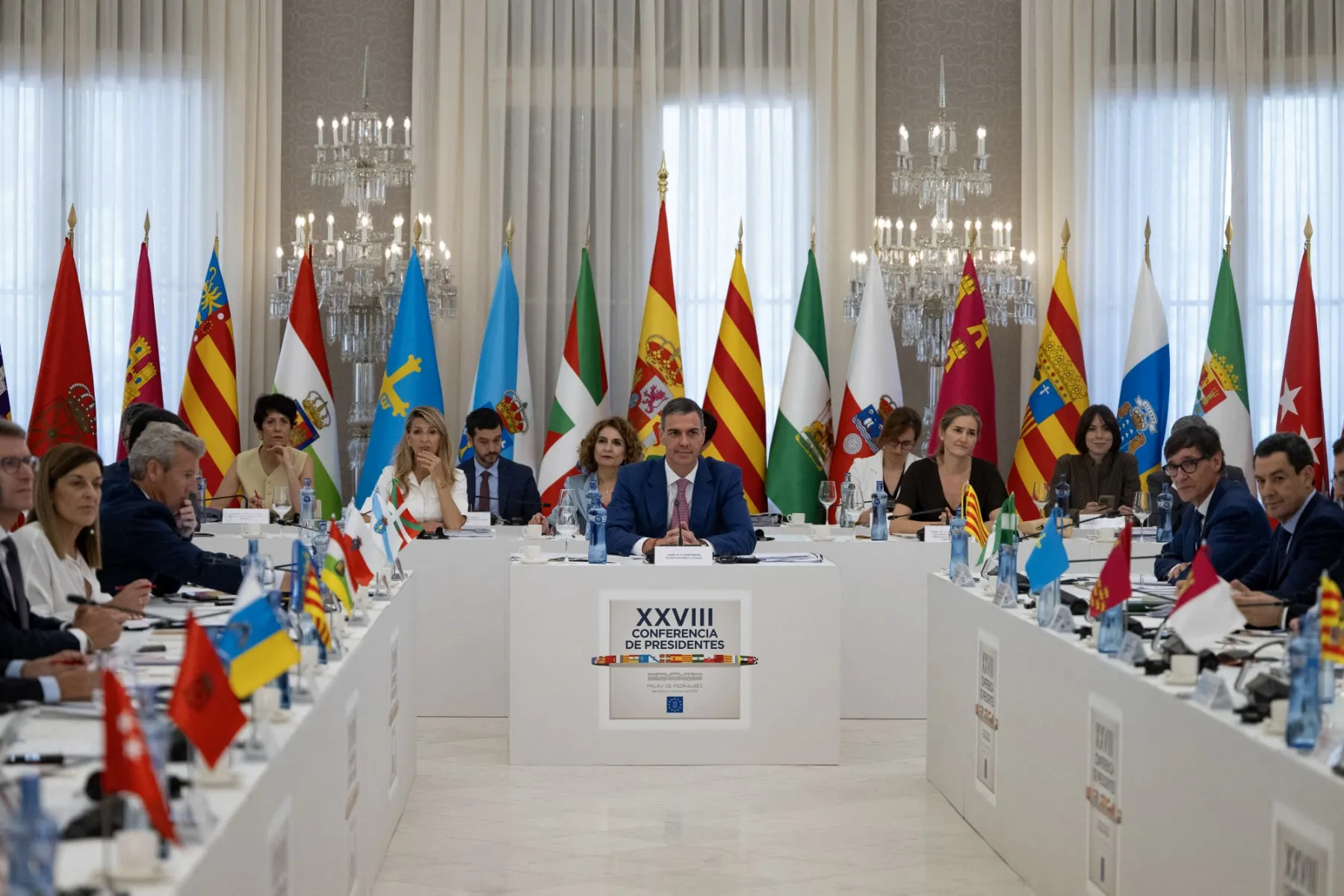
Proposed reforms to Spain’s regional financing system have angered regions across the country, and yet Pedro Sánchez’s government is confident it can pass the legislation in Congress.
Spain’s newly proposed regional financing system not only injects billions of euros into regional governments but has also revealed underlying political tensions in the country, especially the ruling Socialist (PSOE) government’s dependence on Catalan separatist parties in Congress.
The reforms have also been roundly rejected by several regional barons, including even in the PSOE governed regions, who accuse the government of pandering to separatists and favouring Catalonia.
The government is nonetheless confident it will be able to get the law through Congress on the back of its fragile majority.
What is it?
Spain’s Finance Minister, María Jesús Montero, recently presented the proposal for a new regional financing model, which sets out new criteria for the distribution of public resources among Spain’s 17 autonomous communities.
Essentially the Spanish government wants to reform the system that hands out public funds to regional administrations. The model is based on a funding model negotiated with Catalan pro-independence party ERC to bring Catalonia’s fiscal “singularity” in line with fiscal solidarity across Spain.
It is estimated to contribute an additional €20.975 billion in 2027, the year when it’s expected to come into force, compared to what regions would get if the current model were to remain in place.
Between the regions, the amount to be distributed in 2027 is estimated at almost €225 billion. In 2023, the last year with full records, the regions received £152.484 billion.
The reforms attempt to update the rules in so-called “common-regime” regions, which includes all besides the Basque Country and Navarre, both of which have bespoke fiscal arrangements with Madrid.
Advertisement
Why is it controversial?
Essentially because other regions feel that Catalonia is given special treatment, but also because the row renews underlying political divisions in Spain. The harshest critics of the Sánchez government suggest this is a pay-off to ensure Catalan parties back it until the end of its term in 2027.
All regions except Catalonia, which includes those governed by the opposition Popular Party (PP) but also PSOE-run regions of Castilla-La Mancha and Asturias, have criticised the model.
The Andalusian Minister of Finance, Carolina España, stretched a culinary analogy as far as she could in her criticism of the proposed reforms.
In her opinion “Montero wants to give champagne and caviar to the independence movement, and to the rest of the regions and Spaniards, a menú del día but without dessert and, what is worse, a menu that is pre-cooked by the independence movement”.
Does the model favour Catalonia?
In some ways, yes. If passed, €20.98 billion would be earmarked for Spain’s regions and Catalonia would get around €4.7 billion of it, around 22.4 percent.
However, that’s slightly less than the €4.84 billion Andalusia would receive.
It is still significantly more than many other regions, however, such as Castilla-La Mancha (€1.248 billion) and Galicia (€587 million).
Some Catalans have even acknowledged that the new funding model favours them, but argue that the reforms are needed to compensate for historic underfunding.
Catalan Minister of Economy and Finance, Alicia Romero, said recently that the financing proposal is advantageous for Catalonia, given its historic “underfunding” but insisted that with the proposed scheme “everyone wins”.
Romero also pointed out that the regions governed by the PP will receive around 70 percent of the €21 billion set aside.
Advertisement
What about the politics here?
That the model is based on an ERC proposal means it’s viewed by opponents of the government as another capitulation to Catalan separatists and reinforces the idea that the Sánchez government is essentially being held hostage by parties that don’t even want to be part of Spain.
For the PP, the new finance system simply adds to the long-standing narrative that Sánchez is beholden to nationalist parties and a lame duck President clinging onto power.
Even the PSOE president of Castilla-La Mancha, Emiliano García Page, has joined in the criticism, portraying the government as in cahoots with Catalan separatists at the expense of his region: “It’s outrageous that [ERC leader Oriol] Junqueras knows more about the financing of Castilla-La Mancha than I do,” he said in a recent press conference.
Critics would point out that Page has been a long-term critic of Sánchez. Cynics might suggest the criticism is political positioning for control of PSOE in a post-Sánchez party, something widely expected after the next general election in Spain.
Advertisement
Will it pass the Spanish Congress and become law?
Despite the widespread opposition, the proposal could likely still become law.
When appearing at Spain’s Fiscal and Financial Policy Council (CPFF) recently, Montero employed a crafty political trick that may force opposition parties to ultimately back the proposal.
During her appearance, the Minister clarified that the new model will be voluntary, meaning that each region can decide whether to join the new regime or stick with the old one. The trap, however, is that all regions do stand to gain from the new model, some greatly, such as Valencia or Andalusia, which will gain more than Catalonia, and it will therefore be very difficult for the PP-governed regions to justify giving up that money.
Similarly, government sources quoted by Spanish daily El País note that the other major Catalan separatist party that the government’s investiture majority requires, Junts per Catalunya, might also be forced to back the bill despite its scepticism.
The government believes that Junts will, if its vote is decisive, back the reform because not doing so would mean missing out almost €5 billion for Catalonia, something that would likely have a high political cost.


