


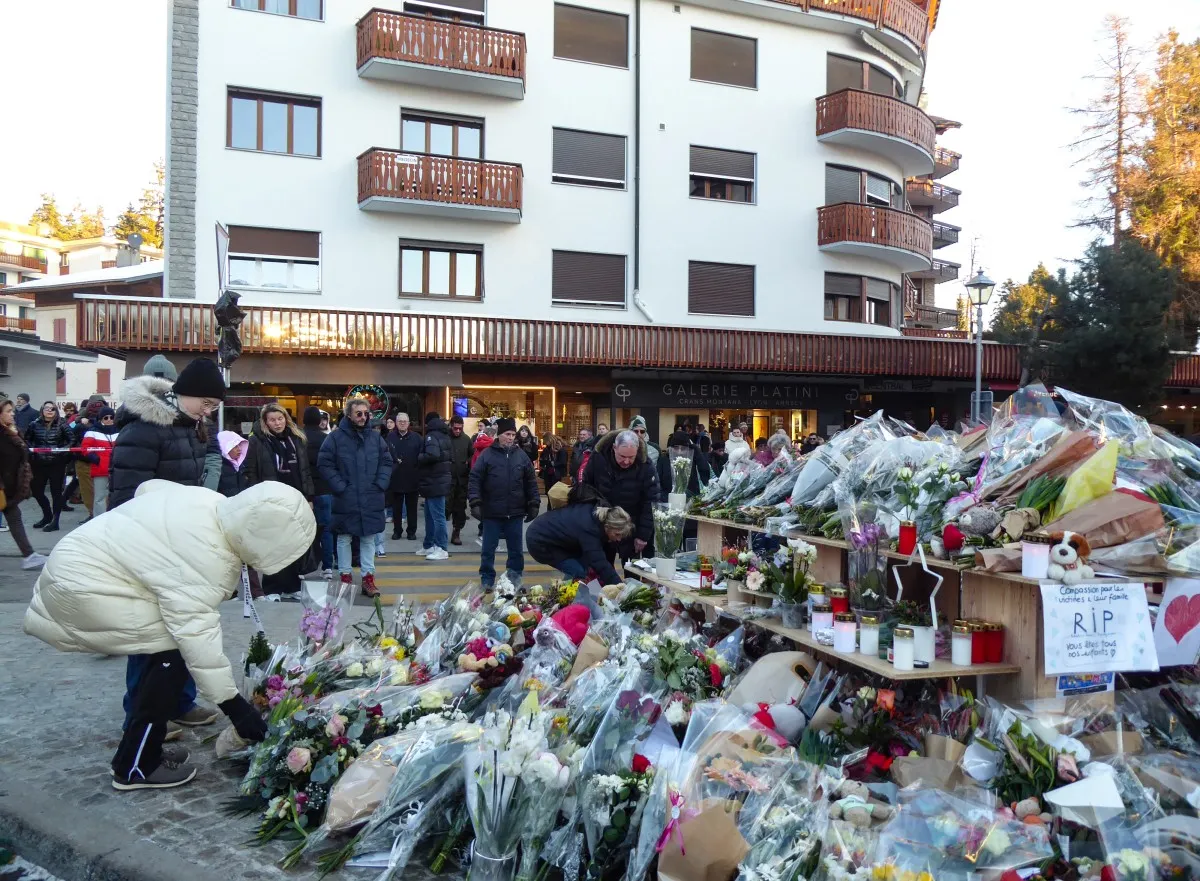
Forty people were killed, mostly teenagers, when Le Constellation bar’s basement caught fire as young people celebrated the New Year early Thursday in the ski resort of Crans-Montana.
Another 116 people were wounded, many seriously burned, after soundproofing foam on the ceiling caught fire.
Alain Macaluso, director of the Centre for Criminal Law at the University of Lausanne, told AFP there were “serious concerns” about aspects of the investigation.
QUESTION: Are the proceedings by the Valais cantonal prosecutors in line with Swiss norms?
ANSWER: “I don’t have access to the case file, but several aspects are initially surprising.
“The first thing surprising many people is that the managers have not been arrested.
“The first few hours after a tragedy are crucial for preserving evidence, notably to prevent the risk of collusion. Detention, even for a short time, allows investigations to take place without interference.
Advertisement
“Another aspect is the apparent lack of searches. In such cases, it is essential to quickly conduct searches of company premises, the managers’ homes, and the relevant municipal services. One cannot simply wait for documents to come forward.
“Finally, it seems some plaintiffs, despite having filed their claims, were not invited to attend the hearings.
“The arguments advanced to justify their absence — speed or fear of leaks to the press — are unconvincing.
“All of this raises serious concerns. In a case of this magnitude, there is an absolute need for transparency, respect for procedural rules, and confidence in the justice system.”
Q: The bar owners have been charged with manslaughter by negligence, bodily harm by negligence and arson by negligence. Are these appropriate charges?
A: “These charges are correct, but they are likely to change as the investigation progresses.
“Some information has emerged thanks to journalists and social media, notably a 2019 video showing a waiter warning of a risk related to the acoustic foam.
Advertisement
“If it emerges there was a heightened awareness of the dangers and a high probability of an accident, we could move beyond simple negligence and into a form of intent.
“This could lead to much more serious charges, such as manslaughter, grievous bodily harm or arson. This does not prejudge the guilt of those involved, who are fully entitled to the presumption of innocence, but the investigation must also explore these avenues.”
Q: Do the penalties for the current suspected offences seem relatively light?
A: “They do. Manslaughter by negligence carries a maximum sentence of three years, but in practice, Swiss courts rarely impose sentences close to the legal maximum. They often result in suspended fines.
“But in the case of intentional offences, the scale changes completely. For a crime such as murder, the minimum sentence is five years and can go up to 20 years.”
Q: Can a criminal investigation be launched against the Crans-Montana municipality, which on Tuesday admitted that annual fire safety checks had not been conducted at the bar since 2019?
A: “In Switzerland, the municipality, as a public entity, cannot be subject to a criminal investigation.
“However, individuals — employees, administrative officials or politicians — may be held criminally liable.”
Q: Are there any statute of limitation issues, given that the bar was last renovated in 2015?
A: “The statute of limitations generally runs from the moment the perpetrator acts, not when the result occurs. Therefore work carried out in 2015 could be time-barred even if the consequences only become apparent much later.
“There may be ongoing liabilities, particularly for those in a position of responsibility, whose obligation to prevent damage continues.”
“In this case, the limitation period only begins to run from the end of holding this position.”


