


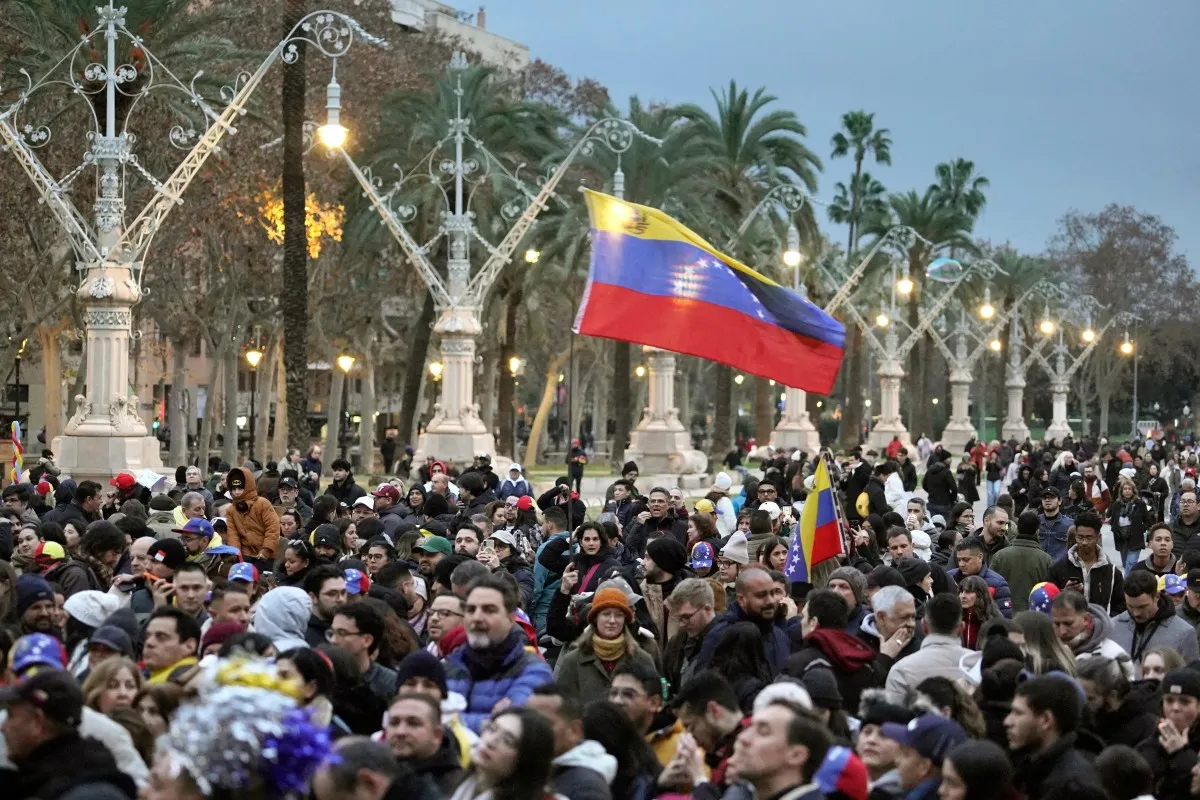
Donald Trump’s military offensive in Venezuela and capture of leader Nicolás Maduro has plenty of implications for Spain, a country which is home to some 600,000 Venezuelans and with longstanding business interests in the Latin American country.
Ever since the US’s military intervention in Venezuela on January 3rd, Spanish Prime Minister Pedro Sánchez has been the most vocal European leader when criticising Trump’s shock operation, and the first to openly call into question its legality.
Sánchez has argued that it sets a “terrible and very dangerous precedent” reminiscent of “other invasions driven by the thirst for oil”, and that although the Spanish government “did not recognise the Maduro regime”, it will not recognise “an intervention that violates international law” either.
Advertisement
Spain has also joined Brazil, Chile, Colombia, Mexico, and Uruguay in a joint statement rejecting the attacks on Venezuela by the US, as well as offering to mediate in the situation to find a “peaceful solution”, a request which is likely to fall on deaf ears given the Trump administration’s openly imperialistic approach.
Venezuela was under Spanish rule for over 300 years, and even though the Bolivarian governments of Hugo Chávez and Nicolás Maduro increased tensions between both nations over the past two decades, their shared cultural and linguistic links have remained undeniable.
So what could regime change in Venezuela and the US’s new tight grip on the country mean for Spain?
Social impact
According to the UN data, 7.7 million Venezuelans have fled the country since 2014 to escape the political regimes there which led to poor living conditions, lack of food and employment opportunities.
As a result, the Venezuelan population in Spain has been growing, exceeding 400,000 people, according to the latest data from the National Institute of Statistics (INE).
However, this figure only includes those with exclusively Venezuelan nationality. If we include Venezuelans who have gained Spanish citizenship, the figure rises to just under 600,000.
This is the largest number of Venezuelans in Europe and the fifth largest number of them in the world. In the first quarter of 2024, Venezuelans were the third largest nationality group in terms of arrivals to Spain.
The military operation has generated uncertainty about the future of the Spanish community in Venezuela and has also left them in a state of relief, shock and also worry about what will happen next.
Much remains to be seen, but a return to democratic elections and economic stability in the Latin American country could see many Venezuelans in Spain return home.
However, it is equally plausible that any possible intensification of instability in the region could also mean greater migratory flows towards Europe, particularly to Spain.
During a recent address, Pedro Sánchez pointed out that since he’s been Spanish Prime Minister, “more than 200,000 residence permits for humanitarian reasons have been granted to Venezuelans being persecuted by the Maduro regime.”
READ ALSO: Venezuelans in Spain rejoice at prospect of return home
Advertisement
Economic effects
Spain is currently Venezuela’s fourth largest trading partner worldwide and takes up to 10 percent of its total exports.
While Venezuela exports gold, coffee and chocolate to Spain, its main export is of course oil. Spain imported record levels of Venezuelan crude oil in 2025, but the control that Trump now has over it could disrupt these supplies to Spain.
On a more promising note, Spanish multinationals with interests in the region, such as Repsol and Indra, have already seen their shares rise amid expectations of a future economic opening and the reconstruction of infrastructure in Venezuela.
Repsol, however, recently increased its imports of Venezuelan crude oil to collect on debt and now faces uncertainty as it will be forced to negotiate with Washington to maintain its operations.
During an interview on Spain’s Antena 3 TV channel, economist Eduardo Bolinches explained: “So this is the main problem, this oil that could generate inflation problems. But given what we are experiencing in international markets, the price of oil has started to fall, it has fallen by 1.5 percent”.
“If Donald Trump decides that nothing will be exported, for Spain it’s like changing petrol stations when filling up; we won’t notice a thing. That said, with a stable barrel at $60, as we have right now. It’s nothing like what happened with Ukraine, where the barrel immediately jumped to $110 and petrol nearly reached €2. No, not now. Now we’re at $60, petrol at €1.40, and logically, it should remain stable,” he continued.
READ ALSO: Spanish protesters slam ‘imperialist aggression’ in Venezuela
Advertisement
Business opportunities
When it comes to Spanish business interests not related to oil, the situation could go one of two ways.
The first is that a peaceful transition and greater confidence in Venezuela among international markets. CEO of international trade consultant TuComex, Cristina Peña sees this as a chance for “many more opportunities” to emerge, which could represent a significant benefits not only for Spanish banks but also for other sectors.
Some major Spanish companies have a significant presence in Venezuela such as Telefónica, BBVA and Mapfre.
“Companies like Telefónica, those dedicated to infrastructure projects such as renewing the road network, ports, and airports,” Peña explains, adding that it could also pave the way for Spanish companies specialising in renewable energy.
The other way is that the transition in Venezuela will not be met with international approval, and the US will seize control of the country’s resources.
In another interview Bolinches told news site Antena 3: “Who will exploit these natural resources, such as the country’s rare earth elements? Will only American companies be allowed to exploit them?” This scenario would severely affect Spanish companies, raising further questions, such as “Will there be expropriations of major companies like Repsol, BBVA, Mapfre, and Zara?”
READ ALSO: Spain offers to mediate for ‘peaceful solution’ in Venezuela


