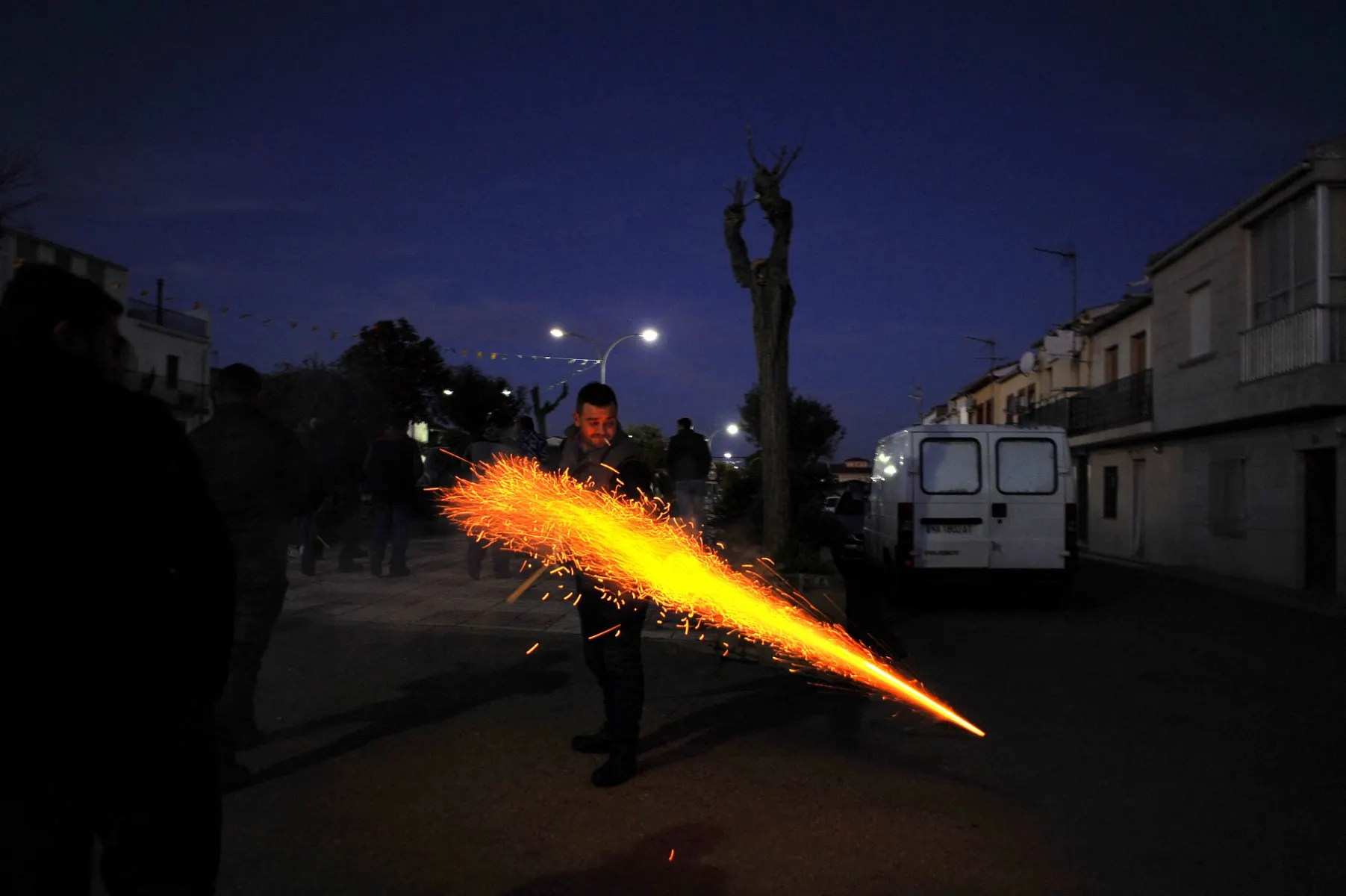
Fireworks are common across the world during New Year’s Eve, but in Spain it’s firecrackers (petardos) that scare the living daylights out of people with their loud bangs. More people are now calling for this heart-stopping tradition to die out.
If there’s a sound that Spaniards associate with Nochevieja (New Year’s Eve), perhaps even more so than villancicos (Spanish Christmas carols), it’s the noise of firecrackers or bangers, known as petardos.
Cebolletas, girasuelos, bengalas, chinos, avispas, cohetes – They go from the small ones that kids throw and produce a quieter but sharp crackle when they hit the pavement, to the kind that are lit up and make such a loud bang it’s as if a bomb has gone off in your neighbourhood.
And this doesn’t necessarily happen as Spaniards ring in the new year, often it’s hours before during siesta time, or even during other days over Christmas.
READ ALSO: What are the rules on fireworks in Spain?
Firecrackers are used in other countries of course, but in Spain they’re very common at Christmas, weddings and local festivals.
Advertisement
Valencia’s famous Mascletàs are pyrotechnic displays focused entirely on these noisy fireworks, even the name derives from notoriously deafening petardos called masclets in Valencian.
Every day during the city’s Las Fallas festival, these ‘rhythmic’ explosions take place for a few minutes, causing a clamour of such magnitude that even deaf people can feel it on their chests.
Petardos generally generate anywhere between 65 and 120 decibels of sound, the maximum level set by the EU.
Anything above that can cause harm to someone’s hearing, but many of the bangers used in Spain create noise above World Health Organisation recommendations.
This can lead to permanent or long-lasting damage to our hearing, such as tinnitus or perforation of the eardrum.
Teresa Moreno, a researcher at Spain’s CSIC Institute, has also pointed out that firecrackers can also damage people’s lungs as their “particles are bio-reactive and can affect human health, especially people with a history of asthma or cardiovascular problems.”
Furthermore, there have been cases of people being hit in the face by a banger or their residue and suffering burns or losing their sight in one eye.
So despite all the risks, why is it a Spanish tradition to throw firecrackers?
Advertisement
Firecrackers were first developed during the 2nd century BC in China, they arrived in Europe in the 13th century and by the 15th century they were being used during local festivals for entertainment.
The fact that Spain is the second noisiest country in the world after Japan may mean they’re more willing to put up with it, or even enjoy it.
According to King’s College London neuroscientist Daniel Glaser, humans are eager to experience feelings close to fear, such as that provided by the anticipation of petardos.
This ‘good’ stress isn’t too different from that which participants in Pamplona’s running of the bulls feel, so it’s clear that such sensations are often part of Spanish traditions and festivals.
And for teenagers eager to cause a scene and scare others, the temptation bangers provide is too great to ignore.
According to the website La Petardería, which specialises in the sale of petardos, the tradition of setting off these bangers before and during New Year also has to do with scaring away evil spirits and ending a cycle.
Regardless of their symbolic meaning and the cheap thrills they offer, there is increasing awareness in Spain that these extremely loud bangs not only have the potential to harm those setting them off or are very close by, but that they can also be damaging for children with autism, babies, elderly people and animals.
In response, several cities in Spain have taken measures to restrict or prohibit their use, with fines that can reach thousands of euros.
The popular tourist town of Torremolinos in Málaga province is among them, having recently banned the sale and use of fireworks without prior authorization from December 20th until the end of the Christmas holidays in Spain – January 6th.
Bigger cities such as Madrid, Seville and Vitoria-Gasteiz in the Basque Country also have restrictions on the use of firecrackers and fireworks, preventing anyone from lighting them whenever they please and setting specific times for their usage, if at all.
The use of bangers in Spain is another example of a tradition that not everyone in modern society is happy to hold onto, but which will probably linger on nonetheless.
So brace yourselves this New Year, as at any given moment a thunderous petardo could be set off not far from you.