


Switzerland already enforces strict language requirements for Swiss citizenship applicants, but could they soon become tougher?
In a recent parliamentary motion, MP Jean-Luc Addor announced he was seeking tougher language proficiency criteria for obtaining Swiss citizenship.
Addor, from the Swiss People’s Party (SVP/UDC), argued in his motion – which will be discussed by his fellow legislators during a future parliamentary session – that proficiency in a national language of the candidate’s region is “a decisive factor in integration as well as in autonomy and independence.”
Therefore, he is pushing for the minimum required level to be raised to B2 for spoken language (from the current B1), and to B1 for written skills – up from A2.
This means that those applying for naturalisation would need an intermediate level for communicating verbally, and a sold basic one for writing.
Though certain cantons had already set their own, tougher language proficiency rules, Addor wants these higher requirements to be put in place on federal level as well.
Which cantons’ language requirements exceed the federal ones?
The official levels – set by the State Secretariat for Migration (SEM) and based on the Common European Framework of Reference (CEFR), a definition of different oral and written language levels created by the Council of Europe – are a minimum requirement, with individual cantons free to introduce stricter criteria.
(The same applies to all federal laws : cantons can enact tougher regulations than the national ones, but can’t introducer laxer ones).
To date, three Swiss-German cantons require higher language proficiency: Schwyz, Nidwalden, and Thurgau all require B1 written level and B2 spoken.
None of these three cantons recognises the lower A2 level for written skills that are set by SEM.
Additionally, two other cantons announced that they want to toughen their language criteria as well.
Aargau, where naturalisation requirements are already stricter than elsewhere in Switzerland, now wants to have harsher rules for the language, by raising them to a B2 level as well.
In Zug too, the cantonal government has responded favourably to a SVP motion calling for a better language proficiency to obtain Swiss citizenship: B2 for spoken and B1 for written German.
Advertisement
Naturalisation only
These harsher requirements concern only citizenship, not work permits.
This is what SEM requires for residency:
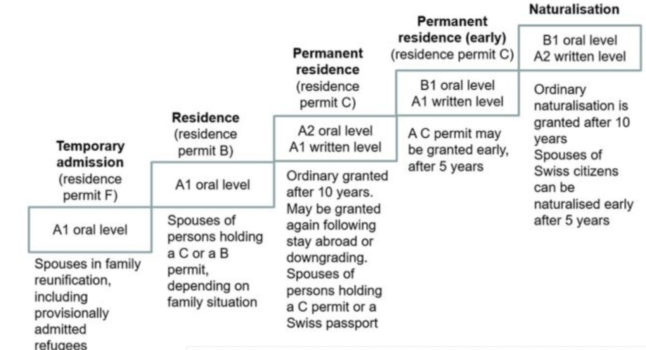
SEM
These ‘linguistic integration’ criteria, however, are not equally or consistently applied to all foreign nationals.
For instance, the largest group exempted from the language requirement – at least for the B permit – are the nationals of the European Union and EFTA (Norway, Iceland, and Liechtenstein) – that is, all foreigners covered by the Agreement on the Free Movement of People.
True, people from Germany, France, Italy, Austria, and Liechtenstein already speak a national language, but citizens of other EU/EFTA states don’t, which doesn’t prevent them from being granted a B permit. (However, if they decide to appy for permit C and, later, for Seiss citizenship, the language proficiency requirement will kick in).
Advertisement
But, in certain cases, the language rule is also waved for third-country nationals.
As reported by Swiss media, “American and British bankers, who are subject to quotas for third-country nationals, often receive more lenient treatment. For these professionals, a good command of English is sufficient. IT experts, consultants, researchers, and cryptocurrency specialists also benefit from the same system.”
READ ALSO: How Switzerland’s language rules for residency can depend on your job
But that’s not all: other exceptions include people who were born in Switzerland to foreign nationals, as well as minor children, among others:
READ ALSO: Who’s exempt from Switzerland’s language requirement for permits and naturalisation?


