


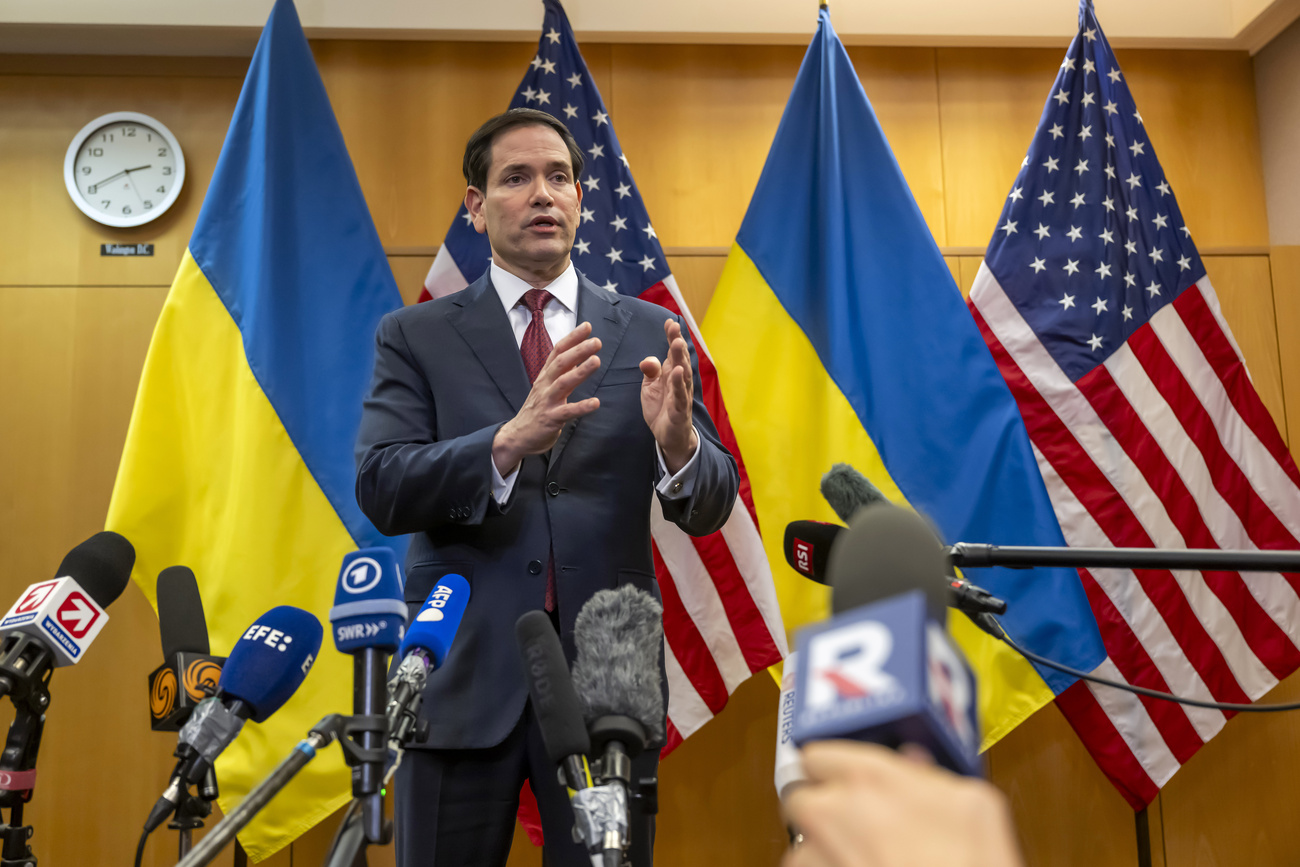
The head of US diplomacy, Marco Rubio, was in Geneva on November 23 for talks with Ukrainian officials. This has rekindled hopes that major peace negotiations in Geneva are not a thing of the past.
Keystone / Martial Trezzini
Weakened by Donald Trump’s return and by a crisis of confidence in multilateralism, International Geneva is heading into 2026 under a cloud of uncertainty. It is also where the future international order is being shaped amid restructuring and inter-state competition.
The year 2025 brought profound upheaval for Geneva-based international organisations. Already undermined by budget cuts and a loss of credibility amid a growing number of conflicts worldwide, the institutions of global governance were confronted with an unprecedented US disengagement following Donald Trump’s return to the White House.
The US, the largest financial contributor and a historically influential player in the United Nations system, withdrew from the World Health Organization (WHO) and the Human Rights Council – both based in Geneva. By dismantling the US Agency for International Development (USAID), the new US administration plunged the humanitarian sector and its leading Geneva institutions into deep crisis.
“The multilateral system is facing a financial and political crisis. Some specialised agencies, particularly in the humanitarian field, depended on the United States for up to 40% of their funding,” Anna Ifkovits Horner, Switzerland’s ambassador and deputy permanent representative to the UN, told a public conference in Bern recently. “That is problematic. The key would be to diversify sources of income, but given the geopolitical context, this is not easy.”
More
More
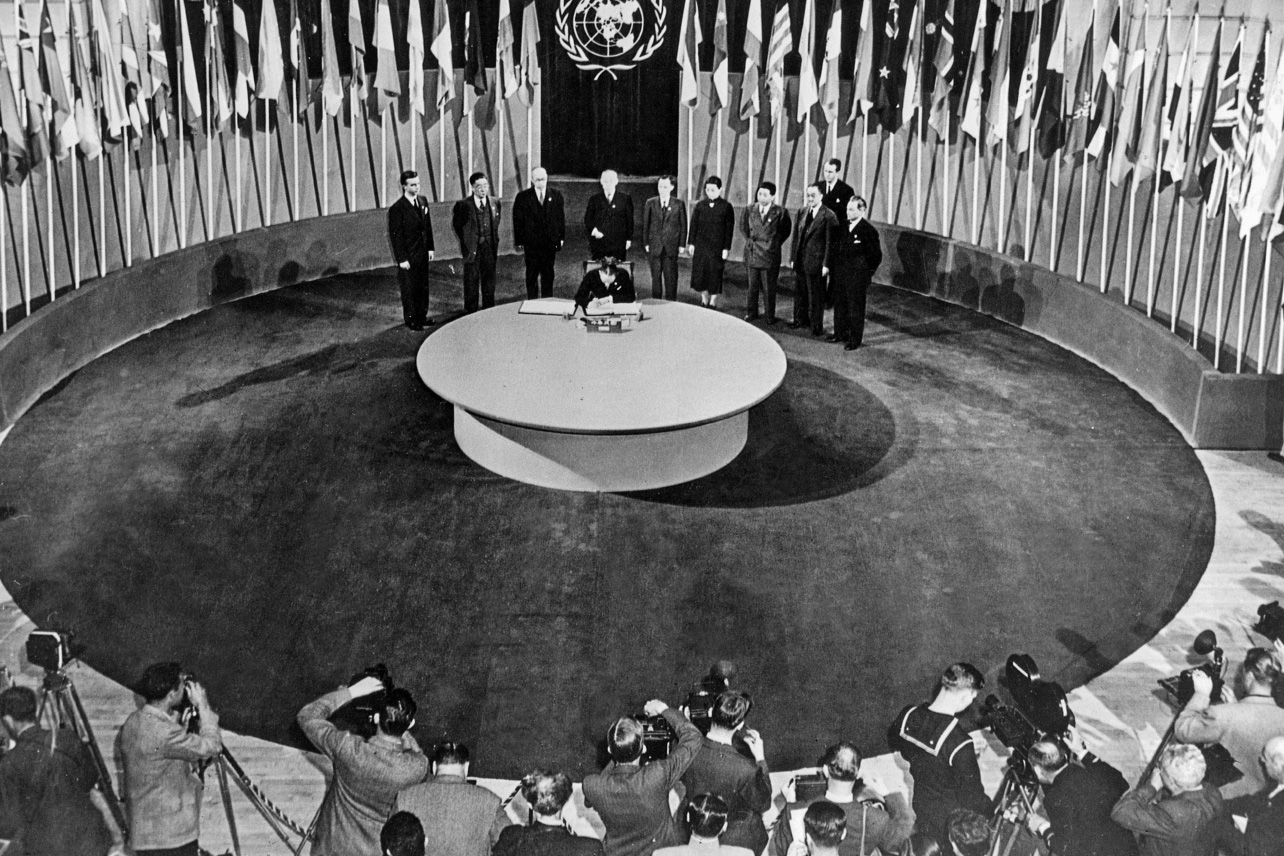
What remains of the UN dream 80 years after the Second World War?
Reforms to continue
In response, UN Secretary-General António Guterres has initiated budget cuts and launched a sweeping reform process known as UN80, aimed at boosting the organisation’s efficiency. Proposed measures include closer alignment of agencies with similar mandates and relocating jobs currently based in Geneva and New York to lower-cost locations such as Nairobi or Rome.
Several Geneva-based agencies are among the hardest hit by the hundreds of redundancies and relocations under way. They include the UN refugee agency (UNHCR), the International Organization for Migration (IOM), the Office of the High Commissioner for Human Rights, the International Labour Organization (ILO), as well as UNICEF (the agency for children) and UNAIDS (the UN programme coordinating the global response to HIV/AIDS).
More
More
Ripple effect of aid freeze becomes real in Geneva
Restructuring efforts are likely to continue in 2026. Optimists point to Geneva’s strengths in terms of expertise and infrastructure and note the measures adopted by cantonal and federal authorities in response to the crisis, including financial support. But the particularly high cost of living in Switzerland’s second-largest city is and will remain a major challenge for organisations seeking to cut costs. This is compounded by the appreciation of the Swiss franc, which has gained more than 10% against the euro in recent years.
Who will lead the UN next?
For António Guterres, 2026 marks the final year of his mandate. He will undoubtedly seek to push through his reform agenda, but he will have to contend with widespread discontent among staff affected by layoffs and restructuring. In 2025, employees mobilised strongly to stage demonstrations on an unprecedented scale in Geneva, a momentum that is likely to continue next year.
The year 2026 will therefore also be a campaign year for the next UN secretary-general, who will take office in 2027. Under the current system of geographic rotation, the post should go to a candidate from Latin America. Several names are already circulating, including Rafael Grossi, head of the International Atomic Energy Agency (IAEA) in Vienna, and Rebeca Grynspan, the current secretary-general of the UN Trade and Development (UNCTAD) and a leading figure in International Geneva.
More

More
Is the UN still relevant in the Middle East?
As the global order undergoes profound change, and amid criticism that the reforms lack a genuine strategic vision and amount to little more than a financial exercise, the candidates’ vision for the future of a UN in crisis will be closely scrutinised by member states.
A turning point for humanitarian aid?
In 2025, UN-coordinated humanitarian response plans received just $13 billion (CHF10.3 billion) of the $45 billion sought – the lowest amount since 2016, when global needs were only half as high. The shortfall is largely due to reductions by Western countries, which are investing in defence and facing budgetary pressures.
In December, the UN Office for the Coordination of Humanitarian Affairs (OCHA) launched its annual appeal for 2026. Significantly lower than last year’s request, it is intended to be realistic, seeking $33 billion to assist around 135 million people affected by war, climate change, disasters and epidemics.
The key question now is whether an increase in funding is still possible. With the US and several European countries, historically among the largest donors, scaling back, humanitarian organisations hope to attract new contributors, including the Gulf states, China, which favours bilateral aid, and the private sector. For now, however, there are no clear signs of a shift in the short term.
More

More
Who will come to the aid of a humanitarian system left behind by the West?
What role for peace?
After a difficult period during the Covid-19 pandemic, Geneva has in recent years appeared to lose its appeal as a venue for peace negotiations – a role that once defined its reputation. In the meantime, cities such as Doha, Istanbul and Cairo have emerged as strong competitors.
While these rivals have further consolidated their status this year, Geneva has regained some of its former prominence, hosting talks on Iran’s nuclear programme and discussions between Kyiv and Washington on the US peace plan for Ukraine. Russia, which has repeatedly argued that Switzerland is no longer a neutral venue after Bern adopted sanctions against Moscow, did not take part in these talks.
A hypothetical summit in 2026 between the Ukrainian and Russian presidents in Geneva – an option floated by some European leaders last summer following the meeting between Donald Trump and Vladimir Putin – still appears highly unlikely, but not impossible. As Switzerland prepares to assume the presidency of the Organization for Security and Co-operation in Europe (OSCE) next year, of which Russia is a member, the “capital of peace” may yet have a role to play.
>> Check out latest episode of the Inside Geneva podcast on international law.
More
Edited by Virginie Mangin/op/ds


