


Move over Santa because there’s a pipe-smoking, beret wearing, more rugged version of you living in northern Spain.
Those who spend time in Euskal Herria, the Basque area of northern Spain, during the run up to Christmas should look out for the Olentzero, a pipe-smoking charcoal burner who became the alternative to Santa Claus and the Three Wise Men for more militant Basque parents in the 1970s.
This big-bellied rough-around-the-edges version of Papá Noel has a wife who goes by the name of Mari Domingui, who also dresses in traditional Basque rural garbs, including some smurf-like headgear.
Nowadays the Olentzero tends to work in partnership with his ‘foreign’ present givers in most Basque households, and he also stops by in the French Basque Country and Navarre. He often carries his toys in a charcoal sack or in the baskets of his mule.
READ ALSO: Did you know? It was legal to kill Basques in Iceland until 2015
The concept is similar to Christmas in other parts of Europe and the world: Basque kids leave Olentzero a letter with the presents they want and if they’ve been good, they get them on Christmas Day.
In many towns and cities in the Basque Country and Navarre, Olentzero parades are held in which a coal-stained effigy of the present giver is carried through the streets or a couple dressed as the Olentzero and Maria Domingui greet the children. These celebrations were actually outlawed during the Franco dictatorship.
READ ALSO: Ten unique Basque words you need to learn right now
Advertisement
The legend behind Olentzero
Some historians believe Olentzero’s origins can be traced back to pre-Christian Navarre and are linked to pagan winter solstice traditions, although the character was later adapted to conform with Catholic rituals
The story goes that Olentzero began his life as an abandoned infant who is found by a fairy godmother.
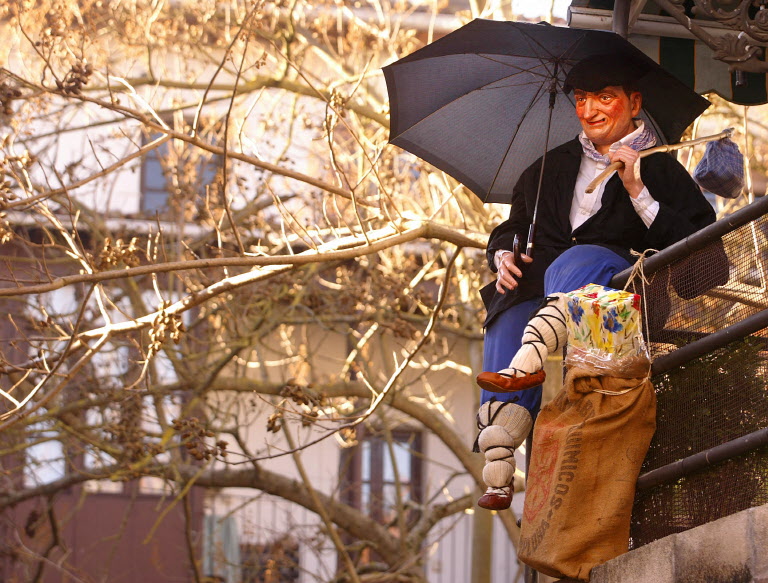
A dummy representing “Olentzero” on a balcony in the village of Santesteban, Navarre. (Photo by RAFA RIVAS / AFP)
After bestowing the child with the gifts of “strength, courage, and love,” the fairy leaves him with a childless couple who raise him as their own in the foothills of the Pyrenees.
READ ALSO: Why Basque cheesecake is taking over the world
Olentzero whittles wooden toys and at Christmas comes down from the mountains to the villages to distribute his crafts among the children.
Then one day as he is taking the gifts to a nearby town he passes a house that is engulfed in flames and charges in to save all the children inside. After performing this heroic deed, however, he perishes in the flames.
But his fairy godmother grants him eternal life so that he can continue to make toys for all the Basque children.
The Olentzero is just another example of how the Basque people have their own culture and traditions that are distinctive from the rest of Spain, coupled with a unique language with no similarity to Castillian Spanish.
¡Eguberri on! (Happy Christmas in Basque)


