


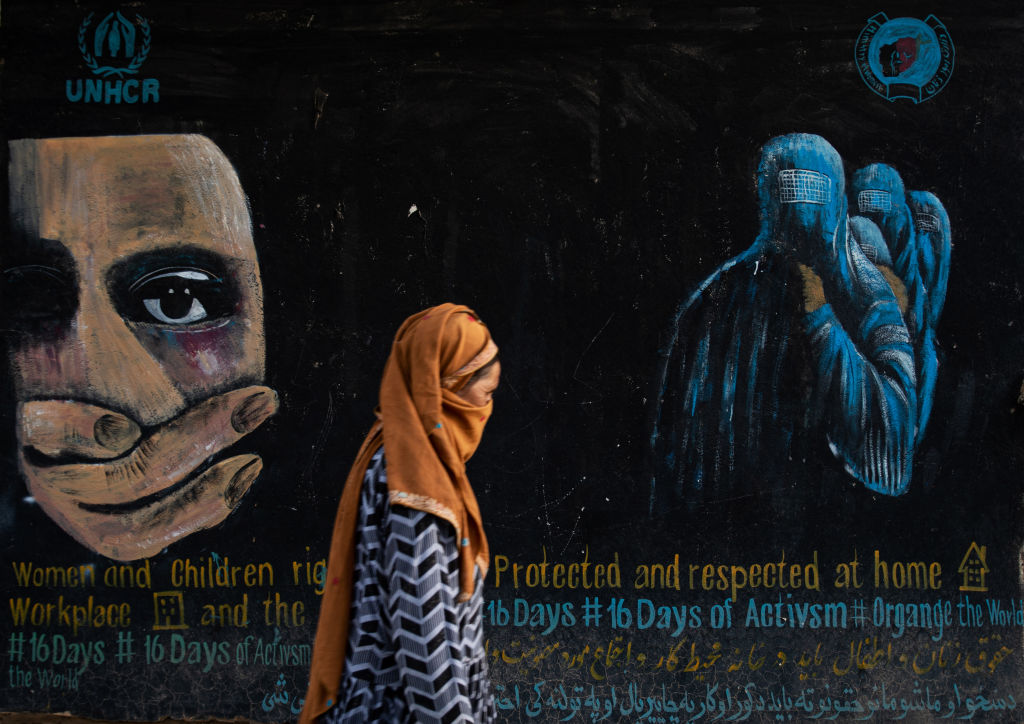
A woman walks past a mural calling for women and children’s rights in Afghanistan.
2022 Getty Images
The UN Human Rights Council has decided to set up an independent body to investigate and preserve evidence of the most serious international crimes committed in Afghanistan, including crimes against women.

In September, more than four years after the Taliban took power in Afghanistan, the Geneva-based UN Human Rights Council moved to establish a specialised “mechanism” to investigate the most serious international crimes committed by the current regime and other actors in Afghanistan’s conflicts.
It has the mandate to “collect, consolidate, preserve and analyse evidence of international crimes and the most serious violations of international law committed in Afghanistan, and prepare files to facilitate and expedite fair and independent criminal proceedings”. It will rely on courts like the International Criminal Court to carry out these prosecutions, or countries exercising universal jurisdiction.
In its press release published at the time, the Human Rights Council particularly deplored the Taliban’s “system of discrimination, segregation and exclusion targeting women and girls”.
This has been welcomed by Afghan women activists and international lawyers and comes as there is a global push by NGOs and international lawyers to inscribe gender apartheid in international law. The debate is part of ongoing discussions in New York on a new UN Crimes Against Humanity ConventionExternal link.
More
More
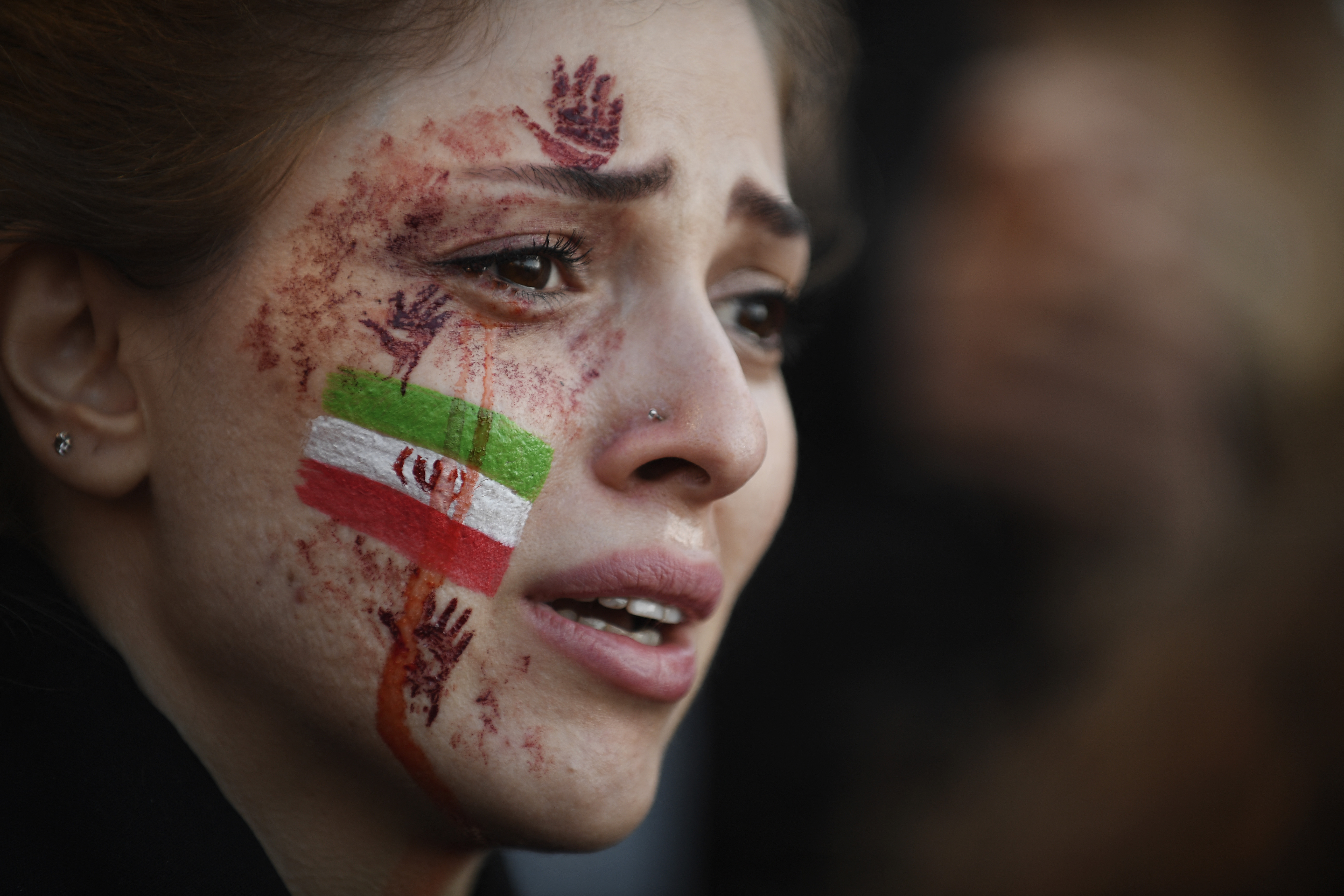
Explainer: What is gender apartheid?
“I think this is something we absolutely needed,” says Azadah Raz Mohammad, an exiled Afghan lawyer currently based in Melbourne, Australia. “With almost five decades of conflict, we have not had a single investigation of the atrocity crimes committed by different actors. We have high hopes, and I am cautiously optimistic.”
She has been part of the campaign to get this UN body set up, and is also legal advisor at the End Gender ApartheidExternal link campaign, spearheaded by Afghan and Iranian women’s rights defenders, as well as international jurists and experts.
Richard Bennett, the UN Special Rapporteur on human rights in Afghanistan, also supports this new mechanismExternal link and says it will fill a gap. He reports to human rights standards, but the new investigative body will prepare files to the standards of a criminal court.
“It has a comprehensive mandate,” he told Swissinfo. “That means it can go back in history and it can look at any party that has committed international crimes. So it is not targeted only on the Taliban. It can target the previous government, it can target other States, including NATO members and the United States, if it wants to.”
‘Funding is a major aspect’
“It’s a thrilling development. I just hope it will be funded sufficiently to be incredibly meaningful,” says Sareta Ashraph, an international criminal lawyer specialising on gender crimes and faculty member of the Geneva Academy of International Humanitarian Law and Human Rights. The vote to set up this mechanism comes at a time when the UN is facing serious funding cuts, and Mohammad shares concerns about its resources. “Funding is a major aspect,” she told Swissinfo, “and we need political will to generate that.”
The new UN mechanism for Afghanistan is expected to be along the same lines as those for SyriaExternal link and MyanmarExternal link. It may take many more months to set up, with “terms of reference” to be thrashed out, a budget approved and staff hired.
>>>Listen to our latest episode of Inside Geneva:
More
More
Inside Geneva: Are we throwing away international law?
The Human Rights Council proposed a “regular” UN budget for the new Mechanism which still needs to be approved in New York. This is expected in coming weeks, but was still pending at the time of writing. Apparently taking account of the UN funding crisis, the Human Rights Council proposed that the Mechanism be set up over a three-year period. Bennett says that, according to the budget proposal, it should have 15 staff in the first year, another 15 in the second, and reach a total of 43 by the end of the third year. It will also need infrastructure. As well as the UN budget, the Human Rights Council called for creation of a Trust Fund for voluntary contributions by UN member States.
‘The worst place in the world to be a woman’
Since the Taliban retook power in Afghanistan in August 2021, they have imposed increasingly harsh restrictions on all Afghan women and girls. Mohammad describes the situation as a system of gender apartheid, “a term we inherited from our predecessors, the human rights defenders and lawyers who had to fight the Taliban the first time in the late 1990s”.
“Afghanistan has been called the worst place in the world to be a woman,” says Ashraph. She describes it as a gender-based system of discrimination, segregation, disrespect for dignity, and exclusion, including denial of education to girls above sixth grade. “Women are banned from public life, they are not allowed to go to national parks, they are banned from participating in radio and TV shows, they can’t go any distance without a male guardian,” she told Swissinfo. “They are basically being manoeuvred into very narrow roles, which are essentially child-bearers, child-raisers, as well as objects available for sexual exploitation and for unremunerated or poorly remunerated labour.”
In a June 2024 report to the UN Human Rights Council, Bennett said the situation of women in Afghanistan under the Taliban amounts to a crime against humanity. “The yardstick I am using is the Rome Statute of the International Criminal Court, and what I was talking about particularly was the crime of gender persecution,” he says, “and gender persecution is a crime against humanity in the Rome Statute.” He also supports the campaign to get gender apartheid recognised as an international crime.
Gender apartheidExternal link is not yet recognised as a crime. International criminal law recognises apartheid on grounds of race – as was the case in South Africa – and gender persecution as a crime against humanity. Indeed, the International Criminal Court (ICC) has issued arrest warrants for two top TalibanExternal link leaders on grounds of gender persecution. Ashraph welcomes this, but says the two crimes are not the same. Gender apartheid may share common facts with persecution on gender grounds (just as apartheid is likely to share common facts with race-based persecution), but she explains the crime of apartheid has unique elements, not replicated elsewhere in international criminal law.
The recognition of gender apartheid would recognise the scope of crimes committed by an oppressive state. According to Bennett, it would also put more expectations on other states and non-state actors such as businesses “not to support a regime where there are allegations of gender apartheid”.
More
More
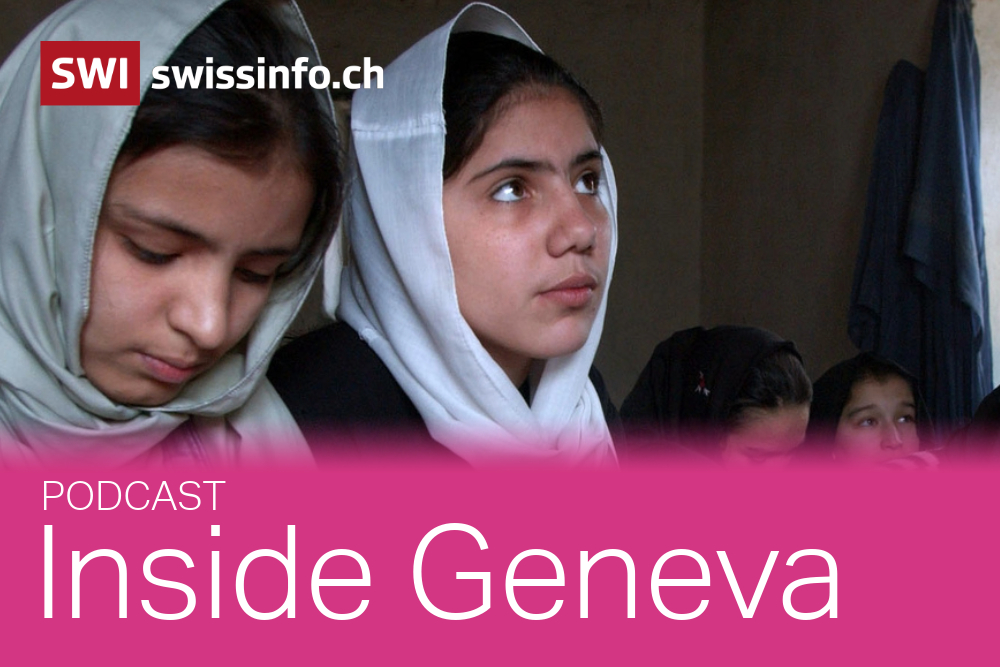
Summer profiles: Afghan women’s struggle against Taliban oppression
UN Mechanism and gender apartheid
The push to recognise gender apartheid as an international crime is supported by many NGOs, with the End Gender Apartheid CampaignExternal link in the forefront. It also has support from some states and within the UN. Experts, though, are hesitant to say the mechanism can directly impact international law.
“I think this mechanism has the ability to document, to say that what the Taliban are doing is a form of apartheid based on gender, and then to investigate, to say what effect this has on women’s lives,” says Mohammad. “And to say that this situation is really unparalleled in the world, when women’s fundamental rights are forbidden by a state institution, by decrees and laws.”
According to Bennett, the mechanism’s work will have “little to do with gender apartheid, at least until it is codified”, and that will take time. Its focus, he continues, will be investigating, identifying perpetrators and preparing case files for possible criminal prosecutions, which could be carried out by the ICC or countries exercising universal jurisdiction.
It remains to be seen if this new mechanism will get enough funding to be “incredibly meaningful”, as Ashraph puts it. Will member states step up? “We really want the UN’s finance committee to approve the budget,” says Bennett, “and for the member states who support it politically to also support it financially.”
Edited by Virginie Mangin/ds


