


The topic of vaccinations is fresh in our memories due to Covid, but what about other immunisations? Here’s what you need to know.
As it became clear during the Covid pandemic, vaccinations — whether against coronavirus or other diseases — are not obligatory in Switzerland.
However, a number of them are highly ‘recommended’, according to the government.
Switzerland doesn’t mandate common childhood vaccines, including those against measles, whooping cough, tetanus, and others required in many other countries around the world, including neighbours Germany, France and Italy.
The map below shows countries where childhood vaccines are required versus those, like Switzerland, where they are merely recommended.
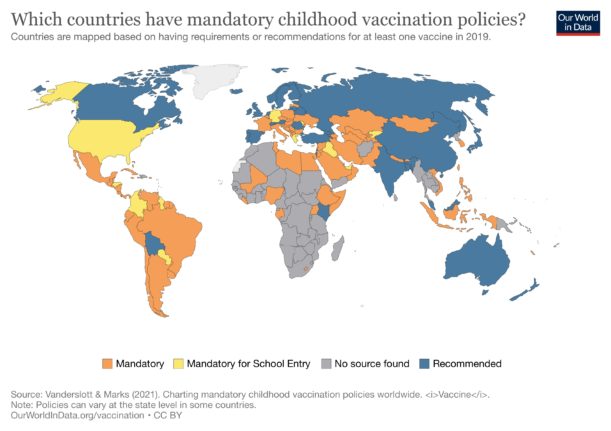 Image: Our World in Data
Switzerland is so lax about immunisations because, pursuant to the constitutional right of each person to “self-determination”, including in matters of health, “no vaccination is compulsory in Switzerland; everyone can decide for themselves”, according to the Federal Office of Public Health (FOPH).
Childhood vaccines are not compulsory either, and a number of children begin school without having received routine immunisations recommended by health authorities.
“Despite having an advanced healthcare system, Switzerland has only partially reached its objectives in terms of vaccination, both for individual protection and collective immunity” , according to FOPH.
Among the main reasons why many people avoid vaccines, or refuse to have their children vaccinated, is “because they harbour doubts about their effectiveness, or fear harmful side-effects”, FOPH said.
Advertisement
Which vaccines do Swiss health authorities recommend for children?
For babies, FOPH recommends the following shots:
- Measles
- Diphteria
- Tetanus
- Whooping cough
- Polio
- Invasive infections by Haemophilus influenzae type b (severe meningitis and laryngitis)
- Hepatitis B
- Pneumococci
- Mumps
- Rubella
- Chicek pox
For adolescents aged from 11 to 15, FOPH recommends a Hepatitis B vaccine, chicken pox (for those who have not had it earlier), as well as human papillomavirus (HPV) for girls.
It is also important to keep up with booster shots, health authorities, say: “Some vaccines, especially those against diphtheria or tetanus, do not protect against the disease for life. To benefit from long-lasting protection, the vaccine must be renewed at regular intervals. A catch-up vaccination is also necessary if the basic vaccination is deficient or incomplete, in particular to protect against tetanus, measles, mumps, rubella or whooping cough”.
More information about which vaccines are recommended for infants and older children, as well as other vaccine-related information, can be found here in German, French and Italian
Advertisement
What about adults?
FOPH recommends seasonal flu vaccines.
Also, those who have not had the full set of childhood vaccines, as outlined above, should have them as well.
“Booster vaccines at regular intervals are sometimes necessary to maintain protection against the disease in question. The FOPH thus recommends regular booster shots for the following diseases: diphtheria, whooping cough and tetanus. A catch-up vaccination is also necessary if the basic vaccination is deficient or incomplete, in particular for protection against measles, mumps and rubella”.
A vaccine against shingles is recommended as well.
Additionally, in view of the increasing number of tick-borne diseases such as Lyme and meningoencephalitis, authorities recommend a vaccine to prevent complications from those conditions as well, especially if you often venture outdoors into grassy areas in the summer.
For more information about which vaccines are recommended for adults in Switzerland, ask your doctor or call the nationwide vaccine hotline at 0844 448 448 (in German, French or Italian).
Advertisement
Can unvaccinated children attend school?
Since immunisations are not mandatory in Switzerland, no public school can turn away a child because he or she had not had the recommended shots.
However, the key word here is “public”.
In 2019, for the first time in Switzerland, a network of private nursery schools called Kita ruled that all children attending their facilities must be vaccinated against at least measles and whooping cough. If parents refuse to comply, the children will be denied attendance.
Generally speaking, any private institution can deny admission to unvaccinated children as they are not held to the same standards as public schools; however, no official data shows any other private establishments following Kita’s example to date.
What if mother and father disagree about vaccinating their child?
Such situations do occur from time to time.
In 2020, Switzerland’s Federal Court ruled that if parents hold opposing views about this issue, the final decision must be based on the recommendations of the public health authorities which, of course, favour vaccinations.
Several years ago, The Local also reported about one such case. “A Swiss court handed down an order requiring a mother to vaccinate her child against several childhood diseases”.
“The mother, a vaccination sceptic who believed all forms of vaccination constitute bodily harm, was engaged in a dispute with the child’s father, who wanted the child vaccinated”.
READ MORE: Can children be vaccinated without parental consent in Switzerland?
Advertisement
Where in Switzerland can you vaccinate your child?
For babies born in Switzerland, shots will be administered by a paediatrician of your choice, who will also set appointments for follow-up boosters.
If you are newly arrived with a small child but don’t have a local paediatrician yet, get in touch with the Swiss Pediatric Society which might be able to direct you to paediatrician in your area.
All vaccinations recommended by FOPH are paid by the compulsory health insurance.


