


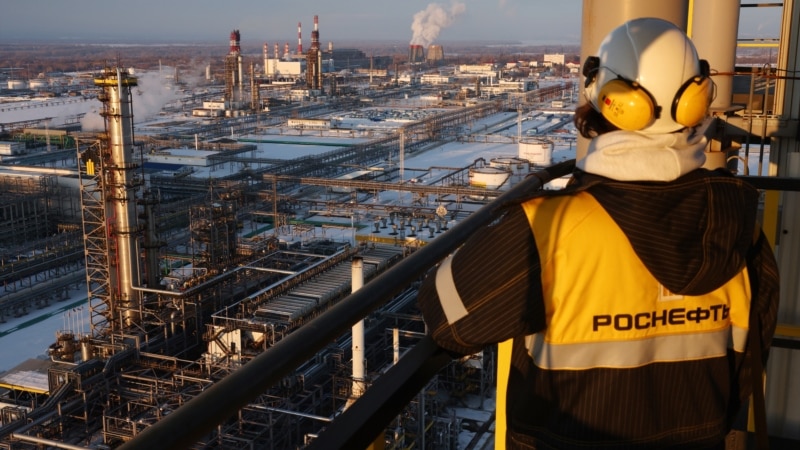
European Union sanctions are “slowly but surely” choking Russia’s oil exports — and are also stepping up in speed and scope, according to the 27-nation bloc’s chief sanctions official.
EU Sanctions Envoy David O’Sullivan told RFE/RL in an interview on December 16 that while enforcement was “a game of cat and mouse,” the measures were working and Russia’s revenues were “suffering.”
O’Sullivan spoke in a video call from Brussels two days before an EU summit that’s due to consider further punitive measures in response to Russia’s nearly four-year-old full-scale invasion of Ukraine.
Using 140 billion euros ($165 billion) of frozen Russian assets to provide financial support to Ukraine is top of that agenda.
But this week the EU will also add some 40 ships to its list of sanctioned vessels, used for evading restrictions on Russia’s oil exports. This would bring the total to some 600 vessels, or about 75 percent of Russia’s so-called shadow fleet, by O’Sullivan’s estimate.
‘Quicker’ Sanctions
The addition marks a change in existing EU practice, which has been to add new ships only during 19 successive packages of sanctions — each of which has required lengthy negotiation among member states.
“We are now agreed that we can proceed more regularly and with slightly less fanfare to listing individual vessels and ships. So it’ll be quicker. We won’t have to wait every few months for the bigger package,” O’Sullivan said. “We’ll be able to do it on a monthly or a weekly basis as soon as we identify a critical mass of vessels.”
O’Sullivan said the EU also wanted to pursue negotiations with countries under which vessels are officially registered, to make it faster and easier to board ships flying their flags, to further disrupt shadow fleet operations.
He said getting permission to board from the flag state on a “case-by-case basis” was problematic.
“In that case, you know, the vessel is passing across your coastline and then you have to send an email to some registry somewhere and say, ‘Hey, this vessel is carrying your flag, we have reason to believe it’s behaving badly. Can we board it?’ And then, by the time you get the reply, the vessel has already moved on.”
Instead, O’Sullivan said, the EU was seeking either “a faster mechanism” or “open-ended permission.”
Russia’s Falling Oil Revenues
Draft conclusions for the December 18-19 EU summit, seen by RFE/RL, call for “further coordinated action by Member States and cooperation with G7 partners, also in relation to port and coastal states and vis-a-vis third-country flag states and the whole shadow fleet ecosystem, to further decrease Russian energy revenues.”
Russia is the world’s third largest oil producer, but the EU has dramatically reduced its own consumption of Russian crude oil supplied by pipeline and has banned seaborne imports. Sanctioned vessels cannot enter EU ports.
Further sanctions have imposed a cap on the price that third states can pay for Russian crude, which currently stands at $47.60 per barrel — well below market rates.
Russian export revenues hit their lowest in November since the full-scale invasion of Ukraine in 2022, the International Energy Agency (IEA) said on December 11. The IEA attributed this to both sanctions and Ukrainian drone attacks on Russia’s oil industry infrastructure, noting also falling oil prices on global markets.
O’Sullivan said new EU measures due to take effect in January were already having an impact. The new sanctions will ban the import to the EU of products derived from Russian oil.
“It was a big part of the business model particularly of Indian refineries but also some others, Turkey, even some Chinese, basically to bring in Russian crude to refine it and then sell it on to Europe as Indian or Turkish or Chinese product. This is no longer possible,” he said.
“If there is even a drop of Russian crude in the refined product, it may not be exported to the European Union. So, this is causing a big disruption,” he added.
Impacts On India And China
In an early sign of this, India’s Reliance Industries announced in November that it would cease importing Russian crude at Jamnagar, the world’s largest oil refining complex, to comply with the new rules.
The move was welcomed by Washington, which has announced secondary tariffs on India due to its Russian oil imports.
In October, the United States also recently announced sanctions on two of Russia’s largest oil companies, Lukoil and Rosneft, adding further pressure to the industry. The EU followed suit with a “tightened transaction ban” on Rosneft and Gazpromneft, a subsidiary of the state-controlled Russian gas giant Gazprom.
But moves to restrict Russia’s oil exports appear so far to have had less impact on China.
“Nobody’s really been willing to take on China. I know that the EU has sanctioned a few oil terminals, but really it’s kind of like a game of whack-a-mole,” Michelle Bockmann, an analyst at Windward, a maritime intelligence company, told RFE/RL on December 15.
O’Sullivan acknowledged the complaint, likening sanctions enforcement to “a game of cat and mouse” that could never achieve complete success.
“You can even do a master’s degree in Moscow on sanctions circumvention. By the way, we’ve just sanctioned the person in charge of the program so that he can speak from personal experience. So, it is a very sophisticated system, sanctions circumvention,” he said.
“What I maintain is that we constantly make it more difficult, more complicated…we are slowly but surely making it harder and harder for Russia to sell oil at any kind of reasonable price.”


