


New rules pertaining to vehicle registration and driving, among others, will go into effect in Switzerland from January 1st.
The vignette
This is not a ‘new’ rule per se, but an important one that everyone living in Switzerland or driving in the country from abroad (even if just transiting) should know about.
It is the obligation to either display the 2026 motorway vignette on the windshield or else buy a digital one – both from the official government website.
If you opt for the latter, it will not be visible on the windscreen, but the verification of e-vignettes will be carried out at the borders for people entering the country, and within Switzerland by the cantonal police by means of random number plate checks.
Not having either of these means you could be slapped with a 200-franc fine.
You must have the vignette if travelling on these Swiss roads:
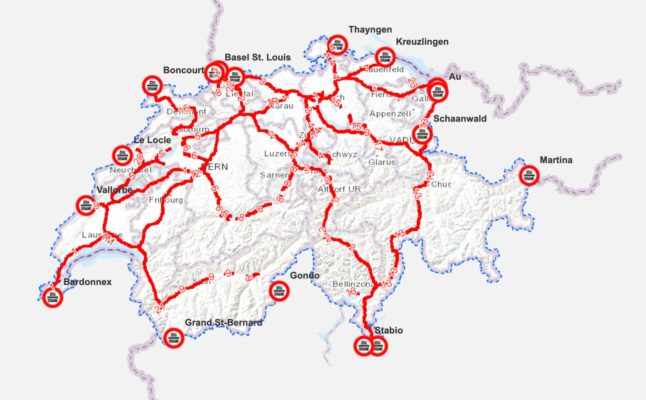
The Federal Office for Customs and Border Security (BAZG)
Other measures that will be implemented in 2026 intend to increase the efficiency of vehicle registration procedures and clarify environmental requirements.
Digitalisation of vehicle registration
From January 1st, vehicle registration will become more digital and efficient.
Electronic European Certificates of Conformity (eCoCs) will be available directly from European databases, making data on individual vehicles in Switzerland’s Vehicle Registration Information System available electronically.
Manufacturers, importers, dealers, suppliers, transporters, garages, and authorities will have direct access to relevant vehicle data.
Vehicles with a valid European Certificate of Conformity (CoC), whether in paper or electronic format, are exempt from Swiss type approval. They can be registered in Switzerland for the first time in the name of any person, provided that all other registration requirements are met.
Advertisement
Payment of CO2 penalty will be a condition for vehicle registration
Also from January 1st, the enforcement of the CO2 law will be more closely linked with vehicle registration.
Concretely, certificates and license plates will only be issued after full payment of any penalty due under the CO2 law or the vehicle’s inclusion in a new vehicle fleet.
This applies primarily to new vehicle importers who exceed specific emissions targets.
Advertisement
Standardisation of the method for calculating the power-to-weight ratio of motorcycles
The power-to-weight ratio of motorcycles will be calculated uniformly throughout Switzerland, using the same method as in the EU. This law will go into effect from July 1st
The new method will correspond to the ratio between engine power and curb weight, and no longer, as before, to the ratio between engine power and unladen weight.
Under the new law, its maximum value is indicated with one decimal place; on the vehicle registration document, this figure is rounded uniformly to the nearest hundredth.
Advertisement
Automated driving and automation systems
Switzerland doesn’t have privately-owned automated cars on the roads yet, but since the entry into force of the Automated Driving Ordinance on March 1st, 2025, Switzerland has established a clear legal framework for the following three applications of automated driving, which will apply to any such vehicle in 2026:
Automatic Steering on Motorways:
The use of an automated steering system is permitted on motorways. The system temporarily takes over driving, while drivers remain ready to resume control at any time.
The Federal Roads Office (ASTRA) is in contact with manufacturers regarding this matter.
Advertisement
Driverless Vehicles:
Driverless vehicles may operate on sections of road approved by the cantons, provided they are monitored from a central control centre. Several pilot projects were approved in 2025 in collaboration with the cantons.
Automated parking:
Automated parking without the driver’s presence is possible in designated and marked parking lots and spaces.
At the same time, road users can already benefit from approved driver assistance systems (CAS), such as adaptive cruise control and lane keeping assist. Automation systems and CAS, which have been part of the testing components of the theoretical and practical driving tests since July 1, 2025, will also be covered in the future road traffic theory course (RTC).


