


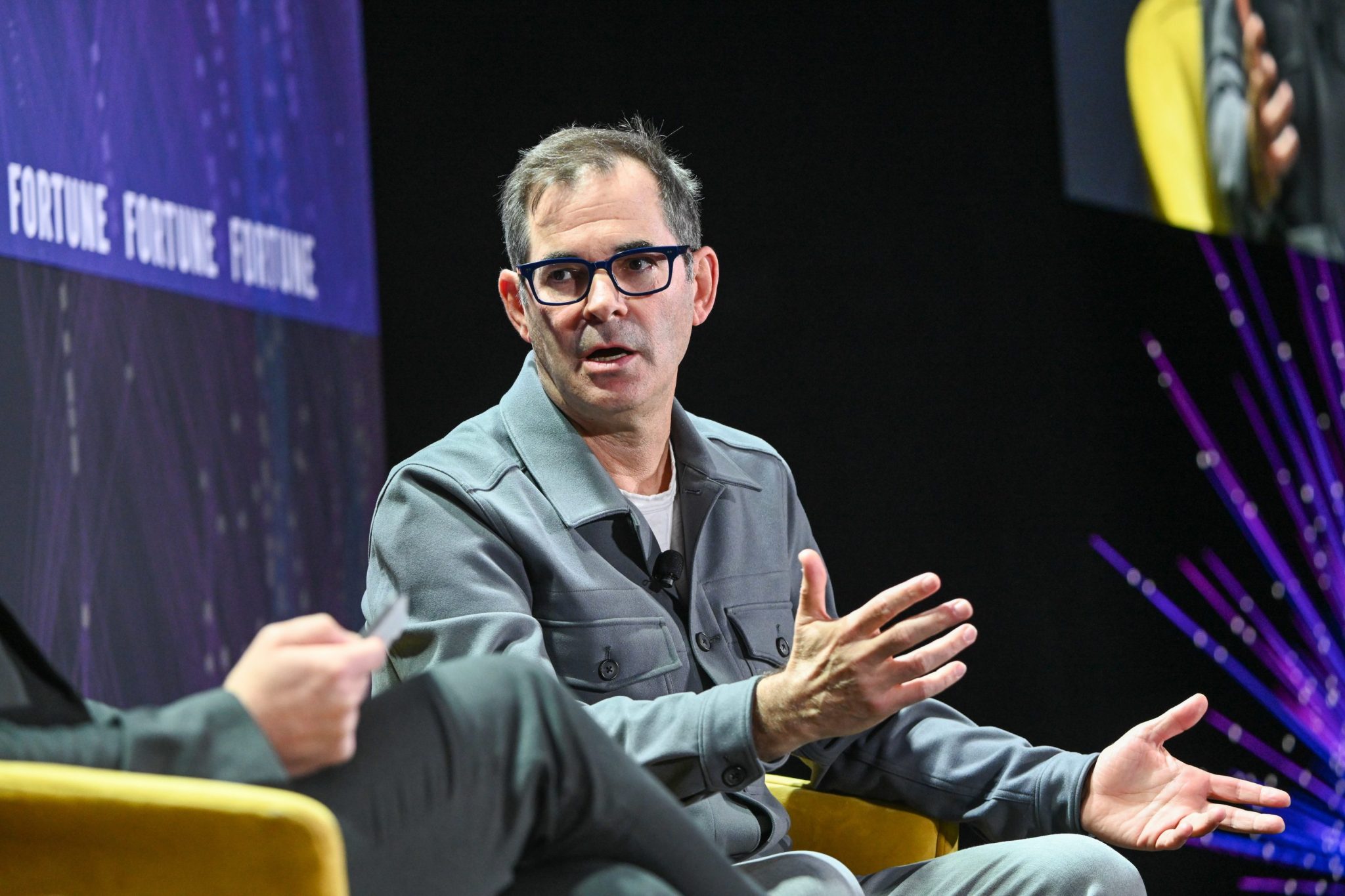
CoreWeave has been rocked by dizzying stock swings—with its stock currently trading 52% below its post-IPO high—and a frequent target of market commentators, but CEO Michael Intrator says the company’s move to the public markets has been “incredibly successful. And he takes the public’s mixed reaction in stride, given the novelty of CoreWeave’s “neocloud” business which competes with established cloud providers like Amazon AWS and Google Cloud.
“When you introduce new models, introduce a new way of doing business, disrupt what has been a static environment, it’s going to take some people some time,” Intrator said Tuesday at Fortune’s Brainstorm AI conference in San Francisco. But, he added, more people are beginning to understand the CoreWeave’s business model.
“We came out into one of the most challenging environments,” Intrator said of CoreWeave’s March IPO, which occurred very close to President Trump’s “Liberation Day” tariffs in April. “In spite of the incredible headwinds, we’re able to launch a successful IPO.”
CoreWeave, which priced its IPO at $40 per share, has experienced frequent severe up-and-down price swings in the eight months since its public market debut. At its closing price of $90.66 on Tuesday, the stock remains well above its IPO price.
As Fortune reported last month, CoreWeave’s rapid rise has been fueled by an aggressive, debt-heavy strategy to stand up data centers at unprecedented speed for AI customers. And for now, the bet is still paying off. In its third-quarter results released in November, the company said its revenue backlog nearly doubled in a single quarter—to $55.6 billion from $30 billion—reflecting long-term commitments from marquee clients including Meta, OpenAI, and French AI startup Poolside. Both earnings and revenue came in ahead of Wall Street expectations.
But the numbers were not all celebratory. CoreWeave disclosed a further increase in the debt it has taken on to finance its expansion, and it revised its full-year revenue outlook downward—suggesting that, even with historic demand in the pipeline.
With media headlines calling CoreWeave a “ticking time bomb,” with critics calling out insider stock sales, circular financing accusations and an overreliance on Nvidia, Intrator was asked whether he felt CoreWeave was misunderstood.
“Look, we built a company that is challenging one of the most stable businesses that exist—that cloud business, these three massive players,” he said, referring to AWS, Microsoft Azure and Google Cloud. I feel like it’s incumbent on CoreWeave to introduce a new business model on how the cloud is going to be built and run. And that’s what we’re doing.”
He repeatedly framed CoreWeave not as a GPU reseller or traditional data-center operator but as a company purpose-built from scratch to deliver high-performance, parallelized computing for AI workloads. That focus, he said, means designing proprietary software that orchestrates GPUs, building and colocating its own infrastructure, and moving “up the stack” through acquisitions such as Weights & Biases and OpenPipe.
Intrator also defended the company’s debt strategy, saying CoreWeave is effectively inventing a new financing model for AI infrastructure. He pointed to the company’s ability to repurpose power sources, rapidly deploy capacity, and finance large-scale clusters as proof it is solving problems incumbents never had to face.
“When I look back at history of the company, it took us a year with with a company investor like Fidelity, before they were like, ‘Oh, I get it,’” he said. “So look, we’ve been public for eight months. I couldn’t be prouder of what the company has accomplished.”


