


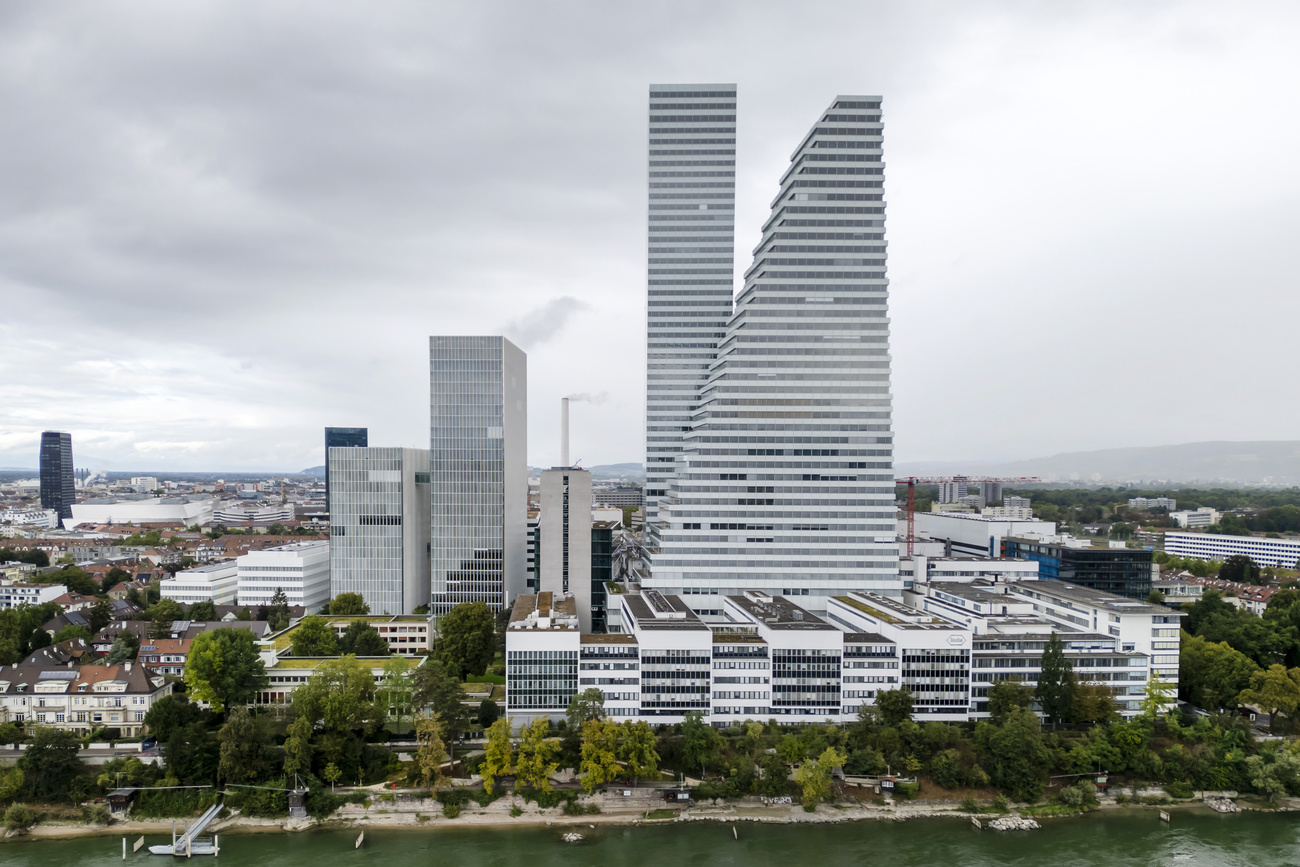
In 2024, Swiss pharma firm Roche opened a new early research centre at its headquarters in Basel.
Keystone / Georgios Kefalas
Swiss pharmaceutical companies are planning massive investments in research and manufacturing in the United States as part of a deal to secure lower tariffs. But this isn’t the only force fuelling anxiety about the future of Switzerland’s pharma dominance.


The Swiss pharmaceutical sector had reason to celebrate on Friday when the government announced a trade deal with the US that brings tariffs from 39% to 15%. The deal also excludes medicine from tariffs for the time being.
The tariff rate on pharmaceutical goods will also be capped at 15% if Trump seeks to impose levies on additional sectors. This is much lower than the 200% on branded drugs US President Trump had threatened over the summer.
Novartis, Roche plan US moves
The tariff deal, which isn’t finalised yet, came about thanks in large part to huge investment pledges by Swiss pharmaceutical giants Roche and Novartis. These amount to a combined $73 billion (CHF58 billion) over the next five years with the aim to produce all key drugs for US patients on US soil.
More

More
Timeline: How US President Trump upended the pharma industry in 2025
“These are significant investments not just from the standpoint of how big they are for US biopharma manufacturing but also compared to what Swiss companies have invested in the past,” said Prashant Yadav, a health supply chain expert and senior fellow at the Council on Foreign Relations in the US. “These investments signal that the manufacturing centres of excellence for advanced therapeutics in the future will be in the US.”
What these investments mean for the domestic pharmaceutical industry is still unclear, said Johannes von Mandach, the head of economic research at Zurich consulting firm Wellershof & Partners. However, they have already fuelled anxietyExternal link in Switzerland that they could further reduce the country’s attractiveness as a pharma hub and undermine the sector’s growth.
The pharmaceutical industry accounts for around half of Swiss economic growth and 60% of exports to the US. If the US share of the industry were to migrate, von Mandach estimates that around CHF3 billion in tax revenue would be at stake.
“It is difficult to assess whether the investments in the US will replace existing production in Switzerland or whether the primary aim is to serve future growth directly on-site,” wrote von Mandach in an email. “But even the latter would have a noticeable impact on Switzerland.”
Competition mounting for pharma investment
The trade deal is the latest jolt to Switzerland’s pharmaceutical dominance that stretches back decades. Around 50,000 people are employed in the industry directly in Switzerland, which has a population of 9 million people. Roche and Novartis alone employ around 25,000 people in the country – about 10-15% of their global workforces.
The industry is made up of thousands of small and medium-sized firms including university start-ups, research-heavy biotech companies, contract manufacturers and service providers. Many foreign pharma companies such as US firm Biogen and Japanese firm Takeda have European or international headquarters in Switzerland.
However, competition is mounting from other countries that see pharma as a source of high-tech jobs and innovation. Spain has become a top destination for new pharmaceutical investment thanks to generous tax breaks for research spending, a speedy regulatory process and a strong health system, wrote BloombergExternal link recently. AstraZeneca, Sanofi, and Roche have all boosted investments in research and development in the country in the last few years.
China has also emerged as a major source of innovation and a growing consumer market with many companies setting up local research hubs to tap into the biotech scene. Over the last five years, 11 big pharma companies committed over $150 billion to license new drugs from China, according to a reportExternal link in Nature.
There are no reliable figures on how much of pharmaceutical exports are actually produced in Switzerland versus how much transits or is packaged and distributed from the country. Production processes are highly fragmented, and many intermediate products cross the border several times during manufacture. As a result, foreign trade statistics may significantly overestimate the production and value added actually generated in Switzerland, explained Johannes von Mandach, the head of economic research at Zurich consulting firm Wellershof & Partners.
More governments are also keen to have pharma production on their own soil rather than have medicine supply be at the mercy of global supply chains. Some localisation is also due to the nature of next-generation therapies that benefit from production being closer to patients.
This is especially the case for cell and gene therapies that are complex to produce and require taking blood samples from patients and frequent visits to the hospital.
Established pharma hubs face strong headwinds
At the same time, companies have become more critical of the regulatory and pricing environment in established hubs like the UK, Japan and Switzerland.
Japan is the world’s third-largest pharmaceutical market, but it is increasingly being overlooked by international drugmakers amid stringent price controls that have stymied the launch of new medicines and stifled innovation.
In September 2025, MSD (known as Merck in the US) pulled out of a £1 billion (CHF1.05 billion) London research hub and ended UK R&D, citing drug pricing pressure and lack of investment in life sciences by the UK government.
In an op-ed in the Financial Times in April, the CEOs of Novartis and Sanofi berated Europe for not properly valuing innovation and said European price controls were reducing the attractiveness of the market. Industry leaders also backed US President Trump’s calls to raise European drug prices in line with US levels if it wants to stay a biopharma leader.
Pharma growth stagnates in Switzerland
The industry has also taken aim at Switzerland after disputes with national health authorities over drug prices. A small consumer market, the country has less leverage to push back than a major revenue generator like the US.
“There is therefore a considerable risk that the increasing localisation of production in the US and other countries will weaken Switzerland’s position as a pharmaceutical centre,” said Georg Därendinger, media spokesperson for the industry association Interpharma.
In addition to strengthening clinical research and securing bilateral deals with the EU, Switzerland urgently needs to “modernise its pricing of innovative medicines and refrain from further cost-cutting measures”.
More
More
The high stakes fight over drug prices
Between 2018 and 2023, foreign investors withdraw CHF560 billion from Switzerland, which is now reflected, among other things, in job growth in the pharmaceutical industry. This fell from 2.5% per year between 2011 and 2020 to 0% between 2020 and 2022, according to Interpharma, Switzerland’s main pharmaceutical lobby group based in Basel.
Swiss ecosystem, stability are advantages
Experts contacted by Swissinfo say the situation isn’t all doom and gloom for Switzerland. The trade deal does keep tariffs at bay. High tariffs on Swiss pharma products would have dealt a major blow to the domestic industry.
Switzerland will “continue to produce for the European markets as well as for global markets outside of the US,” said Christof Klöpper, CEO of Basel Area Business & Innovation. “The investments in the US are not in competition with Switzerland; rather, they represent important additional investments by our large life sciences players.”
The country is also in a better position to weather changes than some others thanks to its strong foundation in research and development, says Yadav. This contrasts with Ireland that became a global pharma manufacturing powerhouse in the 1950s but has very little R&D activity.
This is especially the case as “new treatments such as cell and gene therapies blur the lines between R&D and commercial production”. These therapies often require high skilled, scientific knowledge and strict quality standards to produce and distribute – something Switzerland does well.
Companies like Novartis have hundreds of partnerships with local hospitals and universities for early research and clinical trials. Roche just opened a CHF1.2 billion early research centre, part of around CHF5.8 billion the company has invested in its headquarters since 2009.
Switzerland also offers other perks such as high salaries, low taxes, high quality of life, and stable policies that help woo talent. Several Chinese companies including Hengrui, Luye Pharma, and BeOne Medicines (formerly BeiGene) have recently set up R&D centers or European HQs in the country.
“Industry clusters emerge where there are specialised professionals, suitable infrastructure and expertise built up over many years,” said von Mandach. “This makes a location like Switzerland largely stable, and any rapid relocations rather unlikely.”
Edited by Veronica DeVore/ds
Check out the latest episodes of our science podcast talking about the hottest pharma and healthcare topics:


