


The surprising story of Couto Mixto, a landlocked microstate located in between Spain and Portugal.
The tiny republic of Couto Mixto or Couto Misto was situated between the towns of Montalegre in northern Portugal and Ourense in the Galician region of Spain.
It included the villages of Santiago de Rubiás, Rubiás and Meaus, all of which are located in Spain today, and measured approximately 27 km².
You could easily pass through this area of Galicia and into Portugal without knowing you were driving through an ancient nation.
Today, all that remains are several small sparsely-populated villages and herds of cows that roam the pastures next to the Salas River.
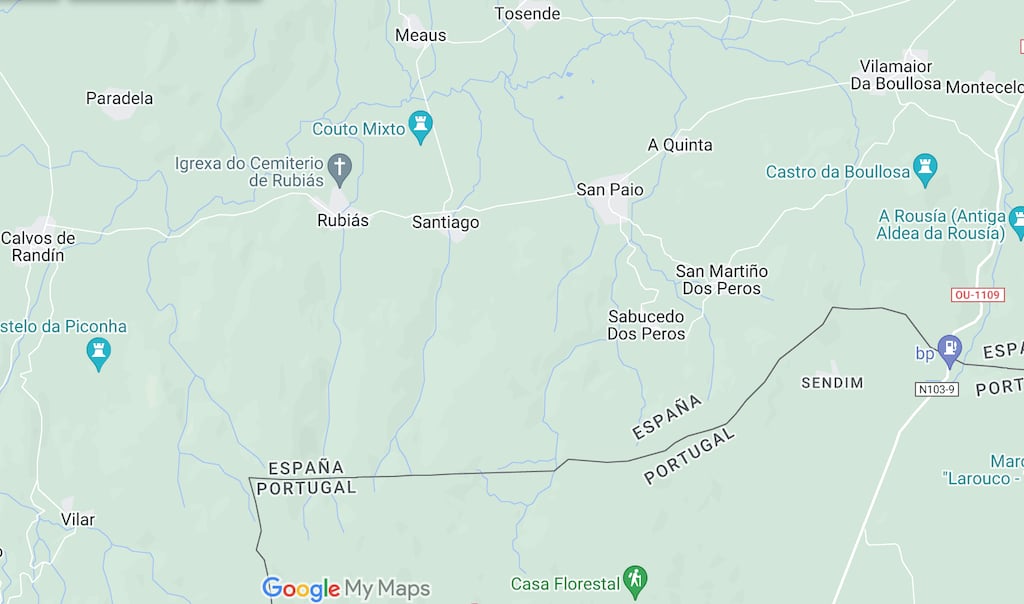
The independent nation of Cuoto Mixto was located in between Spain’s Galicia region and Portugal. Source: Google Maps
Historians aren’t exactly sure when Couto Mixto was established as a state, but it was thought to be sometime between the 10th and 12th centuries.
Some believe that its creation was born out of the signing of the Treaty of Zamora on October 5th, 1143. It was an agreement between two Alfonsos – Alfonso I of Portugal and Alfonso VII of León, which somehow left out a piece of land that was too small to fight over, but large enough to become a republic.
Another hypothesis is that it was created in the Middle Ages as a place where prisoners could serve out their sentences, repopulating lands after the occupation of the Moors.
Meanwhile, locals talk of a legend of an exiled princess who took refuge in the region and was looked after by the inhabitants. To thank them, the princess granted the people freedom to govern themselves.
Advertisement
Whatever the reason it was formed, Couto Mixto continued to be independent for around 700 years and even had its own flag and national anthem.
The inhabitants of Couto Mixto enjoyed several special privileges over those from neighbouring Spain and Portugal, including little to no taxes, exemption from military service, freedom to trade and cultivate land and few crop regulations, meaning that the tobacco trade flourished here.
Inhabitants also had the right to choose their nationality, whether they wanted it to be Spanish, Portuguese or both.
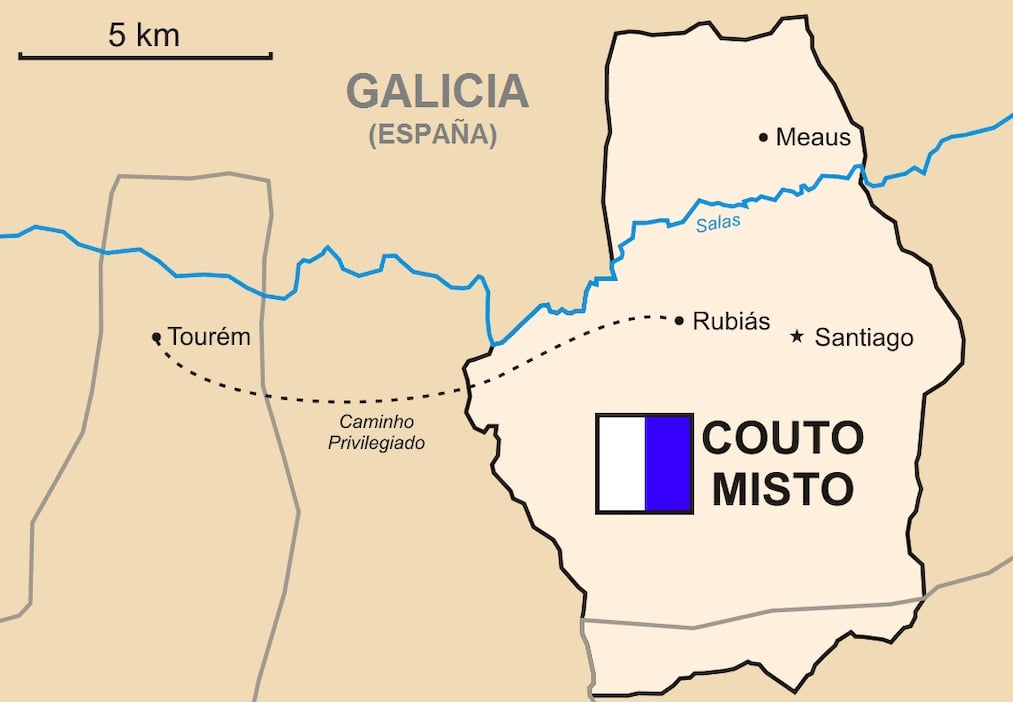
The country of Couto Mixto which once existed in between Spain and Portugal. Photo: Fabio Mendes / Wikimedia Commons
Because of these privileges, it was a haven for refugees and fugitives, and some historians even believe that it was founded for this purpose.
Because of the relaxation of trade rules and the freedom to cultivate, Couto Mixto became a popular smuggling destination. A smuggling route connected the villages within the state with Tourém in Portugal, named the Caminho Privilegiado or Privileged Path, where there were no border guards and no products could be seized. In addition to this, anyone found smuggling here couldn’t be detained.
Advertisement
This doesn’t mean that Couto Mixto was a completely lawless state, on the contrary, it had its own form of democracy.
It wasn’t ruled over by kings or feudal lords, instead it was presided over by a judge who was elected every three years and was supported by delegates in each of the villages. There was also a local vicar, who also had the responsibilities of a sheriff to carry out orders.
Couto Mixto continued to exist until the mid-19th century, when it was finally absorbed by the two neighboring countries as a result of the Treaty of Lisbon in 1864. It was signed in order to put an end to the smuggling and local gangs that had formed. Most of it became part of Spain, modern-day Galicia, while a small slither went to Portugal and the town of Montalegre.
Couto Mixto’s penultimate judge was Delfín Modesto Brandán and today you can find statue of him the atrium of the church of Santiago, as well as in the village of Calvos de Randín where this microstate once existed.


