


The general requirement for all foreign nationals working in Switzerland is to have a certain level of proficiency in a national language to qualify for their residency permit. The Local asked Swiss officials whether this rule is applied equally to all.
This question has become all the more relevant since the reports about two top Thai chefs, twin sisters Vilai and Virat Kanjan, having to leave Switzerland after failing to master German.
The canton where they worked, Nidwalden, has revoked their work permits, explaining that “proof of recognised language is always required when linguistic integration is examined as part of an authorisation procedure.”
READ ALSO: Two top foreign chefs forced to leave Switzerland after failing language test
However, as it turns, the ‘linguistic integration’ criteria are not equally or consistently applied to all foreign nationals.
But first: what are the official language requirements?
According to the State Secretariat for Migration (SEM), “knowledge of a national language is a basic requirement for the successful integration into working and social life.”
Therefore, “all persons applying for family reunification, a residence or permanent residence permit, or regular or early naturalisation, must prove their knowledge of a national language.”
This is what SEM’s requirements look like, with the rules for spoken proficiency higher than for written ones.
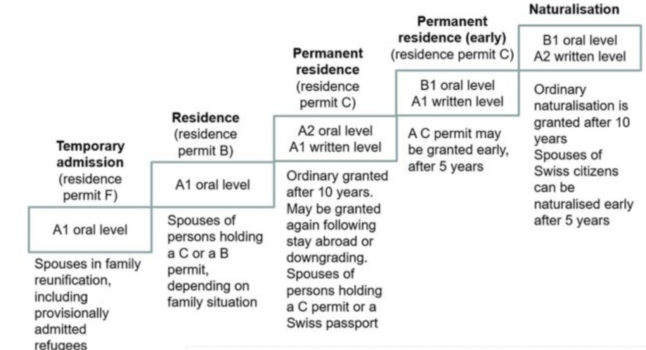
SEM
This is what different levels mean:
A1 A2 : Beginners
B1 B2 : Intermediate
C1 C2 : Advanced
Advertisement
Who has to follow those rules – and who doesn’t?
The largest group exempted from the language requirement – at least for the B permit – are the nationals of the European Union and EFTA (Norway, Iceland, and Liechtenstein) – that is, all foreigners covered by the Agreement on the Free Movement of People.
True, people from Germany, France, Italy, Austria, and Liechtenstein already speak a national language, but citizens of other EU/EFTA states don’t, which doesn’t prevent them from being granted a B permit. (However, if they decide to appy for permit C and, later, for Seiss citizenship, the language proficiency requirement will kick in).
But, in certain cases, the language rule is also waved for third-country nationals.
As reported by Swiss media, “American and British bankers, who are subject to quotas for third-country nationals, often receive more lenient treatment. For these professionals, a good command of English is sufficient. IT experts, consultants, researchers, and cryptocurrency specialists also benefit from the same system.”
Advertisement
‘Unequal’ treatment
According to State Secretariat for Migration (SEM), “when granting residence permits for gainful employment, professional and social adaptability and language skills must indicate a prospect of sustainable integration into the Swiss labour market and social environment.”
In reality, however, that is not always the case.
“The law doesn’t specify language requirements for employed persons,” SEM spokesperson Samuel Wyss told The Local.
“In many cases, the required language proficiency (if any) is not imposed by legislation but is instead determined by individual sectors or employers,” he said.
“This is the case where the relevant requirements are either set out in professional regulations or where minimum language skills are intended to enable persons with medium qualifications in structurally difficult sectors to find their way to the Swiss labour market in the long term,” Wyss pointed out.
Professionals who are exempted from all language requirements, according to Wyss, are foreign religious leaders and counsellors, as well as teachers of native languages and culture.
Advertisement
This is how it works on the federal level, but what about the cantons?
Unlike Nidwalden, where the language rules were strictly applied in the case of the two chefs, other cantons are more flexible in this area.
Take Geneva, for example.
In an interview with The Local, Catherine Santoru, a spokesperson for the cantonal authorities, said that “Geneva verifies the language proficiency of foreign workers when required by federal law and SEM guidelines, but this remains limited to specific cases.”
How so?
The guidelines specify that, in the context of an increasingly globalised labour market “a very good command of English may be sufficient to ensure the long-term integration of skilled employees working in highly specialised sectors and companies,” she said.
In fact, Santoru pointed out that foreigners employed in these sectors and companies “generally succeed in achieving long-term integration into the labour market thanks to their qualifications and their professional and social adaptability.”
“Therefore, it is not necessary to verify whether managers and specialists operating in an international environment possess knowledge of a national language. Since Geneva is a highly international city, we do not, in principle, require fluency in French,” she added.
In Zurich too, professionals considered highly qualified in specialised fields are often exempt from language tests.
According to the Directorate of Public Economy of the Canton of Zurich, “when granting a residence permit to managers and specialists in an international environment, it is possible to waive the examination of knowledge of a national language.”
Advertisement
What other foreign nationals can forego the language test?
People born in Switzerland
If you were born in the country to non-Swiss parents (so are not a Swiss citizen), but have lived your entire life here and have gone through the compulsory Swiss school system, you are exempted from complying with the language rules.
Learned the language at school
Those who have completed compulsory schooling (at least three years) or upper secondary or tertiary education in a Swiss national language are also exempt.
Minor children
Language rules are also waved for children under the age of 18 who come to Switzerland as part of family reunification (but their parents aren’t).
Inability to learn
If the applicant is unable to meet the language requirements or can only do so with difficulty, an exemption may be granted.
This may be because of personal circumstances such as a physical or mental disability, learning difficulties, or a serious or chronic illness.
The person must submit proof of their inability to meet the language requirements.
READ ALSO: Who’s exempt from Switzerland’s language requirement for permits and naturalisation?


