


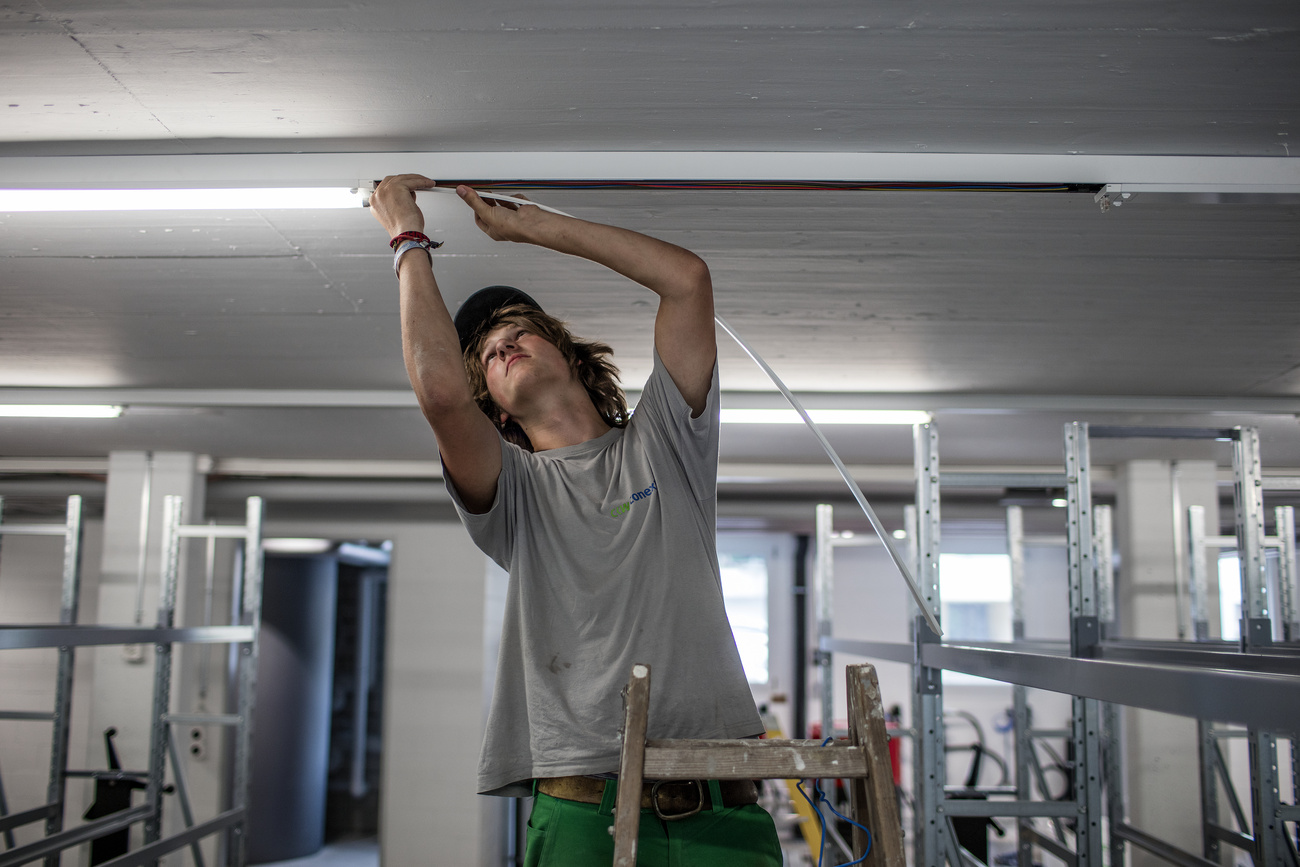
Two-thirds of young people in Switzerland do an apprenticeship after their obligatory school education.
Keystone / Gaetan Bally
Switzerland’s dual-track apprenticeship model serves as a benchmark for education systems around the world. Experts recently travelled to Bern to find out how Swiss apprenticeships work – and how they might use what they learned to advocate for better vocational training in their own countries.
International guests are part of everyday life at the Kursaal Bern hotel and congress centre. But the group touring its corridors on a late summer afternoon is not here to spend the night. They have come to meet apprentices.
The group of around 20 participants were visiting from countries including Haiti, Kyrgyzstan, Mozambique, Cambodia, Indonesia and Laos. They had travelled to Switzerland to learn more about the Swiss vocational education system, following the international Vocational Education and Training CongressExternal link (VET Congress), held in Lausanne, western Switzerland, in early September.
The Bern visit was organised by the Swiss aid organisation Helvetas. “We wanted to give the participants a hands-on look at the Swiss apprenticeship system after the congress,” explains Sabrina Würmli, co-head of the skills, jobs and income team at Helvetas.
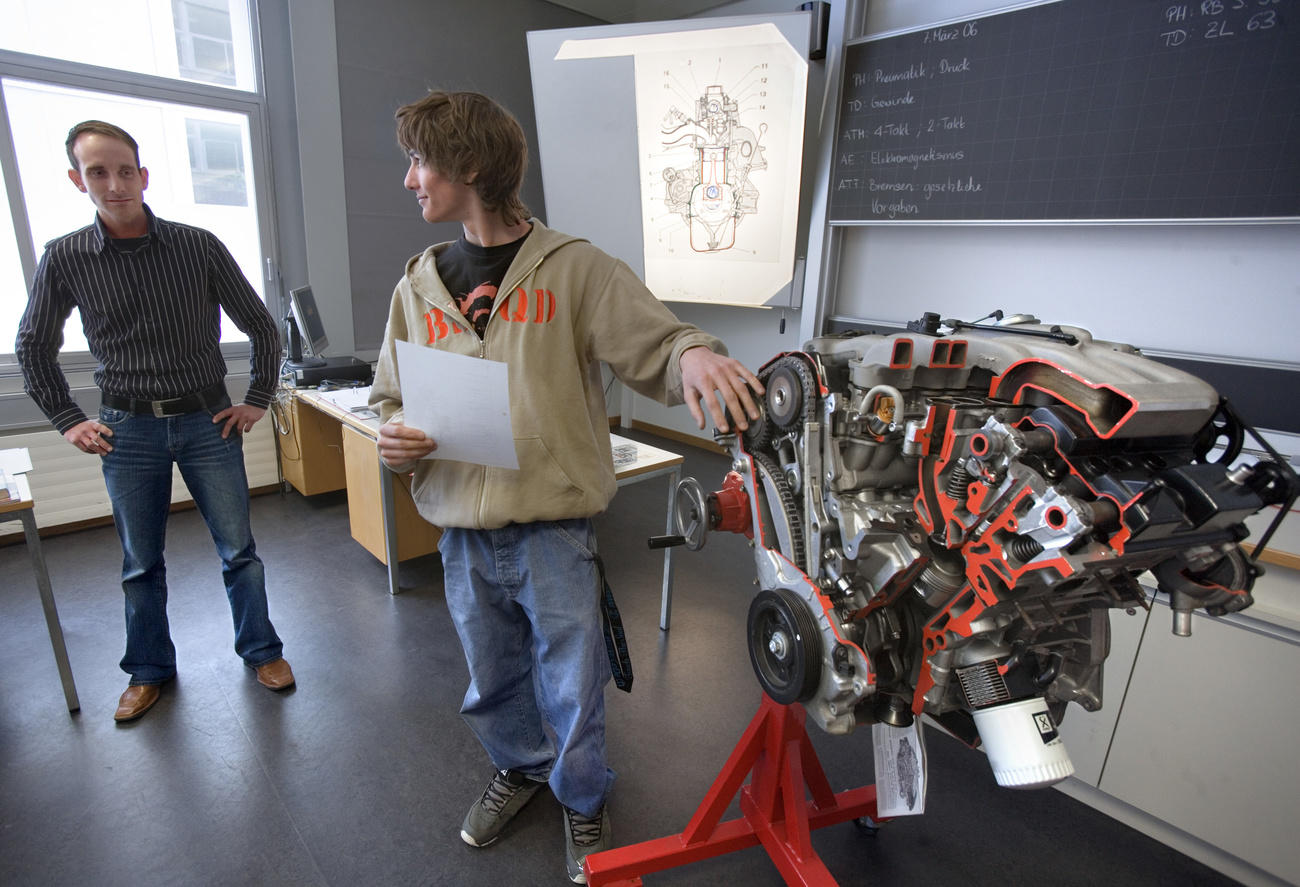
In Switzerland, two-thirds of young people do an apprenticeship after completing their obligatory education. Learn more about this in the article below.
More
More
Why Switzerland’s dual-track education system is unique
Inspiration for reforms back home
The programme took the participants through the same process that apprentices in Switzerland experience – from career information centres and vocational schools to trade associations and company visits. Around 60 people from ten countries took part, including representatives of Helvetas and Swisscontact projects, government officials and delegates from state programme, as well as participants from the private sector.
“The visit to Switzerland provides not just inspiration for reforms, but also a chance for countries to learn from each other’s innovative approaches,” says Würmli. A dual-track system like the one in Switzerland, where young people go to school and work in a company at the same time, does not exist in most of the participants’ home countries.
What is a trial apprenticeship?
The tour of the Kursaal Bern complex begins in the restaurant, where a young woman is doing a trial apprenticeship, known in German-speaking Switzerland as a Schnupperlehre. For the guests from abroad, this is an unfamiliar concept, but they quickly catch on. “Do the teams enjoy having someone assigned to them for a trial?” asks Khanongdeth Viphakone with a laugh. He comes from Laos and oversees the training of young employees in a large company.
After completing an apprenticeship in Switzerland, it’s also possible to go to university. Find out more in this article below.
More

More
Can you study after an apprenticeship?
Christoph Tschäppät from the Kursaal’s human resources department knows what Viphakone is getting at. “Sometimes it can be difficult to find a suitable task that gives a trial apprentice a real insight into the work environment,” he says. But in the end, both sides benefit. The employer can tell whether it is a good fit and the young person can see whether the work feels right for them.
The Kursaal Bern is a four-star hotel with several restaurants, bars and a large events and congress centre. It offers a range of apprenticeships, from business administration to cookery, and currently employs 21 apprentices.
Tschäppät mentions several times that it has become increasingly difficult to attract motivated young people to apprenticeships. The international guests on the tour, however, face the opposite challenge. They want to know how young people in Switzerland find out about the apprenticeship opportunities available to them.
Very impressed by the Swiss approach to career guidance
Altynai Moldoeva was very impressed by the visit to the careers information centre. “They called the young people ‘talents’,” she says enthusiastically. She works for Cheber, a Helvetas projectExternal link funded by the Swiss Agency for Development and Cooperation (SDC) which is building a system of in-company training courses in Kyrgyzstan to boost job opportunities, especially for young people and women.
Moldoeva is visibly moved by the fact that young people are supported closely throughout their journey and treated as individuals. In Kyrgyzstan, formerly part of the Soviet Union, education and training are still very hierarchical and focus more on functions than people.
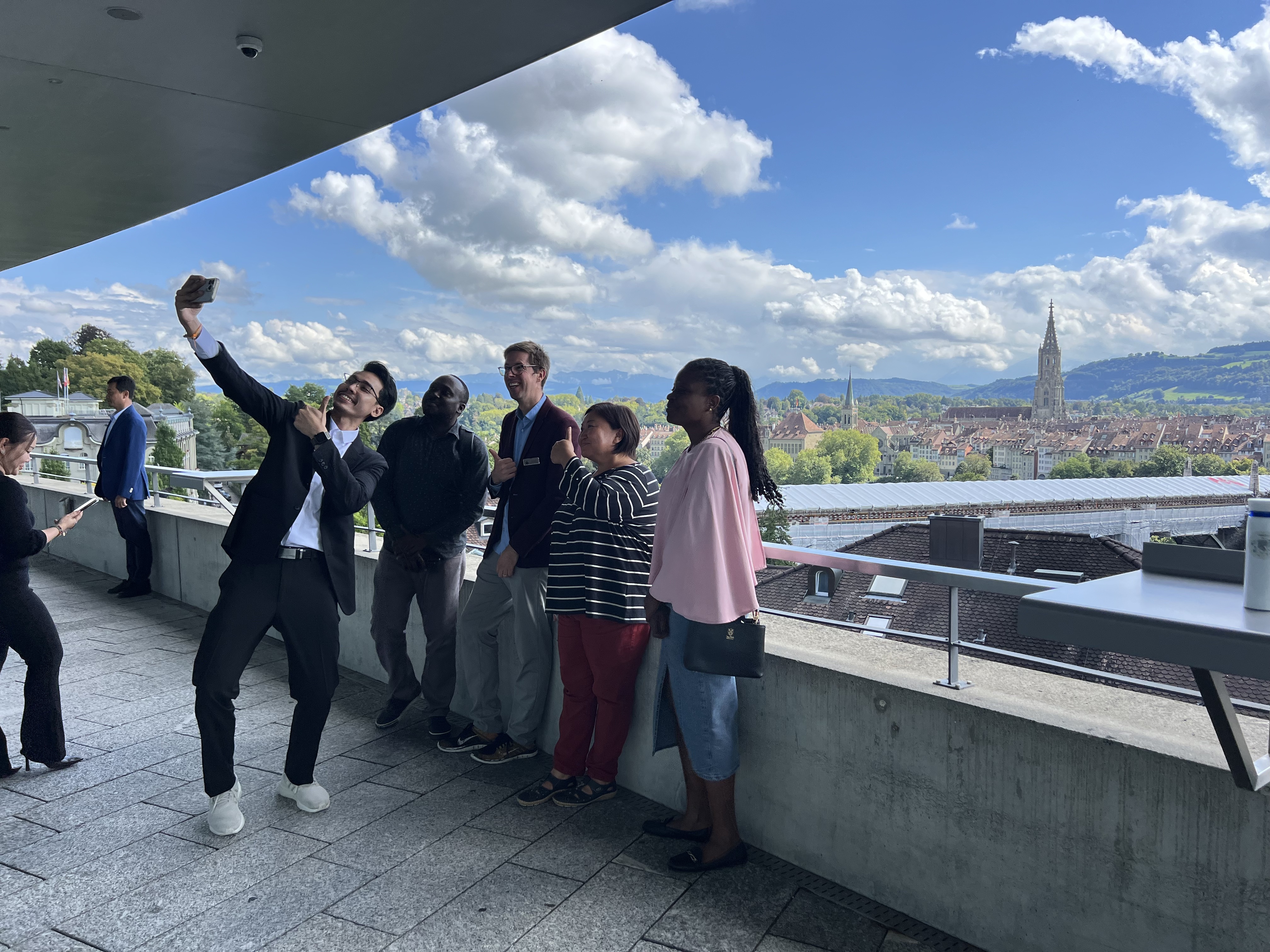
On the terrace of the Kursaal Bern, Christoph Tschäppät (second from the left, near the railing) takes a selfie for the group.
Swissinfo
Tschäppät also talks several times about the way the apprentices are treated. In the past – especially in the kitchen – hours were long, and the tone could be almost military. “Fortunately, that is no longer the case,” he says.
The tour also leads into one of the hotel rooms, which the participants examine with interest. One woman takes a photo of the bathroom; another stands in front of the window and asks where the UNESCO World Heritage Sites are. Tschäppät had advertised that the hotel offered a view of Bern’s historic old town and of the Eiger, Mönch and Jungfrau mountains in the Bernese Oberland.
Unfortunately, this hotel room is too low for that view, but from the terrace on the 5th floor, the panorama is magnificent. Today, the Alps are hidden behind clouds, but the backdrop of the old town and the nearby Gurten mountain still make for great selfies.
Encouraging women to go into ‘male professions’

Fleurant Kerby
Swissinfo
The contrasts between Switzerland and the participants’ home countries are striking – and yet there are issues that affect everyone, like gender bias. Fleurant Kerby heads the Profese project in Haiti, which works to improve the job opportunities of young people, especially young women, through a mix of hands-on training and classroom learning.
As in Switzerland, there are some professions in Haiti which are traditionally done by men and others by women, with the latter earning less. The Profese project has made progress. “At the beginning we had no women in these sectors, now there are 40,” says Kerby, citing carpentry as an example. Often the young woman’s father must be convinced first, but that is usually not a problem.
To encourage others to follow their example, the young women showcase their skills at events. At work, they stand out in a good way. “They are detail-orientated – working as floor layers or painters, for instance” says Kerby. Some even have gone on to start their own small businesses.
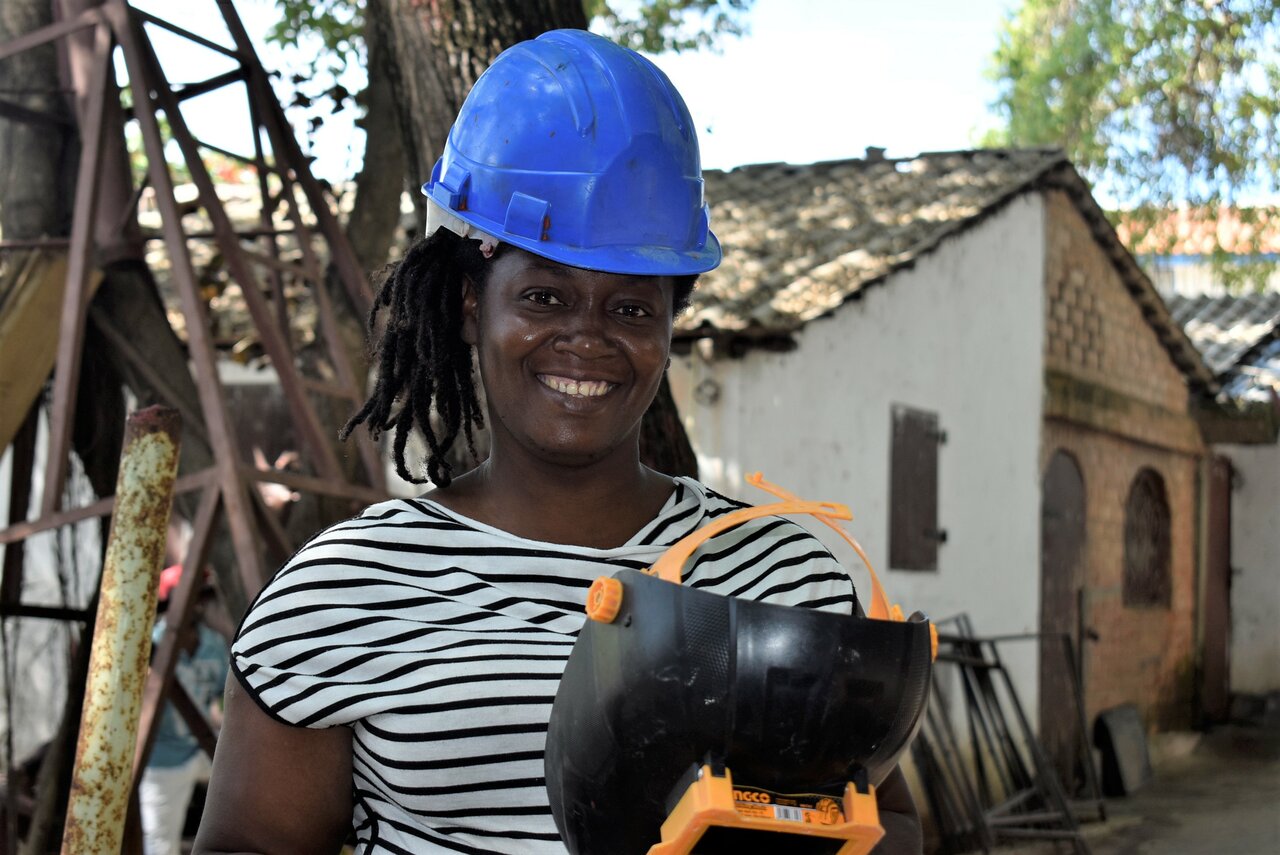
The Profese project gives young women in Haiti access to jobs traditionally reserved for men.
Profese
A solid foundation for a successful career
After a quick look inside the Kursaal kitchen, the group gathers for a final round of questions for Tschäppät and Livia Reber, a second-year business administration apprentice, who has guided the second half of the group through the hotel.
A participant from Nepal asks why Reber chose this apprenticeship, and she is quick to reply. She wanted to learn languages, and enjoys working with people. “The apprenticeship is a good foundation,” she says. And it keeps a lot of doors open.

Jayaseelan Sumitra
Swissinfo
Few in Switzerland would disagree. The dual-track education system is deeply rooted in Swiss society and completing an apprenticeship often marks the start of a successful careerExternal link.
In other countries, vocational training has not yet been accorded the same value. Jayaseelan Sumitra works in Jakarta, Indonesia, where the Association of Southeast Asian Nations (ASEAN) has its headquarters.
There, she is responsible for an SDC-funded initiative that promotes practice-oriented technical training in countries such as Cambodia and Laos. She was particularly impressed by the success stories of the apprentices in Switzerland. “Switzerland shows that there are many ways to excel during training.” Now, she adds, the next step is to convince governments and businesses that investing in apprentices is worth it.
From trainees to valued colleagues
Christoph Tschäppät explains that, by the end of their training, apprentices are often among the best employees, “they know the different areas of the business, and they are young and motivated”. The company also benefits from their youthful perspective and fresh ideas. “After all, the young generation are also our customers of tomorrow,” he adds.
Khanongdeth Viphakone from Laos pulls out his mobile phone and films Tschäppät’s closing remarks. Until now, he wasn’t sure what a company stood to gain from investing so much in apprentices. “But this approach has convinced me,” he says.
Edited by Marc Leutenegger. Adapted from German by David Kelso Kaufher/sb
More

More


