



 Peter Mumby
The Great Barrier Reef is headed for a “grim future” and will suffer a “rapid coral decline” by 2050 but parts may recover if global warming is kept below 2C, a new study has found.
Researchers at the University of Queensland (UQ) used modelling to simulate the lifecycles of certain coral species and found that some were better at adapting to warmer oceans and could help new coral grow.
Reefs near cooler-water currents were also more resilient, giving a “glimmer of hope” to the natural wonder, which has suffered severe climate-induced heat stress in recent years.
The study warned that curbing carbon emissions was crucial to allow coral to recover and avoid a “near collapse” of the reef.
Dr Yves-Marie Bozec, who led the research, said the modelling of more than 3,800 individual reefs that make up the Great Barrier Reef looked at their “eco-evolutionary dynamics”. This included how corals interact with each other, how they deal with warmer water and corals in naturally cooler areas.
“We ran all of those factors with the most up-to-date climate projections – and the news was not good,” he said.
“We forecast a rapid coral decline before the middle of this century regardless of the emissions scenario.”
The Great Barrier Reef is one of the world’s most biodiverse ecosystems, stretching more than 2,300km (1,400 miles) off Australia’s north-east coast.
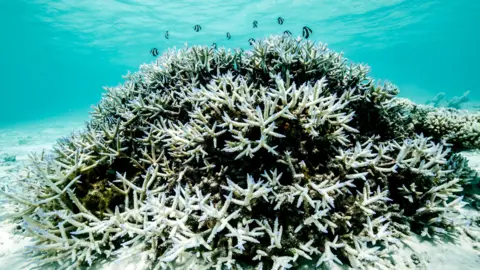
It has suffered four significant marine heatwaves between 2016 and 2022, causing much of its coral to expel the algae which gives them life and colour – a process called bleaching, which is often fatal.
A recent report found that parts of the Great Barrier Reef had suffered the largest annual decline in coral cover since records began nearly 40 years ago.
Dr Bozec said some parts of the reef “may partially recover after 2050, but only if ocean warming is sufficiently slow to allow natural adaptation to keep pace with temperature changes”.
“Adaptation may keep pace if global warming does not exceed two degrees by 2100. For that to happen, more action is needed globally to reduce carbon emissions which are driving climate change.”
Dr Bozec said: “The window for meaningful action is closing rapidly but it hasn’t shut”.
Under the Paris agreement, almost 200 nations have pledged to limit global temperature rises to 1.5C and to keep them “well below” 2C above those recorded in pre-industrial times, generally considered to mean the late 19th Century.
Prof Peter Mumby, who also worked on the study, said they found “many reefs could persist under the Paris agreement target of two degrees of warming”.
“However, higher emissions leading to faster temperature rises would drive most reefs to a near collapse,” he said.
Prof Murphy said reefs in areas “where the water doesn’t heat up so dramatically because it is well mixed, fared better than others” and reefs close to populations of corals that can regenerate were also healthier.
Identifying areas of the reef network that are more resilient will mean efforts to protect the reef can focus on “strategic parts” of the ecosystem, he added.


