


The Umbrella Movement was a pro-democracy protest in Hong Kong which began on September 28, 2014, when the police used tear gas to disperse demonstrators who were demanding transparent elections.
Keystone/ALEX HOFFORD
Amid escalating attacks by the Chinese government, exiled pro-democracy activists from Hong Kong have sought havens abroad, including in the Swiss capital, Bern.
Switzerland seems an unlikely spot for exiled Hong Kong democracy activists to seek to resist repression by China.
The central European nation hosts just over a thousand residents from the former British colony, compared with the three-quarters of a million HongkongersExternal link divided fairly equally between the UK, US and Canada.
Neither has the Swiss government put in place the kinds of special visas or fast-track residency that some countries offered people from Hong Kong following the crackdown on political rights in the city from 2020.
Yet human rights group Amnesty International this year choseExternal link the Swiss capital of Bern as its officially registered centre for Hong Kong. The charity was forced to close its previous offices in the southern Chinese city, saying employees were at riskExternal link from a sweeping national security law that allows arbitrary raids, arrests and prosecutions.
The decision is a mark of Switzerland’s strong legal safeguards for individuals’ privacy, as well as its political stability and rule of law. That’s even as the operations of the newly created Amnesty International Hong Kong Overseas (AIHKO), the first campaign office that the charity has created entirely in exile, are led by diaspora activists in hubs including Australia, Canada, Taiwan, the UK and US.
“Switzerland provides strong legal safeguards that protect the private information of our staff, supporters and other stakeholders,” Fernando Cheung, an AIHKO board member and former Hong Kong legislator, told Swissinfo. It has a strong legal system and stable social environment, “ensuring that civil society organisations, especially those advocating for human rights, like us, can operate without disruption”.
More

More
How active are Chinese spies in Switzerland?
Threats from AI escalate
Picking a jurisdiction with tight information-protection laws is increasingly important for all kinds of rights groups. Growing data collection by governments, tech firms and even criminal networks, on top of plunging storage costs and analysis of giant datasets with artificial intelligence (AI), mean any information harvested can be retained and processed effectively forever. Thomson Reuters Foundation, an independent media-freedom group, published Data Protection: A Guide for Charities and Non-Governmental OrganisationsExternal link, a year ago. China is the ultimate surveillance state and deploys its monitoring capabilities beyond its own borders, putting the regime’s opponents at risk.
Although not a member of the European Union, since 2023 Switzerland has aligned with the EU’s General Data Protection Regulation (GDPR), a global benchmark for data privacyExternal link. Organisations in Switzerland must design safeguards into their systems or services, while non-essential data must not be collected without prior consent.
By comparison, US President Donald Trump issued an executive order in March that sought to centralise information and remove barriers to sharing it across government. Human Rights Watch criticisedExternal link the action, while also adding that current US privacy legislation dating back to the 1970s “does not meet modern data protection needs”.
Canadian efforts to tighten up laws on electronic privacy have stalledExternal link because of political party wrangling. Britain has also faced criticism that its Data Use and Access Act, passed this year and aimed at simplifying legislation, in fact weakens safeguards. European Digital Rights (EDRi), the biggest European network defending online freedoms, urgedExternal link the EU to avoid following the UK’s “rollback” of protections.
OpenAI sees evidence of China surveillance
Such protections may increasingly be warranted, particularly as the growth of artificial intelligence hands new surveillance tools to undemocratic states like China.
OpenAI, the San Francisco-based group behind the ChatGPT large language model, said in FebruaryExternal link that Chinese groups had used its technology to develop an AI tool to automatically scrape and report back on anti-regime posts on Western social media. It was the firstExternal link time OpenAI gained evidence of such activity. The firm said it had seen other US tech being used to generate posts in English criticising Chinese dissidents.
China has intensified its targeting of human rights defenders overseas as activists who fled Hong Kong set up campaign organizations in exile. They face repeated harassment and attacks as well as persecution of family members who remain in the city.
More
More
In Switzerland, Chinese dissidents now know they are not alone
Joey Siu, a board member of AIHKO, is wanted by Hong Kong authorities for allegedly violating its National Security Law by “colluding with a foreign country or with external elements,” with a HK$1 million (CHF102,000) bounty on her head. In January, she received emails “offering life insurance for accidental events and funeral and burial coverage in the event of my death”, in an apparent intimidation tactic, she said.
In May, police targeted the family of Anna Kwok, executive director of the Hong Kong Democracy Council (HKDC), a non-profit pro-democracy movement based in the US. Hong Kong arrested her father and brotherExternal link on suspicion of “attempting to deal with directly or indirectly, any funds or other financial assets or economic resources belonging to, or owned or controlled by, a relevant absconder”.
Hong Kong dissidents targeted overseas
In August, Carmen Lau, who moved to the UK in 2021 and works as a senior international advocacy associate at the HKDC, accused UK policeExternal link of asking her to self-censor and refrain from attending public gatherings, such as protests. Letters offering a £100,000 (CHF106,000) bounty for information on her movements or for her being taken to the authorities were posted to her neighbours, The Guardian newspaper reported.
These and other Hongkongers were forced to flee their hometown after Beijing bypassed the local government in 2020 to put in place legislationExternal link including the National Security LawExternal link, all but outlawing public opposition and dissent.
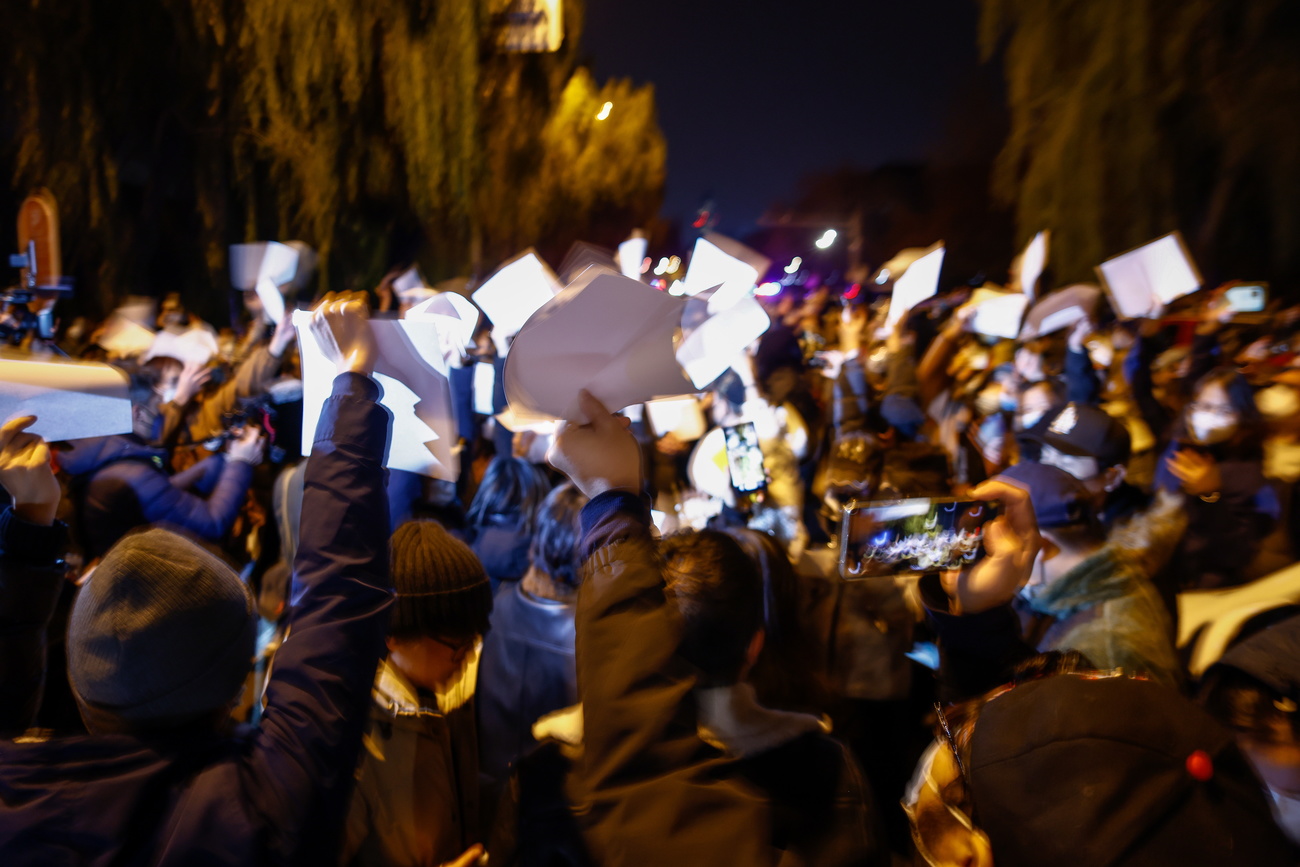
That followed months of protests over a government extradition bill that would have allowed Hong Kong residents to be tried in mainland Chinese courts. Protests initially sought withdrawal of the bill before evolving into a fight for broader democratic rights.
At the time, the vague definitions in the National Security Law sparked fears of legal repercussions among staff at Amnesty International’s Hong Kong offices, renderingExternal link it “impossible to know what activities might lead to criminal sanctions”. Its Hong Kong section became the target of public criticism in pro-Beijing Hong Kong media outlets such as Ta Kung Pao. Members were accusedExternal link of colluding with foreign forces and were portrayed as agents of Western governments aiming to destabilise Hong Kong.
This compelled Amnesty to close its two Hong Kong offices in 2021. It was not alone.
Since Beijing inserted the National Security Law into Hong Kong’s de facto constitution, or Basic Law, in June 2020, more than 58 local civil society groups have been forced to disband, accordingExternal link to Michael Mo, a doctoral researcher in the School of Politics and International Studies at the University of Leeds. Amnesty has saidExternal link that more than 100 non-governmental organisations and media outlets have shut or been forced to flee.

A timeline illustrating how Hong Kong has evolved throughout the years
Kai Reusser / SWI swissinfo.ch
Exiles persist despite threat of reprisals
Like the London-based human rights charity, many such groups have set up abroad. They include the Hong Kong Democracy Council in the US and Hong Kong Watch in the UK. They’re continuing efforts to expand their global networks and connect with diaspora Hong Kong communities, document human rights violations in the city, and bring these issues to the international stage.
Even in exile, many fear China’s reach, with most of those who Swissinfo contacted for this story declining to talk.
“Now is not a good time to interview overseas Hongkongers,” said one, declining to be named for fear of reprisal. “Many are choosing to remain silent and keep a low profile. Only those whose entire families have already emigrated abroad dare to speak out.”
China and its nationalist outriders have worked to elevate such fears.
More
More
Chinese repression of Tibetans and Uyghurs: ‘Switzerland must take action now’
In May, the BBC reportedExternal link that Innes Tang, a pro-Beijing activist from Hong Kong who has reported dozens of people to authorities for alleged national security violations, aimed to move to Switzerland to set up a media company. Swissinfo was unable to find any such registered media in the country. Tang regularly visits the United Nations in Geneva to speak at conventions giving China’s perspective on Hong Kong, the BBC said.
“I worry that Chinese or Hong Kong nationals in Switzerland may be collecting names and intelligence to report on Hongkongers involved in democratic movements here, accusing us of violating the National Security Law,” said James Sun*, a member of the diaspora who participated in a ‘Solidarity with Hong Kong – No Extradition to China’ protest outside the Chinese consulate in Zurich in 2019.
Sun is among those who no longer talk about Hong Kong politics on social media. Yet he sees the opening of exiled human rights operations like Amnesty’s in Switzerland and elsewhere as an opportunity to connect and strengthen Hongkongers’ voices.
“I don’t want to remain silent forever,” he said.
*By request, a pseudonym has been used to protect the identity of the person who spoke to Swissinfo.
Edited by Tony Barrett/vm/sb
The identity of the author has been withheld from this story for security reasons.
More

More


