


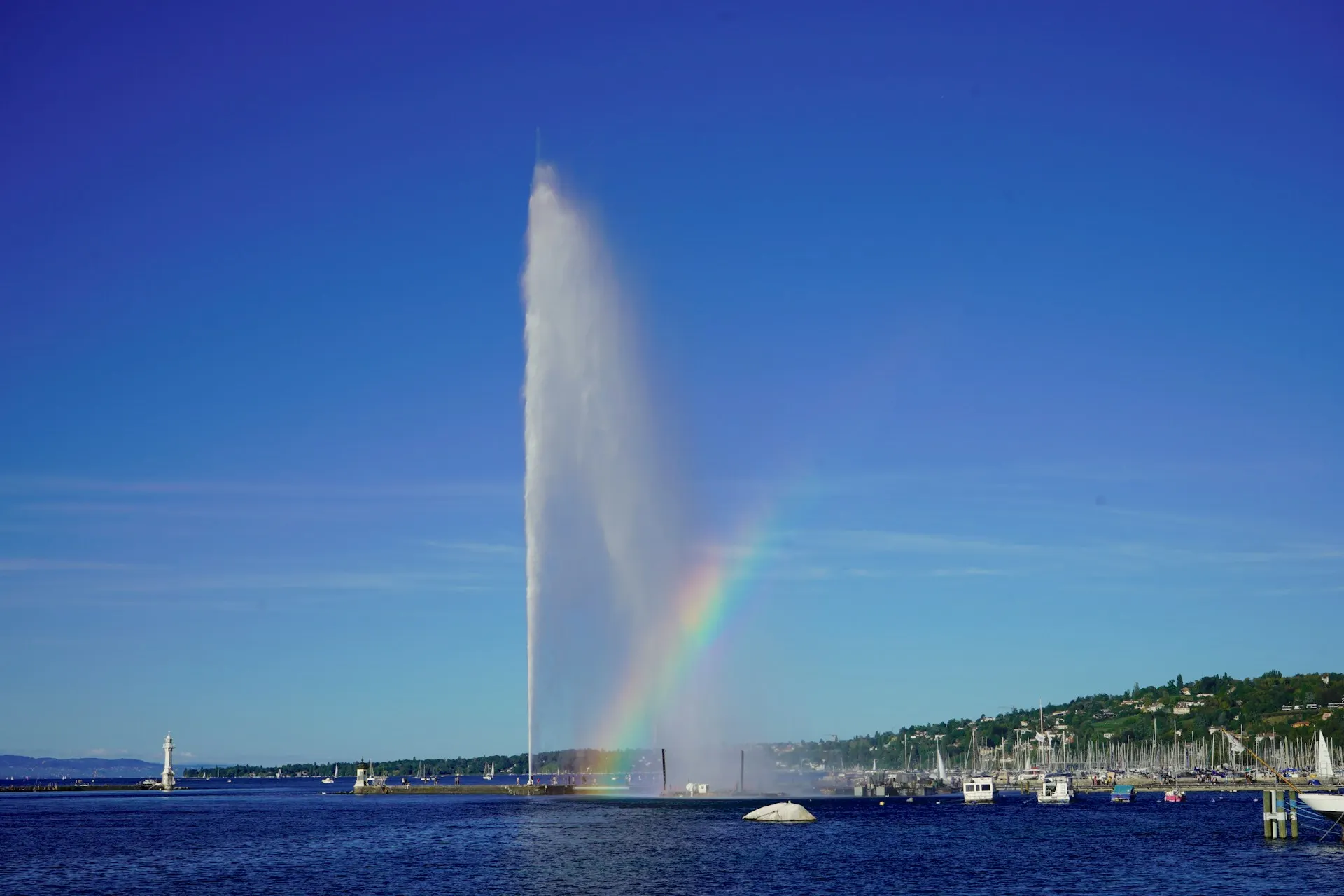
As every year, the emblem of the Swiss city of Geneva, the Jet d’Eau fountain, will be turned off for five weeks starting October 29th.
The canton is taking advantage of this shutdown to continue renovating the Eaux-Vives lighthouse, located at the end of the pier.
Maintenance work takes place every autumn to ensure the proper functioning of the famous fountain.
According to the Geneva Industrial Services (SIG),which is in charge of these works, the focus is on “maintaining the valves, pumps and motors located in the room under the Jet d’eau.”
This is a good time to remember (or learn) some interesting facts about this landmark, which is visible from planes flying into and out of Geneva airport, as well as from the top of Geneva’s Salève mountain.
This is what we know:
1. Created in the 19th century, it wasn’t a fountain at all, but a release valve designed to relieve over-pressure from a hydraulic pumping station that powered the machines of jewellers and watchmakers at La Coulouvrenière. At first it only spouted water 30 metres high.
2. In 1891, Geneva authorities decided to turn it into a tourist attraction and moved the valve to its current position just off Eaux-Vives on the left bank. It was connected to the drinking water system and the water flow increased so the spout climbed to 90m.
3. In 1951, the fountain reached its current maximum height of 140m after it was connected to a new pumping system that took water directly from the lake.
4. Some 500 litres per second of water now flows from the jet, at a speed of 200 kilometres per hour.
5. At any one time, up to seven tons of water are in the air at the same time.
6. Tubes in the specially designed nozzle disperse air into the water, turning it into bubbles and creating the fountain’s white colour.
7. It’s managed by the Services Industriels de Genève (SIG) and manually switched on and off by five volunteers who are retired SIG workers.
8. It costs around 800,000 francs a year to run.
9. The jet d’eau doesn’t run constantly. It is switched off at night, in strong winds, and in below zero temperatures.
10. In 2016, a new walkway was built out to the jet d’eau, replacing the old concrete jetty built in 1891.


