

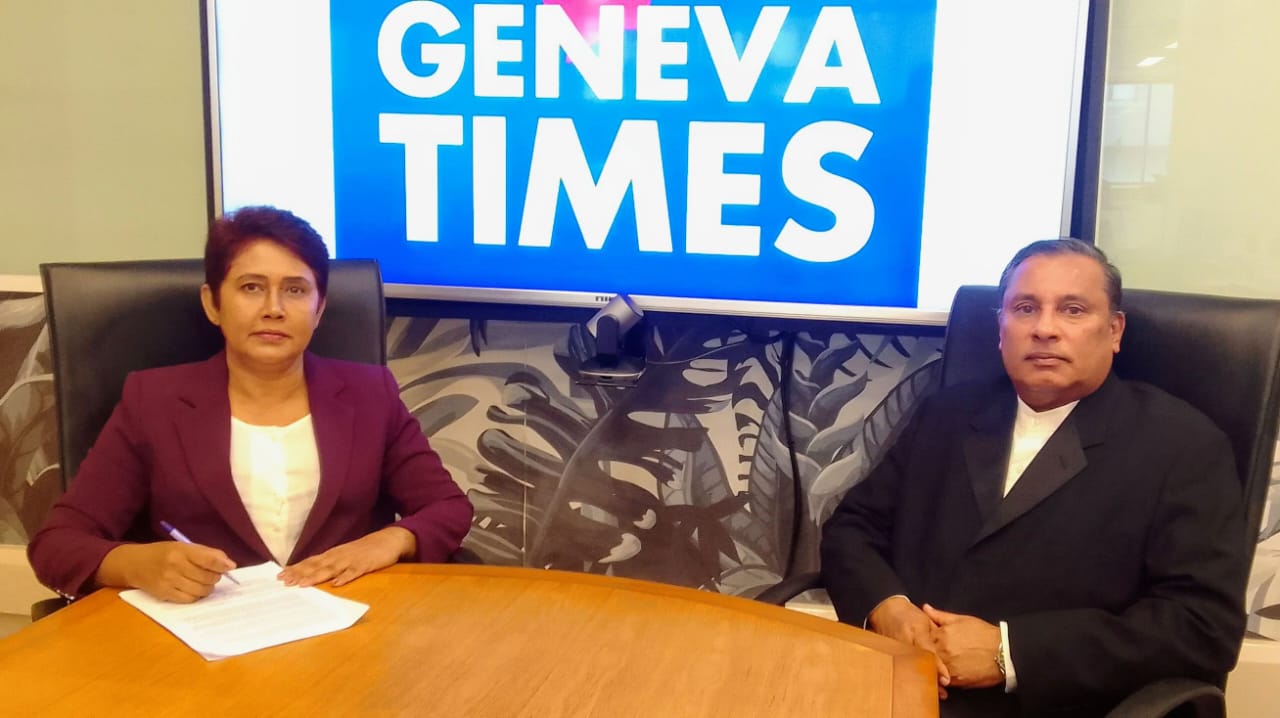
You will find the full video interview attached, offering an in-depth look at the conversation.
Interview by Pranitha Warnakulasuriya , Journalist and Reporter Geneva Times- Sri Lanka , with Dr Sanjay Perera, Resource Person, John Hopkins, Former Advisor Ministry Of Health, Sri Lanka and Former Chairman, Geological Survey and Mines Bureau Sri Lanka.
Q- How significant is mineral mining to Sri Lanka’s overall economy today?
A – Mineral mining including quarrying, gems, mineral sands, etc. plays a relatively minor but still meaningful role in Sri Lanka’s economy today. It contributes value, foreign exchange, especially through exports of gems & jewelry, and supports certain local employment, but it is far from being a dominant sector.
The mining & quarrying sector contributes under 1% of Sri Lanka’s GDP. It is small compared to agriculture, manufacturing and services. Sri Lanka is sitting on the potential of harvesting and exporting millions of tons of Heavy Mineral such as Ilmenite, Zircon, Rutile, Monazite and Graphite which is in demand right now and our Monazite contains rare earth elements which can be exported as high as 4,000 dollars a ton.
The question is why hasn’t any government since independence taken advantage of these natural resources the country is blessed with? My answer is, Internal and opportunistic Politics, lack of permanent Policies and unclear and ambiguous regulatory acts and the lack of vision by government institutions to encourage capitalizing on economic development through the export of Heavy Minerals is what I see as the biggest hindrances in comparison to developments made by countries such as Australia, South Africa, China etc over the past 10 years.
Q – How has the mining sector evolved over the last decade in terms of production, regulation, and investment?
A – Mines & Minerals legal framework has been actively consolidated and updated in recent years including consolidated acts made available in 2022/2023 this brings older laws together and clarifies roles for agencies such as the Geological Survey and Mines Bureau functions. That makes licensing and oversight more explicit than a decade ago but yet there are areas of ambiguity in the current acts regarding heavy Mineral Mining and exports.
There’s been increased emphasis on Environmental Impact Assessment (EIA) compliance, rehabilitation of mined areas and clearer provisions for royalties driven by both domestic policy and donor era governance reforms. But these seem to be strictly overly imposed only to potential private license holders and not to the state-owned Institutions where the Acts and regulations are overlooked or ignored. Rehabilitation is one good example post mining . I think the Government and Government Stake holders should create a level playing field if we are to encourage more investment in the sector.
Constant changes in tax policy such as VAT, removal of export incentives or exemptions in the past 5 years have produced swings in gem & jewellery export earnings and affected investment decisions, negatively rubbing off on the heavy mineral mining Industry confidence as well. Like I said before, Sri Lanka lacks clear policies to encourage investment and exports of processed and separated heavy Minerals.
Q – Are there untapped mineral resources that could transform the country’s economic landscape?
A – Great question. A short answer is YES. But we need to first address the stumbling blocks in order to change our economical landscape through Mineral mining, processing and exports. So let’s address the critical issues first.
Sri Lanka has several untapped or under-developed mineral resources, heavy mineral sands, REE bearing deposits, phosphate, graphite, and offshore hydrocarbons which, if harvested, processed and exported responsibly and competitively, could materially increase export earnings and local industrial value-additions. But unlocking them would require substantial capital investments, stable policy, Environmental safeguards and good community engagement.
I Like to give you an example of the highest-potential resources, the realistic upside, and the main technical, commercial, governance constraints.
Heavy mineral sands or the titanium group minerals such as ilmenite, rutile are plentiful in Pulmoddai, Kuchchweli, Nilaweli, Batiicalo and Ampara (East coast) and the Mannar-coast contain commercially meaningful deposits. Projects and many companies have been working or completed feasibility and EIA stages. These minerals are used in pigments, ceramics and as feedstock for titanium metal. But foreign funded NGOs who support other mineral producing countries under the guise of Environmentalists, opportunistic politically motivated individuals or parties and Geopolitical affiliations, hinder the progress of expediting these projects to the point of harvesting, processing and exports and deprive the much needed foreign earnings for the country.
Certain Sri Lankan deposits such as Monazite in beach sands in the East and apatite/rock phosphate at Eppawala) contain Rare Earth Elements or REE potential. Scientific work shows REE presence in these sands and with the rising global demand for REEs for magnets, EVs and renewables we as a sovereign, nation state is not capitalizing on these demands due to the lethargy and ambiguity in Government departments and the lack of ambition and vision of policy makers in all governments since indipendance that governed Sri Lanka up to date.
A good example is the large, known phosphate rock at Eppawala with estimates often quoted in tens of millions of tons, and is a domestic fertilizer feedstock and could support local fertilizer production. Historically this deposit has been discussed for decades but constrained by ambiguous and inconsistent policy and NGO driven environmental debates and the lack of determination of Policy makers.
Sri Lanka produces high-quality vein graphite and other industrial minerals like sillimanite, feldspar, mica. Graphite demand for batteries should by now increase interest in modernizing and increasing production in Sri Lanka but has not. Existing production is relatively small. Government should encourage the enhancement of exports by offering incentives on investment and speeding up approval processes. The same applies for harvesting, separating and export of heavy minerals such as Ilmenite, Rutile, Zircon, Monazite and REE.
Q – What are the main stumbling Blocks you see in Sri Lanka to capitalize on the current global demand
A – In the current scenario it takes over 3 to 4 years from the date of obtaining an exploration License from the GSMB to the stage of completing a comprehensive exploration and a EIA which, up to this point would cost any investor over $ 250,000 followed by land acquisitions for mining, acquiring lands for the factory, obtaining factory clearances, electricity connections, water supplies, amid NGO or Politically backed and overcoming community objections and overcoming them which, would easily cost another 500,000 $. Then we have investments for the plant and machinery between $ 12 to 15 Million and a total dubious period exceeding over 6 years up to the point of receiving a mining license. This is not an encouraging factor in any way to any investor who has to block close to 20M $ for over 6 years to start earning some returns on investment via exports. The biggest stumbling block are the Government departments and regulatory bodies themselves who find ways to discourage investment in heavy mineral mining rather than encourage the speedy expediting.
There is also a tendency for certain politicians in the North and East to discourage Sri Lankan owned companies in this sector and instead support heavy mineral mining to foreign companies. We have heard it in open statements made at cabinet or provincial levels. Priority should be given to Sri Lankan enterprises who are ready to make investments in this sector because the returns on exports are brought in to the country thereby increasing the foreign exchange earnings for Sri Lanka instead of these export earnings disappearing to another country.
In short encouragement specially to Sri Lankan own enterprises in this sector is minimum by policy makers, thereby discouraging possible FDI through joint ventures and technological transfer affiliations.
Q – What can the Government and Regulators do to increase export earnings via heavy Minerals?
A- REE recovery from apatite and monazite or complex beach sands requires advanced metallurgy and significant capex. Many deposits are not “plug-and-play.” Sri Lanka has top Experts, Geologists, Mining Engineers and Academics with practical knowledge who are more than willing to provide their advice free of charge for the benefit of the country in this sector. No government has fully utilized the knowledge of such experts to improve the industry. Instead, we have continuously seen a few politicians with pollical motives together with a few politically motivated obliging officials trying to develop policies which are not practical and do not encourage the mineral mining Industry.
Environmental & social concerns have to be addressed without doubt specially Beach placer mining and large coastal operations. However, it’s the regulators who need to get involved with the investors and assist in these clearances instead of putting the total onus on the investors. Example in Australia, the government provides the licenses for mining with all required approvals obtained from the regional policy makers and authorities including land acquisition for mining and the mining companies do have to refund all expenses incurred by the Authority for the EIA, land clearances and issuing of the mining license etc. We need to develop this method in Sri Lanka. I have provided a synopsis to the Authorities 3 months ago which you may publish with this interview if required requesting a mineral policy change in Sri Lanka.
Investors want predictable tax, royalty and licensing regimes. Constant Policy and tax changes and the snail pace slow clearance and licensing systems have discouraged long-term capital. I thank the Chairman of COPE who questioned the government departments on this slow pace just a few months ago and I agree with him.
We also need strong policy on Geopolitical and environmental permitting for offshore hydrocarbons. In short, the cost high cost and capex investment and the stretched and time consuming process of approvals and clearances, changing tax and mining policies and foreign funded NGO or politically driven unfounded environmental objections are a big hindrance to reap the benefits from mineral exports for Sri Lanka.
Q – What do you see as practical changes that are required for Sri Lanka who are struggling to come out of an economic crisis, to capitalize on the current demand for heavy minerals?
A – The GSMB, CEA, CCD, Wildlife, Forest Department, UDA, Fisheries Department, MEPA, Irrigation Department etc need to jointly Map & prioritize and publish GIS-based maps of high-potential deposits with baseline studies thereby encouraging serious investors and the speedy harvesting, processing, separating and exports of minerals. A Substantial service fee can be charged by the GSMB which, I consider the overall department and legislator for Mining covering expenses. This substantial fee could have been anyway incurred by investor companies individually. Might as well the government earns this by providing a comprehensive one stop clearance process. This will also ensure that unethical business enterprises do not hold on to valuable mineral deposits for over 2 years and instead are compelled to commence mining within a stipulated period. This will encourage genuine investors to contribute to the economy through exports and not brokers who obtain mineral deposit sites and sell them at a high profit to a investors.
Government should also encourage mining companies specially Sri Lankan owned mining companies and investors, to fund pilot beneficiation for REE recovery and titanium processing to test economics before scaling. This could be a collaboration between universities and experts and private investors. This could also lead to creating a mineral processing zone similar to BOI led zones thereby resolving long drawn approvals, logistics, infrastructure including water and electricity and reduce the current snail pace from application to approval to implementation. We see certain mining companies struggling even after 10 years to come to the point of implementation having incurred costs over 30M $ with no returns on investment what so ever.
We need a Stable, transparent fiscal regime and a speedy process to attract project FDI s and encourage local companies from Investing in this sector with technology transfer joint ventures if needed to keep up with developments in other parts of the world.
One of the biggest discouragements has been the clause of value addition in the GSMB act. This obviously was stipulated by a few lack luster politicians along with few officials with no practical knowledge of what value addition in Heavy mineral mining is. Heavy minerals are found in raw sand which has zero value in the form of sand. If one takes this worthless raw sand and separates through a comprehensive washing and separation process taking the values to a 300$ per ton worth Ilmenite export or a 1,200$ per ton worth Zircon export or a 4,000$ per ton worth REE export, isn’t that value addition? A basic parallel example I can give you is harvesting a worthless stone from the ground, cutting and polishing and exporting for probably millions of Rupees. That’s value addition.
What the pundits in Sri Lanka mean by value addition as per the current act In Sri Lanka, is the production on Titanium Pigments etc. Little have they given thought that Sri Lanka does not produce the chemicals such as sulfuric acid required for this process or the cost of plant and machinery for Titanium processing and most importantly the exorbitant cost of electricity in the country. Cost of electricity is the main reason why even countries such as Australia and South Africa who are the largest producers of heavy mineral do not have Titanium production plants. Currently Titanium conversion plants are available in countries such as Canada, Middle East etc where electricity cost has little bearing on the production cost.
Also, what guarantee does a mining company or investor in Sri Lanka have that the feedstock would suffice to invest in a Titanium value addition plant on his own? This is why, I strongly believe that the government should encourage the Sri Lankan owned mining companies and investors to jointly collaborate with Universities, Academics and Experts and initiate a R&D facility and facilitate a mineral processing zone wherein instead of insisting that every mining company commences a Titanium processing plant there could be a single titanium plant with ample feedstock.
Until such time, exporting of separated Ilmenite, Rutile, Zircon, Monazite etc from raw sand should be considered as value added thereby capitalizing and earning much needed foreign exchange to the country via exports catering to the current demand.
This why I said that government should get Experts and Academics with practical experiences and not follow advise given by “theoretical frogs in a well”
Q – How does mining contribute to job creation and local community development?
A – Currently Around 500,000–600,000 people are estimated to be directly or indirectly engaged in gem mining, cutting, trading, and jewellery production including artisanal miners, lapidarists, and small traders. If the heavy mineral mining sector is developed and operational to its fullest potential an equal number could be employed within the sector.
Then we have subcontractors and Support services such as Transport, machinery maintenance, security, and mechanized and manual miners or mineral farmers in mining zones. This provides thousands of indirect jobs and substantial regional economic development through individuals and families. Local supply chains such as food vendors, equipment suppliers, fuel stations, hostels would thrive around mining hubs.
Mining companies, specially Sri Lankan owned Companies will be more than willing to fund local infrastructure such as schools, water supply and medical facilities under community development under CSR obligations. I was involved recently in an eye camp where 362 spectacles were given out free of charge. This was sponsored by a fully Sri Lankan owned mineral mining company who are yet to be granted the Mining license despite completing most of regulatory requirements. As such local communities can be sponsored and benefited should the government encourage heavy mineral mining, processing and export to commence speedily instead of investors spending millions of $ and having to wait for 6 to 10 years for the mining license under the current ambiguous acts and regulations, Lethargy in Government Departments, Opportunistic political motives with zero government intervention to resolve such matters, and Geopolitics surrounding Sri Lanka creating negativity in the minds of Investors.
Local governments and GSMB collect royalties and permit fees under the Mines & Minerals Act, part of which can be retained for regional development activities such as rural infrastructure etc.
Q – How well integrated is the mining sector with Sri Lanka’s broader industrial and manufacturing sectors?
A – Limestone and dolomite mined in Ratnapura, Kurunegala, and Monaragala feed directly into the cement and construction sectors. Aggregates such as sand, gravel and clay provide raw inputs for concrete, bricks, and tiles. This is the strongest existing vertical linkage between mining and manufacturing in Sri Lanka, supporting domestic construction demands.
However, Ilmenite, rutile, and zircon from coastal deposits are largely exported as raw minerals, with limited domestic processing. Local value-addition pigments, ceramics, titanium metal is minimal, meaning the sector remains poorly integrated with industrial manufacturing due to lack of chemicals and the high cost of electricity and uncertainty of ample feedstock for a healthy ROI.
Sri Lanka produces high-quality vein graphite mainly for export, but domestic use in batteries, refractories, or lubricants is still very small.
The gem sector integrates well with artisan manufacturing and export-oriented jewellery production. However large-scale industrial integration with branded jewellery and tech applications is limited.
Q – What challenges exist in ensuring that mining promotes sustainable economic growth rather than short-term gains?
A – This is a critical question. In Sri Lanka, as in many resource-rich economies, mining can either support long-term, sustainable growth or lead to short-term exploitation with social, environmental, and economic costs.
Heavy reliance on a few high-value minerals such as gems can expose the economy to global price volatility and demand.
Excessive focus on mineral exports may divert resources away from manufacturing or services, reducing diversification.
Small-scale artisanal or speculative mining often prioritizes immediate cash extraction over long-term suitability and value addition.
We have fragmented, Multiple ministries, local authorities, and regulatory agencies and this create overlaps, delays, and loopholes. GSMB as the main regulatory body should be the single government entity to liaise on mineral mining. Currently investors are sent from pillar to post making it very frustrating, costly and time consuming.
High upfront investment is needed as sustainable mining requires modern equipment, processing facilities and environmental mitigation which, are costly. Added to these costs the approval and regulatory process while being costly is processed at snail pace making this industry and future potential for the country’s economic growth impractical in the current scenario.
We also need to capitalize right now on the favorable Global price swings. Competition from other countries including from China with lower costs and integrated processing, could compete with larger producers in the future.
Strengthening regulatory framework is key. Government must Ensure stable, transparent mining laws, develop standard environmental safeguards, and formalize mineral mining. We should also consider Long-term revenue management and establish funds or reinvestment schemes to turn short-term royalties into long-term development capital. Technology transfer and skills development is required. We must build local expertise for advanced processing and safer, efficient mining methods.
The Bottom line to this question is the main challenge of balancing immediate revenue with long-term sustainability. Without careful governance, environmental management, and industrial linkages, mining can generate short-term gains at the cost of degraded land and ecosystems, loss of future productivity, social inequality, and missed opportunities for industrial development. With proper policies, investment in processing, and community engagement, mining in Sri Lanka can support a sustainable economic growth rather than fleeting profits.
Q – Are there strategic minerals in Sri Lanka that have attracted global geopolitical attention?
A – Excellent question and highly relevant in the context of Sri Lanka’s emerging role within the Indian Ocean’s strategic resource corridor.
Yes, Sri Lanka possesses several “strategic minerals” that have drawn global geopolitical and commercial interest, particularly from powers seeking to secure critical mineral supply chains for clean energy, electronics, and defense. These include heavy mineral such as ilmenite, rutile, zircon, monazite with rare earths, graphite, and potentially rare earth element (REE)-bearing deposits. Let’s unpack this systematically.
Our sands contain titanium-bearing minerals like ilmenite and rutile which, is vital for aerospace, defense, paints, and renewable energy sectors. Our mineral sands also contain Monazite with rare earth elements (REEs), crucial for electronics, wind turbines, EV motors, and military technologies. Presently the West is attempting to diversify away from Chinese REE dominance, making deposits in Sri Lanka geopolitically significant.
Historically, Pulmoddai was operated by Lanka Mineral Sands Ltd (LMSL), a state enterprise. Since 2019, there has been renewed foreign interest notably from Indian, Australian, and Chinese firms exploring or proposing joint ventures for Mannar and Kokkilai projects.
Control over coastal mineral resources ties into broader Indian Ocean maritime strategy, as the East Coast with very good heavy mineral deposits lies close to sea lanes critical for regional trade and naval movement. India views Sri Lanka’s Eastern mineral belt as strategically sensitive given its proximity to Trincomalee and the Bay of Bengal.
REEs are indispensable for semiconductors, renewable energy, and defense example, missile guidance, permanent magnets etc. China currently controls ~80% of global supply, prompting interest in alternative sources such as Sri Lanka.
Several academic and private studies since 2020 have confirmed REE-bearing minerals in Sri Lanka’s coastal sands. As a result, Western and Indian institutions have expressed informal interest in joint exploration, viewing Sri Lanka as a potential non-Chinese REE node in the Indian Ocean region. Such Geopolitical Pressures on the Government could undermine the potential of Sri Lankan owned mining enterprises making investment in this sector. As a sovereign Nation state the government should develop a clear and transparent international policy and encourage local investment ensuring resource sovereignty.
Another case in point is Phosphate. While not a critical mineral in a geopolitical sense, phosphate has agricultural and food-security importance. Eppawala’s large deposit could have made Sri Lanka self-sufficient in fertilizer feedstock, reducing dependence on imports of fertilizer from politically sensitive countries. Has anyone stopped to think if the NGOs and groups that filed a court against harvesting of phosphate did so with the support of fertilizer importers and foreign suppliers? These are important matters we need to consider when we talk about Geopolitics. Again, we need to encourage Sri Lankan enterprise investment and collaboration instead of the collaboration for phosphate by a U.S. and Japanese consortia as in the 1990s resulting in a public backlash and Supreme Court intervention, highlighting national concerns about resource sovereignty.
The next critical Geopolitical pressure the country may face is the Mannar Basin which has proven gas-bearing formations, which could lessen Sri Lanka’s import dependence. Interest from India, China, and international oil companies has been consistent, linking resource access with strategic maritime influence. This could end up another Phosphate resource sovereignty concern and Sri Lanka may lose the opportunity of capitalizing on this resource.
Q – What should be the vision for Sri Lanka’s mining sector over the next 20 years in terms of economic, social, and geopolitical impact?
A – We must Develop an integrated mineral-industrial ecosystem. This is mining, processing separating, and export. We must also develop a strategy to diversify the mineral portfolio and leverage REE potential, phosphate, and industrial minerals to support domestic manufacturing and export-oriented industries.
Ideally as a country we must target a GDP share of 4–6% from mining sectors by 2045, up from less than 1% today, with a corresponding rise in exports and foreign exchange earnings. To achieve this, the Government should encourage public-private partnerships with priority given to Sri Lankan investors and enterprises, facilitate local investment and FDI for high-capital and high-tech processing facilities.
Speedy approval processes are key to achieve this. As I mentioned before, establishing of an industrial cluster near key mineral deposits for synergy is also important. Providing tax and investment incentivesfor local value addition and R&D will help in Sri Lanka taking the step forward to producing the end products within our borders. Low cost of electricity and availability of locally manufactured chemicals for the processing will be key.
Geopolitically Sri Lanka’s strategic minerals titanium, REEs, graphite are of very high global interest but domestic leverage is limited. We must position Sri Lanka as a secure, reliable supplier of strategic minerals while maintaining sovereignty and balanced foreign relations.
We must use strategic minerals to enhance regional influence and international partnerships with China, India, Korea and Japan while promoting and facilitating domestic processing of strategic mineralsto reduce dependence on foreign refiners and capture higher-value technology benefits.
This encouragement could start by adopting a transparent licensing and investment regime that balances foreign interest with national security and Sri Lankan enterprise investment. Sri Lanka should also Integrate mining policy with maritime and industrial strategy, especially in coastal mineral belts.
Watch the full interview:


