

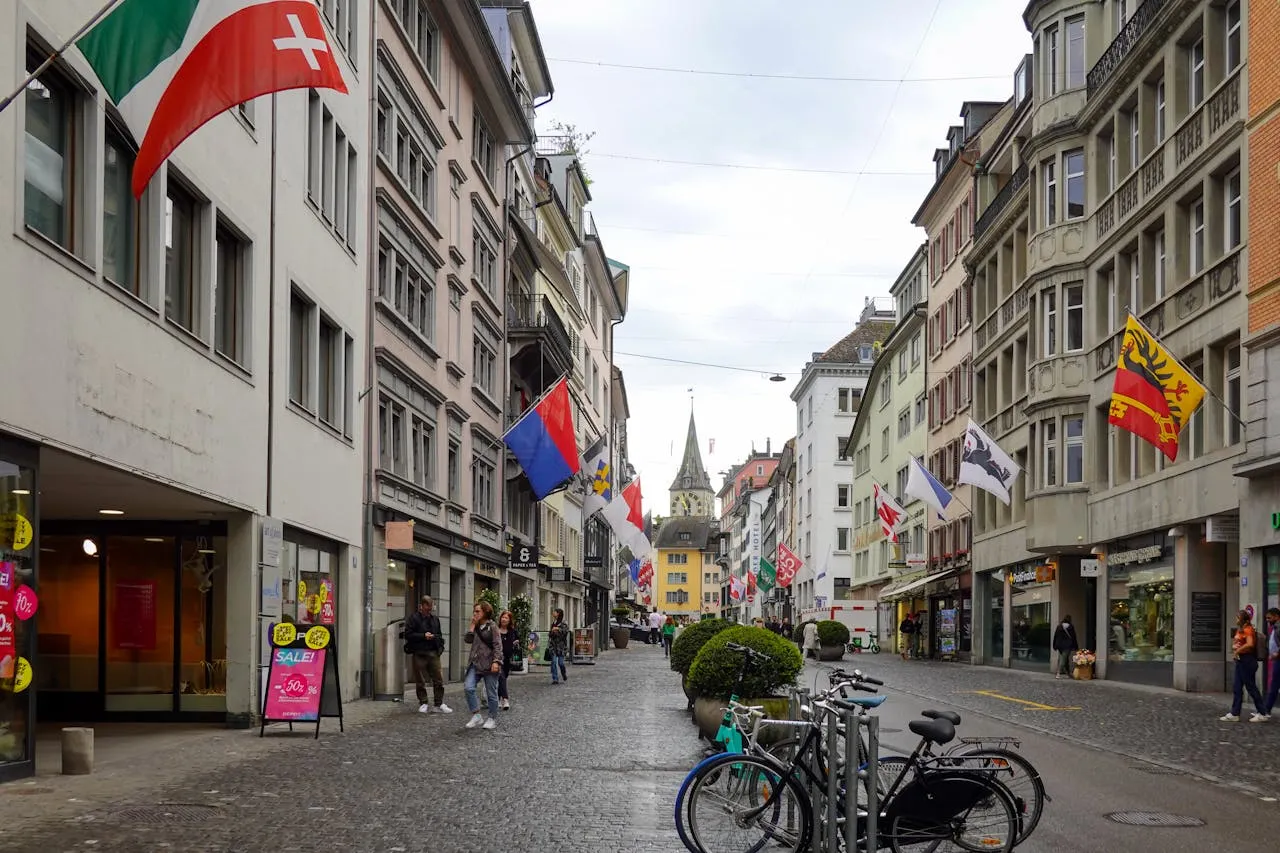
Though, seen from abroad, Switzerland may seem like a homogeneous country, it is just the opposite – while small, it offers lots of variety and diversity throughout.
Whatever canton you happen to live in, you are accustomed to its way of life – how things function on the political, social, and administrative level.
For instance, each canton has its own tax system, along with school, healthcare, and public transport infrastructure, as well many rules and regulations in general, which may differ from what you were used to in your former home.
Of course, if you move from one linguistic region to another, you might have more of an adjustment – and a higher learning curve – than if you relocate to the-same language region.
Crossing the Röstigraben divide (between German and French-speaking cantons) or the Polentagraben (to Italian-speaking Ticino) will likely be even more of a culture shock, as you will find yourself subjected to a different way of life and, often, mentality as well – all this while still remaining in Switzerland.
Let’s look at some of the challenges involved in switching cantons, starting with how open (or not) they are toward foreign nationals.
That’s because certain cantons are more inclusive of foreigners — in terms of political rights and citizenship — than others.
Studies have shown, for instance, that in terms of naturalisation, “the cantons of Zurich, Appenzell Ausserrhoden and Jura have the most inclusive provisions. At the opposite end of the spectrum, the cantons of Aargau, Schwyz and Graubünden have the least inclusive provisions, generally imposing higher requirements in terms of residence, language, civic and cultural integration, good moral character and economic resources.”
Yet another study revealed that the level of tolerance toward foreigners differs across the country, with the split observed along the geographical and linguistic lines.
For example, foreign nationals are “perceived as different” less frequently in the French and Italian-speaking cantons than in the German ones, with the exception of Zurich.
Advertisement
There is also an urban-rural divide at play.
“Openness is comparatively less wide among those politically oriented to the right and those living in sparsely populated areas,” the study found.
Overall, “the population living in urban spaces turns out to be more open to national or cultural difference. Inhabitants of densely populated municipalities generally show more openness than people living in low-density areas”.
All those factors play a role in how easy or difficult a transition from one canton to another could be for a foreigner.
READ ALSO: Why moving to another Swiss canton could complicate your life
Advertisement
Next: the language
Most Swiss cantons belong to German, French, or Italian linguistic regions. But there are also some where two national languages are spoken,
which may complicate daily life for foreign nationals.
Both French and German are spoken in the cantons of Bern, Fribourg, and Valais.
Additionally, in Graubünden, three languages are spoken: German, Romansh and Italian, depending on the proximity to neighbouring linguistic regions.
The demographic data indicates that most people in Bern (81 percent) speak German, with the exception of the area called Jura bernois, which is French-speaking.
Fribourg’s population is mostly French-speaking (63 percent), with German being prevalent in the eastern part of the canton, where it changes its name to Freiburg.
In Valais, 63 percent of residents speak French, and German is spoken in mountainous regions, where Valais becomes Wallis.
This means you don’t have to move from one canton to another to be faced with a different language; sometimes moving within the same canton can pose this problem as well.
READ ALSO: Is life more complicated in Switzerland’s bilingual cantons?
Advertisement
Prices, cost of living
If you make a ‘lateral’ move from one high-cost canton to another – for instance from Geneva to Zurich or vice-versa – then you will probably not feel too much of a sticker shock.
But if you relocate from cantons with a relatively low prices – like Jura, Valais (except for ski resorts), or from central cantons such as Uri and Glarus – to more expensive ones like Zurich, Geneva, Vaud or Basel-City, you will likely feel the sting.
It is true that your salary may be higher in the latter cantons and it could partly compensate for higher prices, but you will still have to spend much more on food, housing, and public transportation.
This is an example of what you can expect if you move from the Valais capital city of Sion to Zurich, according to Numbeo database:
- Cost of living, including rent, in Zurich is 35.4 percent higher than in Sion
- Rent prices in Zurich are 124.2 percent higher than in Sion
- Grocery prices in Zurich are 11.3 percent higher than in Sion
- Local purchasing power in Zurich is 2.7 lower than in Sion (the reason: much higher salaries in Zurich).


