


Ludvig Ramestam realized something had changed in Ukraine when people on the ground facing the Russian invasion began urgently requesting more fishing nets from his native Sweden.
In 2022, the co-founder of the Operation Change nonprofit organization had sent retired fishing nets to Ukraine to be made into camouflage. “But we couldn’t understand,” Ramestam told RFE/RL, “because we’d sent 16 cubic meters of nets. It takes time to make this camouflage, but they were already asking for more.”
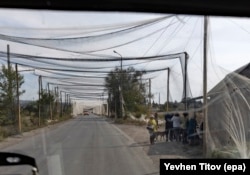
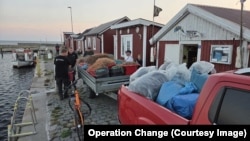
Ramestam soon learned the nets were being used to counter first person view (FPV) drones. Since then, he said, the need for fishing nets in Ukraine has become “endless” with the war evolving into a conflict fought largely from the air with drones. Together with its partners, Operation Change has trucked around 400 tons of fishing nets to Ukraine.
In Sweden, the urgent demand for fishing nets has come at a bitter time for fishermen.
The Nordic country’s fishing industry has been largely frozen due to tightening EU environmental regulations that, in 2021, culminated in an outright ban on cod fishing in the Baltic Sea. For thousands of fishermen, valuable nets that in some cases were handed down from their parents have become treasured but unused relics.
For many, the chance to put the equipment to use for a cause they believe in has convinced them to pull their nets out of storage.
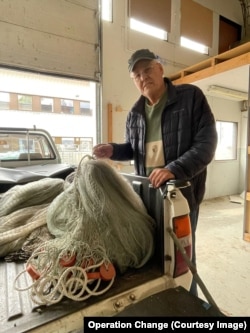
“In Sweden there’s pretty broad support for Ukraine,” Ramestam said. “So, for many of these fishermen they are so happy to provide [nets] to the Ukrainian front line you cannot imagine. They feel that they are part of this defense now.”
That sentiment may be strongest on the islands of Aland, a territory of Finland populated by Swedish speakers. Many here are old enough to remember their own conflict with the Kremlin during the 1939-1940 Winter War, when the Soviet Union invaded Finland.
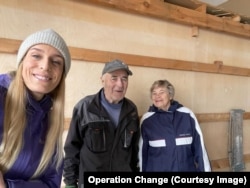
Minnie Regland works on the island and has helped gather nets for Ukraine.
The volunteer with Operation Change recalls one woman in her 70s who described the fears that haunted Finland years after the 1939 Soviet invasion. “She told me when she was seven or eight her teacher came to school and announced ‘the Russians are coming!’ There was this rumor going around and everyone panicked. Her father was out at sea at the time.”
Regland said the woman became emotional when recalling her fisherman father teaching her how to handle the nets. “Although she didn’t continue fishing she had never been able to part with her father’s nets. But now, it was like she knew he would be happy for them to go to this cause.”
In Ukraine, netting is one of the most important elements of preventing FPV drone strikes as front-line troops depend on multiple layers of defense in an ever-evolving arms race between drone pilots and soldiers.
Iryna Rybakova, a press officer with Ukraine’s 93rd Mechanized Brigade, told RFE/RL that anti-drone nets “are now being installed everywhere on the roads of the Donetsk region.”
But, she added: “Nets are not a panacea. They are just one element of protection against drones, which may not work. There are many examples where a drone flew into a hole in the net and waited for a car. Our drone pilots do the same.”
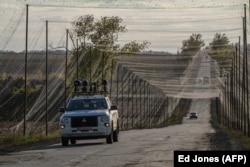
With nylon fishing nets and agricultural netting vulnerable to fire, Rybakova says the ideal material would be chain-link fencing, but “obviously this is expensive and difficult to install.”
Rybakova says a trip to the front line now requires an array of anti-drone tactics. Troops drive fast, turn on powerful electronic jamming devices, and have multiple spotters with weapons. “In addition to machine guns, we have shotguns, and also small net launchers called Ptashkas, which soldiers have dubbed, ‘last chance.'”
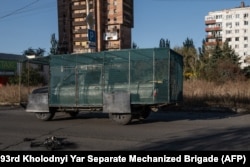
In Sweden, Ramestam said the generosity of his country’s fishermen and their descendants has directly saved multiple lives in Ukraine.
“There was one car where donated nets were installed, and then just a couple of days later the car was attacked [by a Russian FPV drone],” Ramestam told RFE/RL. “These nets were mounted around a meter from the car on metal bars so the impact of the explosion was severely reduced by the net and the people in the car survived.
“They specifically said in the thank-you note that those nets saved their lives.”


